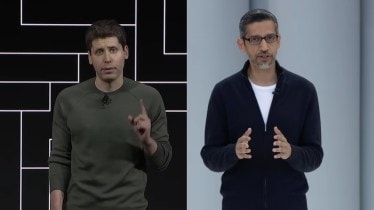
OpenAI seems to be terrified of Google’s surge in the AI race. Ever since the Gemini 3 model dropped, CEO Sam Altman had sounded the alarm bells within the company, urging its employees to get up and try everything in their power to do work on the next-gen models. Now,
In a candid interview with CNBC, Altman reveals that he considers Google a huge threat to the company’s dominance and had it taken ChatGPT seriously in 2023, it could have wiped out OpenAI earlier.
In a recent discussion regarding OpenAI’s strategic positioning, Altman offered a blunt take on the fragility of the startup’s early lead. Speaking on the competitive timeline, Altman admitted that OpenAI’s current dominance was far from guaranteed.
“Google is still a huge threat, you know, extremely powerful company,” Altman told CNBC. “If Google had really decided to take us seriously in 2023, let’s say, we would have been in a really bad place. I think they would have just been able to smash us.”
OpenAI and its ‘Code Red’ reality
Despite ChatGPT’s early meteoric rise to nearly 900 million users, the atmosphere inside OpenAI is on high alert. Altman compared the current competitive AI landscape to a pandemic scenario, where early, aggressive actions are the only way to control exponential growth from rivals. For OpenAI, falling behind Google or any of the other rivals even slightly could result in a permanent loss of market share, which, according to Altman, is impossible to recover.
The urgency within the company to tackle Gemini 3 comes from Google’s unparalleled infrastructure. With Gemini 3 now deeply integrated into Search, Gmail, Maps, and YouTube, Google takes advantage of a distribution network that OpenAI is still working to match.
OpenAI still wants to build AI-native tools
While Google’s strategy relies on embedding AI into its existing software ecosystem, Altman is betting on a clean sheet philosophy. His vision for OpenAI hovers on building AI-native software – tools designed from the ground up to be intelligent, rather than legacy platforms with AI ‘bolted on.’
For Altman, the goal is to capture users early and create ‘sticky’ experiences through deep personalisation and memory. Altman believes that AI brand loyalty will eventually mirror that of household staples.
“Altman likens AI brand loyalty to toothpaste brands,” said Alex Kantrowitz, founder of Big Technology in a chat with CNBC. He said that for Altman, the theory is simple – once a user spends months training an AI on their personal preferences, schedules, and work habits, the friction of switching to a competitor becomes too high.
For Altman, the mission is clear. OpenAI must continue to innovate at a pace that prevents Google from leveraging its massive scale.