



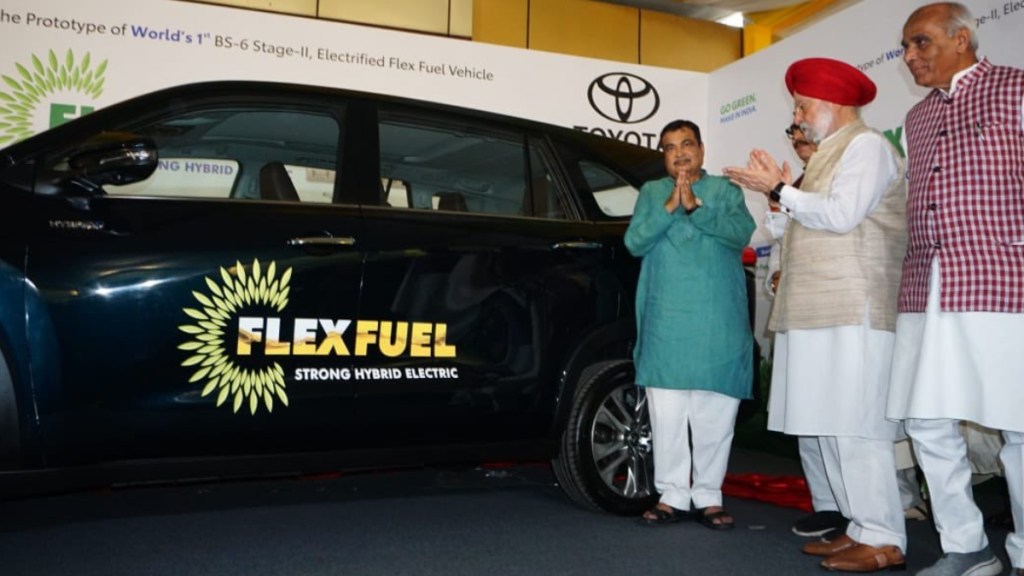
Toyota Kirloskar Motor (TKM) has unveiled a prototype of the world’s first BS 6 (Stage II) electrified flex fuel vehicle an Innova Hycross. The company says the challenge with flex-fuel vehicles is the lower fuel efficiency of Ethanol due to its lower energy density.
Globally to counter this challenge, electrified flex-fuel vehicles are being introduced, as an advanced green technology that has both a flex fuel engine as well as an electric powertrain. Therefore, as in the case of a Strong Hybrid Electric Vehicle (SHEV), which can run 40 percent of the distance and 60 percent of the time in electric mode (under specific test conditions) with the petrol engine shut off, the use of the electric powertrain in combination with the flex fuel engine overcomes this challenge with enhanced fuel efficiency.
As such, electrified flex-fuel vehicles provide the twin benefit of higher fuel substitution (with ethanol) as well as good fuel efficiency, due to the high ratio of electric mode driving. The electrified flex-fuel vehicles use minimal advanced chemistry batteries (around 1.3-1.5 KWhr versus 40-60 KWhr for BEV), thus guarding against the negative impact of high imports of cells and cell raw material, considering possible geo-political supply risks.
The Japanese carmaker says while electrified flex fuel vehicle technology was introduced in Brazil in 2019, the emission norms followed there are lower than BS6. The prototype vehicle unveiled is built on the most admired Innova Hycross and is designed to be compatible with India’s higher emission norms, making it the world’s first prototype of a BS 6 (Stage II) electrified flex fuel vehicle. The next steps for the prototype include further finer calibration, homologation, and certification.
Ethanol as an energy source
Due to a large increase in mobility needs, the transport sector, which currently accounts for about 50 percent of oil demand, will be the most significant consumer. As per estimates, the transport sector energy consumption in India is expected to double to 200 Mtoe (Million Tonnes of Oil Equivalent) of energy in 2030. The higher fossil fuel consumption is also bound to result in larger carbon emissions. Therefore, it is imperative for us to rapidly shift away from fossil fuels with utmost urgency.
India is well endowed with renewable energy, surplus sugar, food grains, and biomass which offers huge possibilities for a transition to a cleaner energy future, which is also indigenous. The abundantly available sugarcane, excess food grains, along with huge biomass waste can be used to produce ethanol that can substitute a significant amount of petrol used by vehicles in the shortest possible time.
Notably, in the recent past, the ethanol mix (in petrol) in India has gone up from 1.53 percent in 2013-14 to 11.5 percent in March 2023, which has helped reduce the oil import bill by Rs 41,500 crore in the last 8 years. Further, in 2020-21, ethanol blending enabled a reduction of 26 million barrels of petrol, thereby resulting in savings of Rs 10,000 crore. With the impending implementation of E20 (20% ethanol blending in petrol) by April 2025, India is expected to save Rs 35,000 crore annually in its oil import bill and reduce GHG emissions by 21 million metric tonnes. E20 fuel will also reduce PM2.5 emissions by up to 14 percent as compared to petrol.
Besides ethanol from sugarcane & food grains, India also has huge potential for Ethanol production using plant waste or residues like Parali by using 2G technology, which is otherwise burnt causing widespread pollution in northern parts of India. This has already started and can help derive economic value from waste and generate greater wealth for the agrarian economy, supporting the government’s vision.
Future potential
The carmaker says for India, ethanol provides exciting opportunities for a most impactful and disruption-free energy transition. Higher Ethanol use presents the possibility to realise self-reliance due to its abundant availability, technology accessibility, existing competitive manufacturing ecosystem, as well as the fuel generation and dispensing infrastructure. Post 2025, India will have surplus ethanol well beyond the requirement for E20 regime. To fully realise the available potential and to maximize the social benefits, Flex Fuel Vehicle technologies i.e., vehicles that can use higher blends of ethanol beyond 20% mix (E20), will be required.
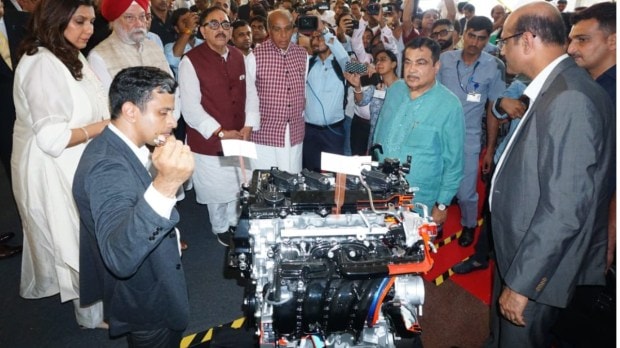
The event was attended by Nitin Gadkari, Minister of Road Transport and Highways, Government of India; along with Dr. Mahendra Nath Pandey, Union Minister – Ministry of Heavy Industries; and Hardeep Puri, Union Minister – Ministry of Petroleum and Natural Gas and Ministry of Housing & Urban Affairs, Government of India. Geetanjali Kirloskar, Chairperson and MD, Kirloskar Systems and TKM Senior Leadership –Masakazu Yoshimura, MD and CEO; Vikram Gulati, Country Head & Executive VP; Sudeep S. Dalvi, Senior VP, Director & Chief Communication Officer and other Toyota executives.
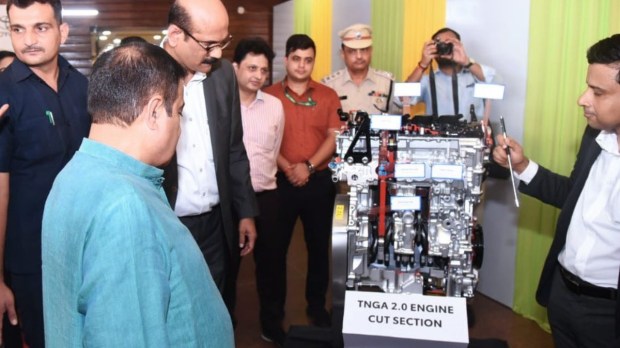
Nitin Gadkari said, “Ethanol being an indigenous, clean, and renewable fuel holds a promising future for India. The government’s focus on ethanol is for achieving energy self-reliance, spurring the incomes of farmers and having a better impact on the environment. The government’s plan is not only to diversify agriculture surpluses towards the energy sector but also to generate wealth from waste using 2G technology for producing ethanol from bio-waste. A lot of emphasis is being laid on building and expanding the necessary infrastructure to produce ethanol in the whole country.
It is indeed commendable to see that Toyota is making strong efforts for transition to cleaner energy options and for environment conservation with its multiple advanced technological capabilities like Hydrogen Vehicle, Electrified Flex Fuel Vehicles and more. Today, we unveiled the Prototype of the World’s First BS 6 (Stage II), an Electrified Flex Fuel Vehicle of Toyota, aligning with the ‘Atmanirbhar Bharat Abhiyaan’.
Dr. Mahendra Nath Pandey said, “Allying with the Prime Minister’s vision to achieve the target of Net Zero by 2070, we are rapidly shifting towards sustainable mobility, India will require all green technologies, wherein biofuels will play a major role. Accordingly, the Ministry of Heavy Industries has been supporting the development and manufacturing of all clean vehicle technologies through various schemes such as PLI, FAME, etc. These schemes will help in attracting investments, localisation of advanced technologies, employment generation, and promote sustainable growth & development of the Indian auto industry.”
Hardeep S Puri said, “In 2014, India was blending Ethanol only to the extent of 1.53%. With the huge efforts made by the government and the industry, in a short span of 8 years, have increased by over 8 times to reach the blending of around 11.5% (Mar ’23). This has helped us not only to make big savings in the import bills but also has contributed to lowering of carbon emissions. We have advanced the target for E20 blending to 2025 (5 years ahead of earlier planned schedule), from the original plan of 2030 and I am very happy to note that with the strong efforts made by all the stakeholders, we will achieve this.”
“Currently, E20 fuel is being dispensed at more than 3,300 fuel stations across the country and shall be available pan India by April 2025. With E20 implementation by April 2025, expected import bill savings may be around Rs 35,000 crore annually, oil import displacement will be 63 million barrels of gasoline (in EY 2024-25). This will further contribute to reducing GHG emissions by 21 million metric tonnes and PM 2.5 emissions by up to 14% more than gasoline. We are confident that by such time, we will not only have E20 but beyond. We have supported the introduction of facilities with 2G technology, therefore the use of Parali, to generate Ethanol, which is otherwise burnt causing pollution,” he added.
Masakazu Yoshimura said, “At Toyota, we believe that ‘Carbon’ is the real enemy. We believe that the technology is only a means to the end. Toyota has access to all vehicle technologies. Having said that, each market has its uniqueness, and we continue to evaluate and introduce cleaner technologies that suit the local ecosystem, considering the local energy mix, infrastructure readiness, and consumer acceptance so that the reduction in usage of fossil fuel and carbon emissions can be achieved at scale and faster pace.”


