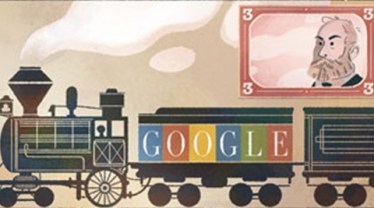
Google worldwide is celebrating the 190th birthday of Sandford Fleming, the inventor of standard time zones. Fleming, a Scottish-born Canadian inventor and engineer, was first to propose the idea of standard time in 1879. It is said that Fleming had his missed a train due to confusion in the time of two different regions. Later, in 1884, scientist’s idea was adopted by 25 nation. Around 25 years later, all major countries in world implemented the idea. Fleming passed away in July 1915. The scientist is credited for inventing the idea of standard time. Prior to the revolutionary idea, regions were mainly dependent on solar times.
Here are 5 must know things about the scientist:
1) Fleming first presented the idea of a worldwide standard time at a meeting of the Royal Canadian Institute (RCI)on February 8, 1879. It is said that solar time worked well till the time trains came into existence. However, with the revolution in transportation, particularly the trains, a need for a standard time arose keep up with the schedule.
2) Fleming, with his revolutionary idea, advocated for a division of the world time into 24 time zones beginning at the Greenwich Meridian and spaced at 15 degree intervals. The same was responsible for the introduction of Greenwich Mean Time across Great Britain in 1847.
You may also like to watch
3) Fleming’s proposal was formally adopted at International Prime Meridian Conference, 1884. 25 countries agreed to the proposal. It was here that Fleming’s system of international standard time was adopted.
4) Not only a scientist!
With his exceptional contribution to science, Fleming was also a noted artist. As an artist, he designed Canada’s first postage stamp in 1851. The stamp became quite popular with its central image, known as “three-penny beaver.” An online biography says that Fleming defied Queen Victoria’s likeness to represent Canada’s industrious spirit.
5) A railway engineer.
Fleming, after being migrated to Canada’s Ontario, started contributing his skills to Ontario, Simcoe and Huron Union Railroad. As a railway engineer, he later proposed a plan to build a Pacific railway.
A photo of Fleming driving “last spike” later got known as the iconic image. Fleming also found Alpine Club of Canada during his expeditions as chief engineer.