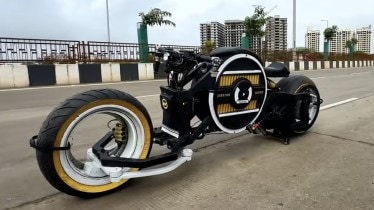
Two students from India’s Surat have managed to utilise the power of AI to build a custom electric motorcycle that can drive itself. In a remarkable feat of waste-to-best engineering, three mechanical engineering students from Surat have developed ‘Garuda,’ a prototype that is hailed as India’s first AI-powered driverless electric superbike. Built using nearly 50% scrap materials, the project gives a glimpse of what future electric motorcycles could end up looking like.
The creators of Garuda, namely Shivam Maurya, Gurpreet Arora, and Ganesh Patil from Bhagwan Mahavir University, spent approximately one year and Rs 1.8 lakh to bring their vision to life. Inspired by Tesla’s autonomous technology, the three students aimed to prove that futuristic mobility could be developed affordably using local resources and recycled components.
How Garuda relied on Raspberry Pi and voice integration
At the heart, or rather brain, of Garuda is a Raspberry Pi module, which serves as the motorcycle’s central processing unit. This compact computer system allows the bike to interpret and execute voice commands via Wi-Fi. During demonstrations, the bike has shown the ability to regulate its own speed, respond to verbal instructions like “stop,” and operate in three distinct modes – manual, phone-controlled, and fully autonomous.
The motorcycle’s physical design is equally innovative, as it features futuristic hubless wheels. Despite its scrap-metal origins, the prototype is equipped with premium tech-stack features usually reserved for high-end EVs, including a full touchscreen dashboard with GPS navigation, front and rear cameras for live traffic feeds, and a wireless mobile charging dock.
AI adds advanced safety features
AI helps with the bike’s safety features. The bike is equipped with high-range sensors that continuously scan its surroundings for obstacles. The AI system is programmed with a two-tier safety protocol – if a vehicle or object enters a 12-foot radius, the bike automatically reduces its speed. If the obstacle closes in within three feet, the bike triggers an automatic braking system to come to a complete halt, regardless of rider input.
Performance-wise, Garuda holds its own against commercial electric bikes. Powered by a lightweight lithium-ion battery, it boasts a range of up to 220 km in Eco mode and 160 km in Sport mode – these are far more than what any commercial electric bike and scooter can deliver in today’s times. Remarkably, the battery can achieve a full charge in just two hours.
Will Garuda go into production? With advanced AI features and a futuristic design, there’s a great potential for a motorcycle like this to come alive.