




At the end of a long day, we return home to comfort, security, warmth, food and family, the walls identified as home protecting and comforting us. So what, might one ask. Well, what is obvious for some is elusive for many, especially in the fractured times we live in where displacement is discourse and violence is norm.
The themes of home, displacement, migration, eviction—be it wars, climate change, be it strife, or be it just life taking over—are explored in heart-breaking detail and an involved eye, or even celebratory musings, at the 10th edition of the Serendipity Arts Festival, on in Goa.
Voices from the Frontlines of Exile
In the project tilted, what else but Displacement, curator Rahaab Allana brings together voices of the affected. Artists from Palestine, Afghanistan, Iraq, Morocco tell stories of their lands through pieces of broken homes, photographs, sounds and installations.
The human plight as a consequence of loss and displacement finds a narrative in sculptures denoting shattered notions of shelter and security, photographs of empty eyes, installations of captivity and freedom. Like Ali Arkady’s striking images of finding human touch amid the destruction of war in Iraq, using monolithography, in his work Memory, War, and the Art of Transition, brings attention to the fact that 100 million people were displaced in 2024 alone.
It was these compelling numbers that made Allana focus on the theme. “That’s the largest movement—forced or willing, coercive or controlled—of people that has ever taken place. So it becomes a guiding foundation on which we address our questions of home, identity, belonging, separation. And this is why I decided to address it,” he says. When asked if artists feel a responsibility to raise a voice in face of political indifference, he says: “Different kinds of mixed and multiple solidarities can be developed by individuals, by groups, by communes, by societies.
And the world of artists is one such space that can create lines of sight and connections and bridges to one another. These connections are lifelines for all of us to be able to produce work, to know exiled artists can have a place in the world, that permanence and impermanence go hand in hand.”
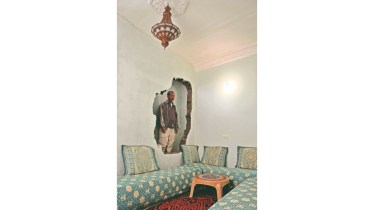
Hadi Rahnaward’s installation Turning Point touches upon the socio-political turmoil in Afghanistan. Using cartography and an aerial perspective, he etches the resistance and surrender of the people trapped between hope and despair in the strife-torn country. The Hole by Moroccan artist Hicham Benohoud packs a punch in its vivid and surrealist description of the destructive forces of war, and the fragility of the walls we perceive as security blankets. Gaping holes in the walls, roofs and floors of houses lays them bare to invasions and strips them of any shroud of respectability and privacy. What do people do when their homes are bombed to pieces, how do they repair their homes, their lives? Where do they go from here, and who do they go to?
Ecological Dissonance
Ravi Aggarwal returns to Serendipity, this time exploring displacement via the lens of collective dissonance in his project Murmurations. Climate change, construction and everything manmade disrupts rhythms of nature, and its inhabitants. Regions of the Northeast, the hills of Ladakh are captured through photo lenses—a woman covering her eyes and crying in despair, having obviously lost all hope, a young father cradling his newborn, or a woman just gazing emptily into space.
Shifting sands, broken buildings, destroyed abodes capture the viewers’ imagination. The murmurs of discontent can be disruptive, and not to be taken lightly, the curator cautions. “Art is a pointer, a predictor and an inaudible voice before it is articulated. Murmurations is suggesting we listen to the ground, and how these embodied expressions could speak together in what could be a collective response to the violence and extinctions in the future,” says Aggarwal.
Dinesh Khanna, a migrant from undivided Punjab, curates a collection of photographs on belonging, identity and memory of everything we symbolise as home. From Goan matriarchs foraging for food in their handwoven baskets, in forests deeply familiar, to kitchens redolent with smells of home cooking, Assavri Kulkarni captures the connections between a woman, her hearth and her home. Anurag Banerjee, a Dkhar (outsider) in bustling Mumbai, strangely feels at home, as a metropolis embraces each migrant into its folds, welcoming them all.
Avani Rai reconnects to her roots in Punjab, trying to hold on to what remains, understanding that home is not something that is found, but is felt. Khanna tells us how his own displacement and the nomadic existence of his daughters compelled him to explore the theme of belonging, to ask, “where is home?”
Or, as Kristine Michael attempts to evoke emotions through her project Home is Where the Heart is, tying the concept of home to a cocoon. Like the glass nest created by Srila Mookherjee, or our first biological home, the womb, a ceramic pelvis created by Lyla Freechild and Gopal Saini, signifying care, safety and protection—words that all say ‘home’.


