




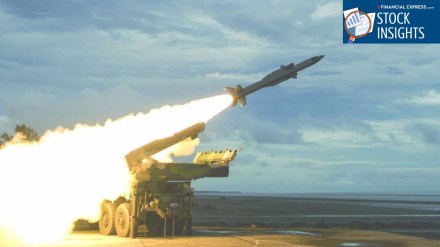
The Defence Acquisition Council meeting held on 29 December has quietly set the tone for the next phase of India’s defence modernisation. The council approved the purchase of equipment worth ₹79,000 crore, sending a clear message that the government aims to strengthen the defence ecosystem amid heightened geopolitical concerns.
The range of equipment cleared, from missile systems and rockets to radars and loitering munitions, shows a measured effort to strengthen capabilities across the Army, Navy, and Air Force in parallel. This continued tilt towards domestic manufacturing reinforces the idea that defence spending is now being used to build long-term capacity within the country.
Multiple companies are likely to benefit from this budget approval. In this note, we focus on two companies that are majorly exposed to the MSRAM (Medium Range Surface-to-Air Missile) programme and could therefore potentially benefit from this order.
#1 Premier explosives: The solid-state monopoly
Premier Explosives (PEL) is a key indigenous supplier to the MRSAM missile system, a tactical surface-to-air missile used primarily by the Indian Army. PEL is responsible for providing 100% of the solid propellant requirements for the MRSAM program. This means the company is the sole provider of the high-energy material necessary to propel these tactical missiles.
The MRSAM is currently in the production stage. PEL works with key national defence agencies, particularly the Defence Research and Development Organisation (DRDO) and Bharat Dynamics, to fulfill these orders. Its expertise in supporting high-stakes programs lies in its advanced research and development.
From mining crags to missile cores
PEL has successfully developed combustion-stable propellants specifically designed for the MRSAM and other prestigious programs like the LRSAM and ASTRA. Maintaining stability during combustion is critical for the accuracy and safety of missile systems.
It also holds the distinction of being the first private company in India to manufacture solid propellants for missile programs. This was a major shift from the company’s origins as a commercial explosives manufacturer for the mining and infrastructure sectors.
Note that manufacturing missile-grade high-energy materials requires deep technological complexity. In addition, it also needs licensing from the Department for Promotion of Industry and Internal Trade (DPIIT) and the Petroleum and Explosives Safety Organization (PESO). These complexities create very high entry barriers.
The MRSAM program is a cornerstone of PEL’s defence segment, which is the primary driver of the company’s growth. In H1FY26, the Defence & Space segment accounted for 85.5% of PEL’s total revenue. Programs like the MRSAM contribute significantly to this revenue stream through high-margin defense contracts.
Decoding the Rs 1,297 crore defense backlog
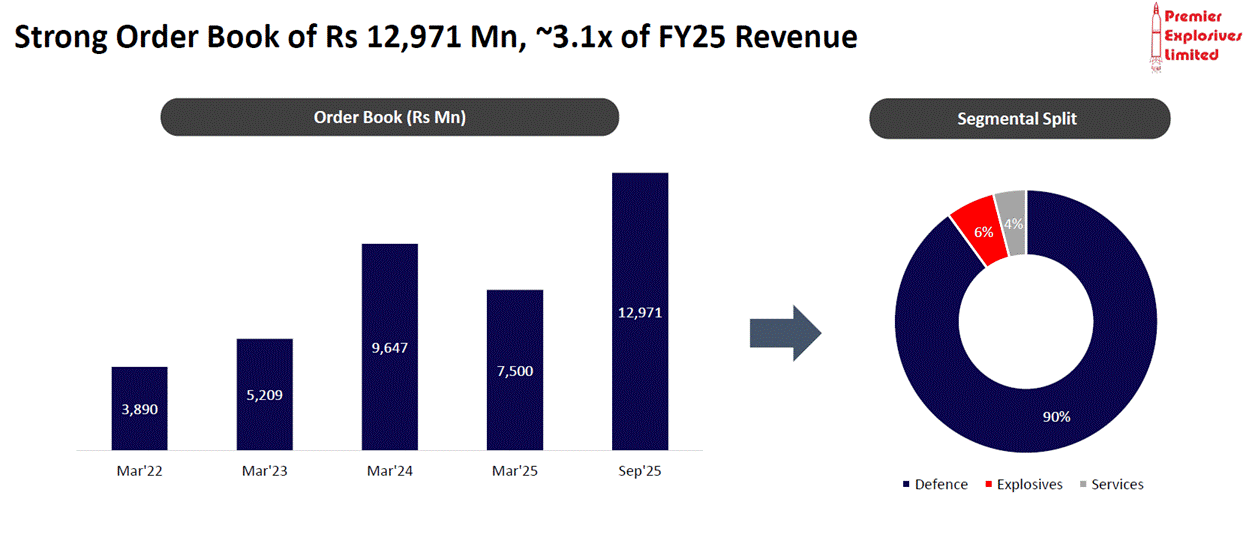
The PEL order book stood at ₹1,297 crore as of Q2FY26. This represents about 3.1x the company’s FY25 revenue, providing strong visibility for future revenue. High-margin defence contracts, including explosives, account for about 96% of this backlog.
Premier Explosives Order Book

Scaling from propellants to integrated rocket systems
Looking ahead, under its Vision-2030 plan, PEL aims to expand its role from a component supplier to a more integrated strategic partner. It plans to increase its participation in missile integration as a strategic partner under the DRDO’s Development cum Production Partner (DCPP) schemes.
Beyond solid propellants for missiles, PEL is diversifying into warheads, ammunition, bombs, and mines. This includes high-explosive payloads for drones and Unmanned Aerial Vehicles. A big future driver could be the joint venture (JV) with NIBE. This JV aims to produce full rocket motors, integrating PEL’s high-energy materials with NIBE’s hardware and launchers.
PEL is aggressively expanding its manufacturing footprint to meet rising demand. Major expansion projects for RDX and HMX plants are on track, with production expected to commence by the end of the current financial year. This is intended to address a persistent global shortage of these high explosives.
#2 Apollo micro systems: Silicon governance for surface-to-air
Apollo Micro Systems is extensively involved in the Surface-to-Air Missile (ASTRA Variant). It is the only company with the highest participation in DRDO’s indigenous missile programs. Specifically, it develops the mission-critical internal intelligence for missiles, making it a key beneficiary of the budget.
The Intelligence moat
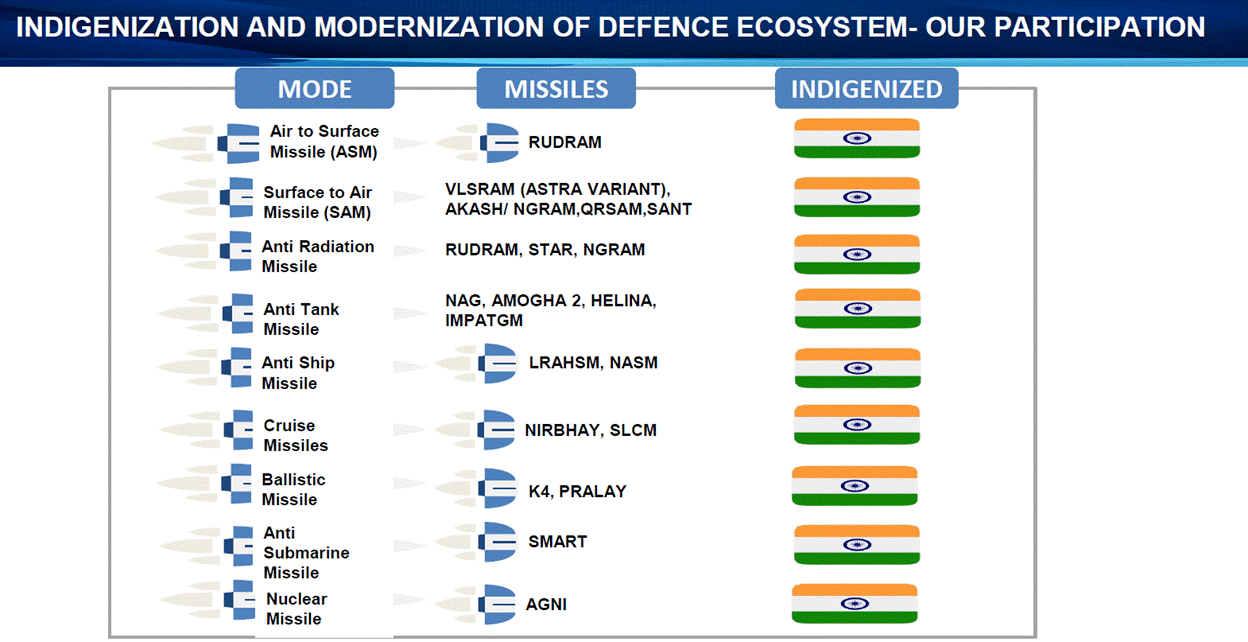
Apollo describes this as building the “brain” that makes mid-flight decisions, the “nerves” that sense and respond to the environment, and the “eyes” that track targets. The VLSRAM (Astra variant) is a key part of its Surface-to-Air Missile portfolio. It is developed alongside other critical systems such as AKASH, NGRAM (Next Generation Anti-Radiation Missile), QRSAM, and SANT
Apollo Participation in Missile Programs

For the Indian Air Force, Acceptance of Necessity has been granted for the procurement of an automatic take-off and landing recording system, Astra Mk-II missiles, full mission simulators, and SPICE-1000 long-range guidance kits, among other items. This is expected to benefit Apollo given its key participation in this program.
The BrahMos catalyst
Apollo has already received orders for subsystems for the new version of BrahMos. It is also conducting technological evaluations for five to six more projects related to the program. QRSAM (Quick Reaction Surface-to-Air Missile) is currently in the Request for Quotation stage. Apollo expects to receive orders for this program by the end of FY26 or Q1FY27.
The IDL Integration
Beyond missiles, Apollo also has extensive involvement in torpedo programs and the development of indigenous Underwater Mines and Moored Mines. It recently completed a strategic, all-cash acquisition of IDL Explosives for ₹107 crore. This move serves as both backward and forward integration, allowing AMS to provide complete weapon platforms by integrating its own electronic systems with high-energy explosives.
With this, Apollo is currently transitioning from a system and subsystem provider to a full-fledged weapons manufacturer. Management anticipates that 12 to 13 full-fledged weapon products will enter large-scale production over the next two years. IDL financials will be consolidated into results starting in Q3FY26. Management expects a total financial turnaround for this subsidiary by Q2 of the next financial year.
The 8X capacity leap to power a 50% CAGR
To support the mass production phase of mature Surface-to-Air Missile platforms, the company has undertaken significant infrastructure expansion. The new facility in Hyderabad, being developed in phases, will increase the company’s production capacity by eightfold from its current level.
Also, Apollo and Bharat Dynamics are production partners for the Multi-Influence Ground Mines program, with a total opportunity size of about ₹4,000 crore. Acceptance of Necessity approval is expected by Q3 FY25, and orders by FY26 end or Q1FY27.
The company expects its core business to grow at a 45-50% CAGR over the next two years, driven by multiple missile products entering production. Apollo is also expanding its international footprint to increase its growth. As of 30 September 2025, Apollo’s order book stood at ₹785 crore, providing revenue visibility of about 1.5 years. It expects its revenue to grow by 3x by FY26 end.
Growth at Any Price?
Both companies are trading at significantly higher valuations compared to industry multiples. They also have moderate return ratios, Return on Capital Employed (RoCE) and Return on Equity (RoE). Premier, with slightly better return metrics, is currently trading at a discount to its 5-year average multiple. However, Apollo, after a sharp surge, is trading at a much higher valuation.
| Valuation Assessment (X) | |||||
| Company | P/E | 5-Year Median P/E | Industry P/E | RoCE (%) | RoE (%) |
| Premier | 56.4 | 82.3 | 23.7 | 16.9 | 12.3 |
| Apollo Micro | 110.0 | 50.5 | 60.5 | 14.5 | 10.2 |
While opportunity is big, execution will be key. Premier offers steadier visibility due to its niche dominance, while Apollo’s growth hinges on successful integration and scale-up. At current valuations, selectivity and patience remain critical despite strong sector tailwinds.
Disclaimer
Note: Throughout this article, we have relied on data from http://www.Screener.in and the company’s investor presentation. Only in cases where the data were not available have we used an alternate, widely used, and accepted source of information.
The purpose of this article is only to share interesting charts, data points, and thought-provoking opinions. It is NOT a recommendation. If you wish to consider an investment, you are strongly advised to consult your advisor. This article is strictly for educational purposes only.
About the Author: Madhvendra has been deeply immersed in the equity markets for over seven years, combining his passion for investing with his expertise in financial writing. With a knack for simplifying complex concepts, he enjoys sharing his honest perspectives on startups, listed Indian companies, and macroeconomic trends.
A dedicated reader and storyteller, Madhvendra thrives on uncovering insights that inspire his audience to deepen their understanding of the financial world.
Disclosure: The writer and his dependents do not hold the stocks discussed in this article.
The website managers, its employee(s), and contributors/writers/authors of articles have or may have an outstanding buy or sell position or holding in the securities, options on securities or other related investments of issuers and/or companies discussed therein. The articles’ content and data interpretation are solely the personal views of the contributors/ writers/authors. Investors must make their own investment decisions based on their specific objectives, resources, and only after consulting such independent advisors as may be necessary.


