





India’s automobile industry is booming of late. It has entered a period of sustained growth, supported by rising incomes, premiumisation, and increasing adoption of electric and technology-rich vehicles.
As vehicle production expands and manufacturers add more electronics, safety features, and advanced systems, the value of components used in each vehicle is also rising. This is creating a structural growth opportunity for auto component manufacturers.
As per the Automotive Component Manufacturers Association of India, the industry has more than doubled in size over the past five years, growing at a compound annual growth rate (CAGR) of 17% between FY21 and FY26. India’s auto component industry recorded its highest-ever turnover of ₹7.6 lakh crore in FY26, up 12.7% year-on-year.
The opportunity is expected to grow further. McKinsey projects the industry to reach $200 billion (about ₹19 lakh crore) by 2030, driven by higher vehicle production, increasing localisation, premiumisation, and higher electronic content per vehicle. Against this backdrop, these 3 listed auto-component companies are well-positioned to benefit.
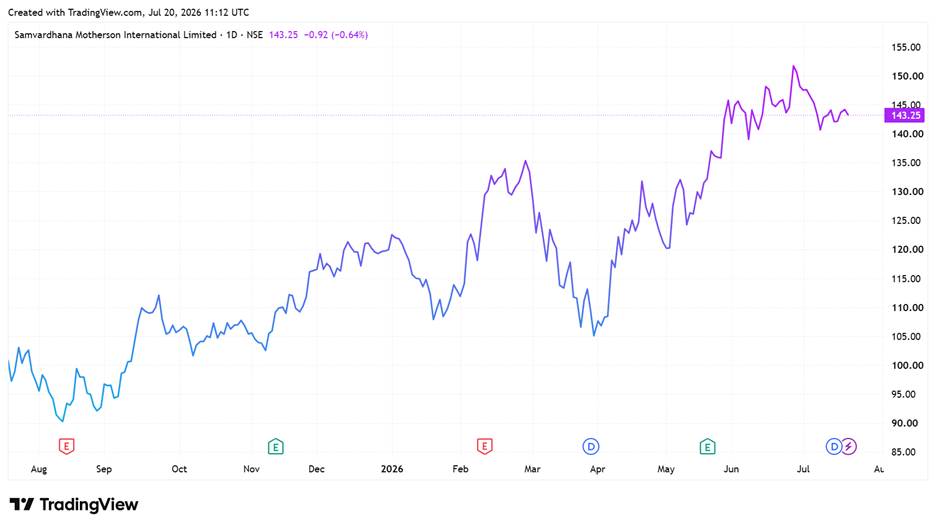
#1 Samvardhana Motherson
Samvardhana Motherson (SAMIL) is a global Design, Engineering, Manufacturing, Assembly, and Logistics company. Today, it is the largest auto ancillary company in India and ranks among the top 15 automotive suppliers globally. Motherson operates across 12 distinct business verticals. Exports accounted for 19.2% of revenue in FY26.
How Powertrain Agnosticism Protects SAMIL’s Revenue
The Wiring Harness business is the company’s largest segment. It is a full-service system supplier with end-to-end design, development, and manufacturing capabilities. The company manufactures everything from plastic components to highly integrated wiring harness systems.
Megatrends such as vehicle premiumization, the surging popularity of SUVs, and the transition toward electric and software-defined vehicles are acting as structural growth drivers. This allows Motherson to capture an increasing wallet share per vehicle, driving revenue growth.
Motherson’s revenue mix is insulated against shifts in the powertrain transition. More than 95% of its product portfolio is powertrain-agnostic, meaning that the vast majority of its components (such as mirrors, interiors, and door panels) are required regardless of whether a vehicle is powered by gas, electricity, or a hybrid system.
Currently, EV programs account for about 11% of its revenue. However, this is expected to grow, as EVs currently make up 22% of the company’s US$ 96 billion order book. Major customers include global automakers such as Volkswagen, Mercedes-Benz, Audi, Maruti Suzuki, BMW, Honda, Stellantis, Porsche, Hyundai, Ford, and Toyota.
Non-Automotive Expansion: Consumer Electronics & Aerospace
To reduce its dependence on the automotive cycle, Motherson is expanding its capabilities in non-automotive sectors such as consumer electronics and aerospace. The consumer electronics vertical saw strong growth in FY26, with revenue growing 7.5x and achieving operating profit.
Further, the aerospace division grew by 40% in FY26 and over 10x over the past three years. The aerospace business had an order book of US$ 1.6 billion. It is also expanding its manufacturing capacity to supply everything from cockpit components to structural sub-assemblies for large platforms like Airbus and Boeing.
FY27 Operational Triggers & Long-Term Targets
One trigger for the earnings growth is the completion of capex projects. Motherson currently has 16 facilities under development, with 13 scheduled to commence operations in FY27. The most significant of these is a mega-facility for its consumer electronics division in Chennai. This plant is equivalent to 33 football fields.
Commissioning this facility will not only increase production capacity but also integrate capabilities, bringing more of the value chain in-house to directly enhance profit margins. In FY27, European OEMs are slated to launch new vehicle models with advanced technologies. Motherson’s share of business in these upcoming launches could act as a growth trigger.
The company reported robust financial growth in FY26. Revenue grew by 11% year-on-year to ₹1,26,104 crore. EBITDA also increased by 11% to ₹12,033 crore with margins at 9.5%. Net profit grew by 17% to ₹3,860 crore. The company has set an ambitious FY30 target.
It aims to report a revenue of $108 billion by FY30 and a 40% Return on Capital Employed (ROCE). Motherson also plans to distribute 40% of its consolidated profits as dividends.

#2 Uno Minda
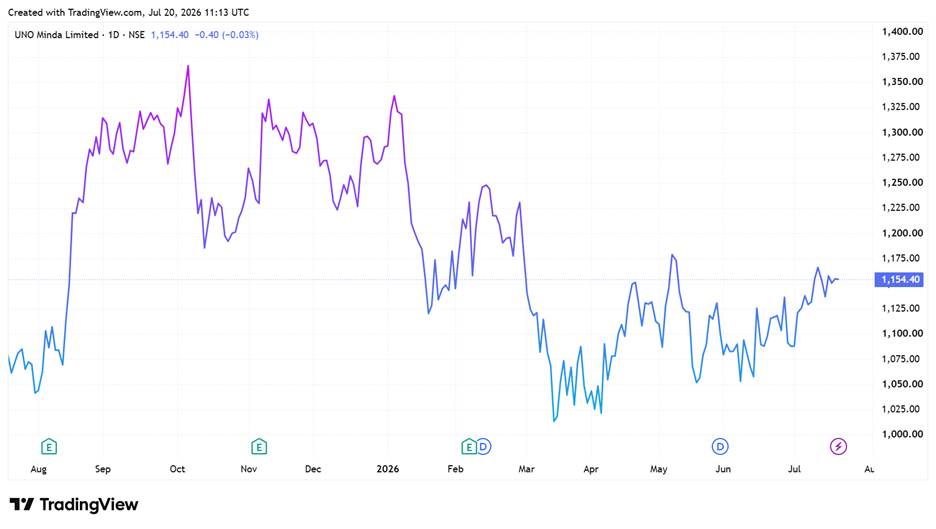
Uno Minda manufactures automotive components. Original Equipment Manufacturers (OEMs) account for 93% of FY26 revenue, while aftermarket and replacement channels make up the remaining revenue. Switches generate 25% of revenue, Lighting 22%, Castings (19%), Seatings (7%), Green Mobility (7%), and Others (20%).
Product Diversification & Revenue Distribution
Its components serve a diverse mix of vehicles, primarily 4-wheelers (48%), 2-wheelers (42%), commercial vehicles (4%), 3-wheelers (3%), and off-road vehicles (3%). A significant strategic advantage for Uno Minda is its resilience to industry disruptions. More than 95% of its product portfolio is ICE-EV (Internal Combustion Engine to Electric Vehicle) powertrain agnostic.
The company serves almost every major OEM in India. While Uno Minda maintains a diversified customer concentration risk, two specific customers each accounted for more than 10% of the Group’s total revenue in FY26. While 90% of its revenue is generated in India, it has a steadily expanding international presence, which contributes 10%.
Rising KIT value through premiumisation is one of the key drivers of earnings. Premiumization increases the kit value per vehicle by integrating haptic switches, connected pixel-based OLED tail lamps, sunroofs, and intelligent telematics. The company also invests 4% of its revenue in R&D. Capacity expansion could be a major growth trigger.
Uno Minda’s ₹1,750 Crore Execution Pipeline for FY27
Uno Minda is investing ₹1,750 crore in growth capex. It has commissioned Phase 1 of its 4W alloy wheel plant (with a capacity of 60,000 wheels/month). It is also investing ₹764-800 crore for an 18 lakh wheels/annum facility and ₹200 crore for a 2W alloy wheels facility(15 lakh wheels/annum).
The company is consolidating its Sonipat and Bahadurgarh 2W lighting plans at a new location in Kharkhoda to unlock economies of scale. A new 4W lighting plant was commissioned in Indonesia to support global OEMs. Uno Minda has established a dedicated Green Mobility reporting segment that serves as a structural growth engine.
Green Mobility & Execution Timelines for FY27
Uno Minda is building two state-of-the-art greenfield facilities. The Khed City (Pune) plant will manufacture e-axles and integrated drivetrains. Another newly announced ₹550 crore facility will assemble Electric Drive Units and Dedicated Hybrid Transmissions. It is estimated to capture an incremental EV kit value exceeding ₹1,00,000 per vehicle.
Management sees FY27 as a year for execution.” About 7 out of 11 ongoing capital projects are scheduled to commence production or ramp up. Most notably, the commercial operations for two entirely new product segments (EV powertrains and sunroofs) will begin. This is expected to trigger consolidated earnings growth over the next two to three years.
Uno Minda reported strong FY26 financials. Revenue increased 17% year-on-year to ₹19,658 crore. EBITDA grew by 20% to ₹2,251 crore with margins at 11.5%. Net profit surged by 27% to ₹1,197 crore. Revenue growth was driven by volume expansion across its core product offerings and the integration of value-added features.
#3 Sona BLW
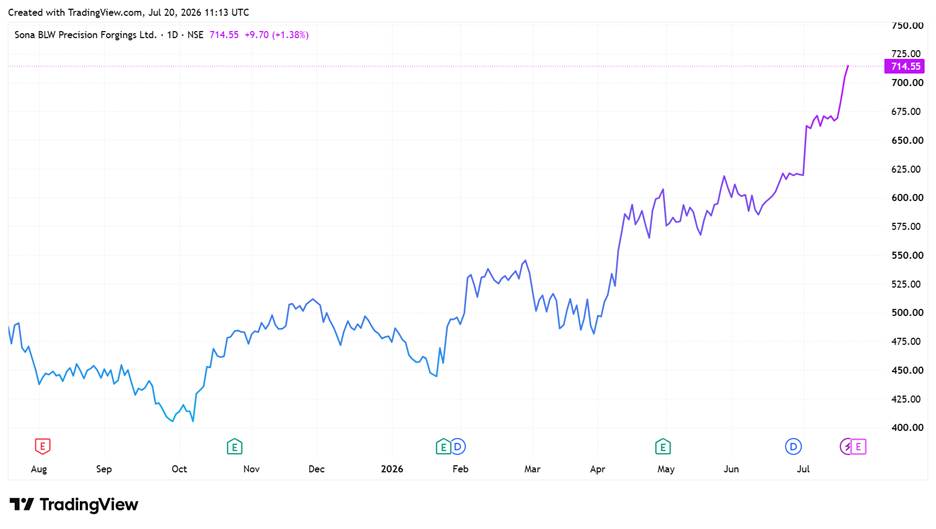
Sona BLW is a global mobility technology and product engineering company. It manufactures critical drivetrain components. This includes differential gears, differential bevel gears, and fully assembled differential units. The company is also present in the electric mobility segment. India accounts for 51% of total revenue, with 49% from exports.
Revenue Transition Across PVs & Non-Automotive Verticals
The Passenger Vehicles segment accounts for 49% of revenue in FY26, down from 71% in FY25. EV contributed 35% of the automotive business revenue, and others (26%). At the same time, the non-automotive segment (railways and off-highway) now contributes 31% of revenue, against just 9% in FY25. Eight products contributed 86% of FY26 revenue.
Sona BLW: Decoding the ₹23,700 Crore EV-Heavy Order Book
The most visible growth driver for Sona Comstar is its robust net order book of ₹23,700 crore, equivalent to 5.3 times its FY26 revenue. EVs dominate the backlog, accounting for 70% (₹16,600 crore) of the order book. The company has successfully secured 67 EV programs across 35 different global customers.
Importantly, 30 of these EV programs are yet to enter production, providing a strong multi-year pipeline for revenue growth. Management says global EV momentum is returning strongly, with significant recent sales growth in the EU, India, and the US, which continue to act as structural growth drivers.
Revenue growth is also expected from specific automotive product lines. Suspension motors are the fastest-growing business. The company expects triple-digit growth in the coming year. As the second-fastest-growing segment, traction motors currently account for approximately 10% of revenue and are expected to achieve high double-digit growth rates.
R&D Commercialization & Physical AI Integration
Further, it is actively investing in next-generation “Physical AI” and intelligent systems. The company is commercializing in-cabin radar solutions for passenger cars. It is also developing exterior radar solutions to meet upcoming Advanced Driver Assistance System regulations for commercial vehicles in India.
Sona Comstar reported strong financials for FY26. Revenue grew 26% year-over-year to ₹4,475 crore. EBITDA increased 13% to ₹1,107 crore, while margins stood at 24.7%. Adjusted net profit (excluding special expenses related to the new labor code) increased 11% to ₹670 crore. The company plans to maintain margins between 23% and 25% going forward.
Final Verdict on Valuations
Uno Minda stands out for its strong Return on Capital Employed (ROCE) and Return on Equity (ROE), followed by Sona BLW and Samvardhana. Valuation-wise, all three companies are trading at a premium to the industry median price-to-earnings (P/E) multiple. Relative to the 3-year median P/E, Uno Minda and Samvardhana trade at a discount, while Sona BLW at a premium.
| Particulars | Price-to-Earnings Multiple (X) | Return Ratios | |||
| Company | 3Y Median | Industry | ROE (%) | ROCE (%) | |
| Uno Minda | 54.8 | 58.2 | 30.2 | 19.3 | 19.6 |
| Samvardhana | 35.2 | 37.6 | 30.2 | 11.2 | 13.4 |
| Sona BLW | 67.3 | 63.7 | 30.2 | 11.7 | 15.1 |
The sector’s outlook remains favourable, supported by increasing localisation, premiumisation, and higher component content per vehicle. Although all three companies operate in a sector with strong structural tailwinds, they offer different investment propositions.
Samvardhana Motherson provides scale and diversification, Uno Minda is capitalising on premiumisation and new product launches, while Sona BLW offers higher exposure to electric mobility. On the risk side, a slowdown in the auto industry (if any) could impact performance.
That said, these companies could be worth keeping on your watchlist.
Disclaimer
Note: Throughout this article, we have relied on data from http://www.Screener.in and the company’s investor presentation. Only in cases where the data were unavailable have we used an alternative, widely accepted source of information.
The purpose of this article is only to share interesting charts, data points, and thought-provoking opinions. It is NOT a recommendation. If you wish to consider an investment, you are strongly advised to consult your advisor. This article is strictly for educational purposes only.
About the Author: Madhvendra has been deeply immersed in the equity markets for over seven years, combining his passion for investing with his expertise in financial writing. With a knack for simplifying complex concepts, he enjoys sharing his honest perspectives on startups, listed Indian companies, and macroeconomic trends.
A dedicated reader and storyteller, Madhvendra thrives on uncovering insights that inspire his audience to deepen their understanding of the financial world.
Disclosure: The writer and his dependents do not hold the stocks discussed in this article. The website managers, their employees (s), and contributors/writers/authors of articles have or may have an outstanding buy or sell position or holding in the securities, options on securities, or other related investments of issuers and/or companies discussed therein. The articles’ content and data interpretation are solely the personal views of the contributors/ writers/authors. Investors must make their own investment decisions based on their specific objectives, resources, and only after consulting such independent advisors as may be necessary.


