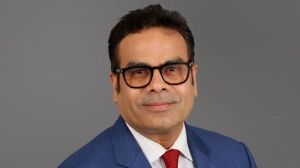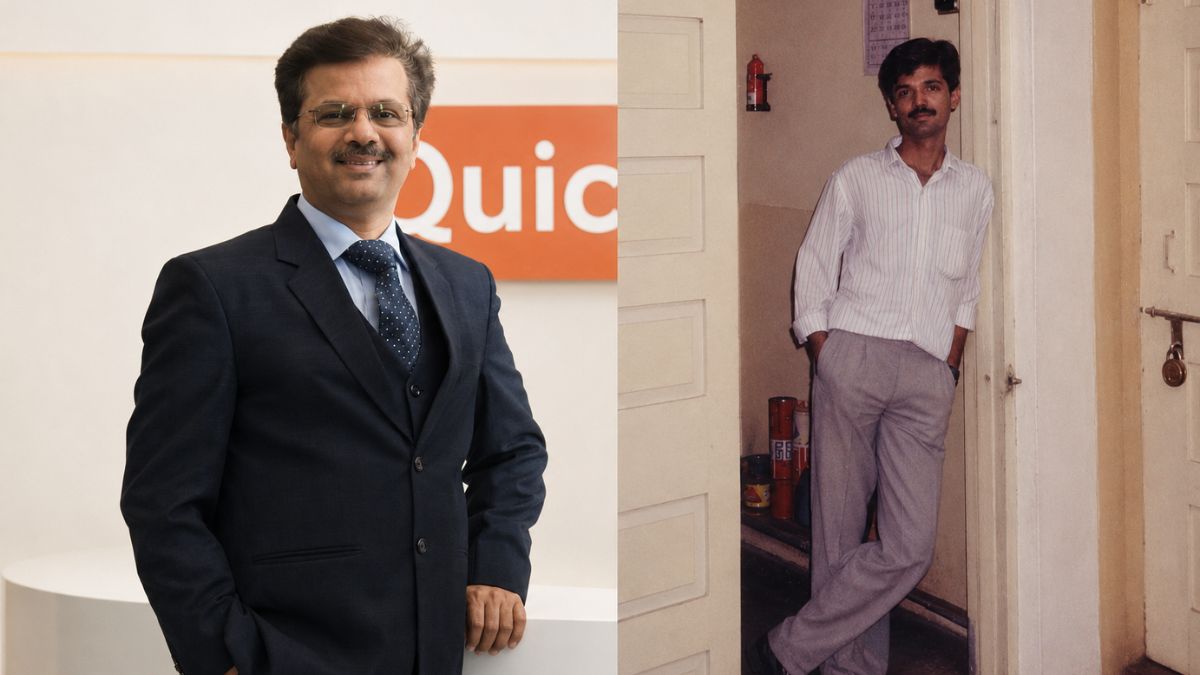
I sat in front of my laptop, a little apprehensive as I waited for the screen to light up. A sixty-something gentleman appeared, big glasses perched on his nose, peering into the camera with an apology even before he said hello. He had been stuck in the Pune rains. As we settled in, he started tracing his journey – from his early days – his father, the radio repair shop, a Rs 350-a-month job, and the twists and turns of destiny that eventually led to the foundation of Quick Heal Technologies.
Towards the end of the conversation, he shared his ultimate vision. He wanted Quick Heal to outlive its founder, leave behind a kind of legacy that one associates with Tatas. “The company should be alive; it should run like Tata.”
Today, Quick Heal is one of India’s best-known cybersecurity companies – listed with a network of more than 33,000 partners, a scale second only to Samsung’s, Katkar notes proudly.
Lessons From a Pune Chawl: How strict discipline shaped Kailash Katkar’s value system
Katkar’s parents were the first in the family to move to a city from the village, he reminisced with a certain pride. His father worked at Philips and had built a reputation for his expertise. Colleagues would come looking for him on his off days because the “machine simply refused to run without him.”
Though neither of his parents had much formal education, his father had a theory: engineers earned more than labourers, and English medium was the way to get there. So all his three children, Kailash and his younger siblings, were put into an English-medium school, even though school fees and tuition fees were beyond the family’s means.

He recalled with a smile about his father’s strict demeanour and his mother’s mild nature that in many ways became the foundation of his personality.
From failing 9th Grade to earning Rs 1,200/month: How Kailash Katkar cleared his boards
School was never easy for Katkar. He failed the fifth standard, then the ninth. His younger brother, meanwhile, did well in his studies.
Term after term, it was his mother who pleaded his case with the principal. After the second failure, Katkar had had enough. He told his parents he did not want to go to school anymore. He already had proof he could earn without it – close to Rs 1,200 a month, repairing radios and doing some screen painting, skills he had picked up watching his father work.
It was his old schoolteacher who eventually pulled him back. She tracked him down through his mother and offered to tutor him privately so he could sit for the tenth standard board exam as an external student.
Katkar was certain he would fail. He passed on the first attempt. “I felt that the school was more strict than the board actually,” he told me, laughing a little at the memory. College was never really on the table after that – there was already too much work waiting for him.
The Rs 350 calculator technician who taught himself digital electronics
The turning point came from an advertisement buried among pages of newspaper job listings: a company was looking for calculator technicians. Katkar had taught himself analogue electronics from library books, and this felt like a chance to learn digital electronics too.
He walked into the Mumbai interview with nothing in his hands, surrounded by older, better-prepared candidates, and almost turned around before his name was even called. He was eighteen, maybe nineteen, and had never been out of Pune before that.
When the interviewer asked what he knew, he picked up a pen and began drawing radio circuits from memory. That was enough – he was the only one selected.
He was sent to Mumbai for what was meant to be three months’ training, but he finished in two weeks. Within three weeks he was repairing 25 to 30 calculators a day, more than anyone else. He was sent back to Pune soon after, partly for learning so fast, partly because the food away from home hadn’t agreed with him.
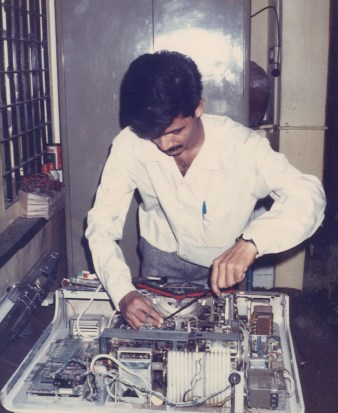
His starting salary was Rs 350 a month, and he signed a bond promising no repair work on the side – he wanted only to learn, and he learnt far more than calculators. Repairing bank machines for clients like State Bank of India and Central Bank of India, he built an ear for mechanical trouble so sharp he could often tell what was wrong just from the sound.
It was inside one of these banks that he first saw a computer, and asked the operator, genuinely confused, why there was a glass room in the middle of the floor with something that looked like a TV. “They told me that it’s not a TV, it’s a computer,” he recalled.
An opportunity no one saw coming
Katkar sensed early that calculators wouldn’t stay relevant for long, so he taught himself computer repair the same way he’d taught himself everything else – through books and by watching closely.
A long strike by bank employees resisting computers ended up buying him the time he needed to study before the machines arrived in numbers. He left his calculator job after two years and opened his own repair centre, taking on banks first, then private customers.
The Times of India Breakthrough: Turning one printer into a business
One moment changed everything. The Times of India office in Pune had a printer their own technicians had given up on. Katkar was asked to try – ten minutes later, it was working. Word travelled to their Bombay office fast, and Times of India signed a maintenance contract on the spot.
He used that one contract as a key to open doors elsewhere. New India Insurance came next, then a saree shop spread over five floors, full of computers. Within a week he had contracts for 25 to 30 computers in Pune alone.
Michelangelo & 1995: How a brotherly partnership created Quick Heal
The idea for Quick Heal came out of a problem Katkar couldn’t solve alone. Machines at his clients’ offices kept breaking down in ways that had nothing to do with hardware. His younger brother, in the first batch of a computer science course in Pune, used to drop by Katkar’s workshop between lectures to practice. One day, watching Katkar struggle with a machine making strange noises, his brother figured it out in seconds: not hardware, a virus.

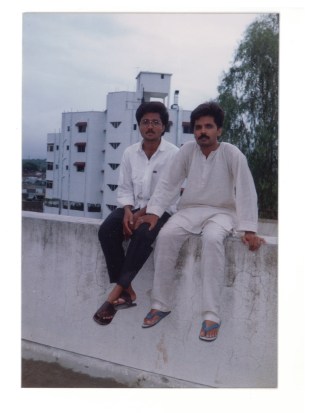
His brother, Sanjay, began reverse engineering each new virus and building small tools to clean it out, starting with one called Michelangelo.
Katkar gave these away free, first to his own clients, then to other repair technicians in Pune. Word spread, and soon people were asking the obvious question – why not turn this into a proper antivirus product?
Neither of them really knew what that meant, or what it cost to run a software company. Sanjay took it on anyway, working from a computer Katkar moved into their family home so he could stay up late building it. It took about a year and a half, working alone, to finish the first version, released in 1995.
Trying to sell something nobody wanted to pay for
Building the product turned out to be the easier part. Pirated software was simply how things worked, and most people never expected to pay separately for what ran inside their computer. Katkar’s sales team couldn’t sell a single copy in four months.
He eventually set down his own tools, changed how he dressed, and started selling door to door himself. Within two days, he’d sold ten copies, one conversation at a time. He built his network by turning to the repair technicians he’d once helped for free, promising he’d never take their repair customers away.

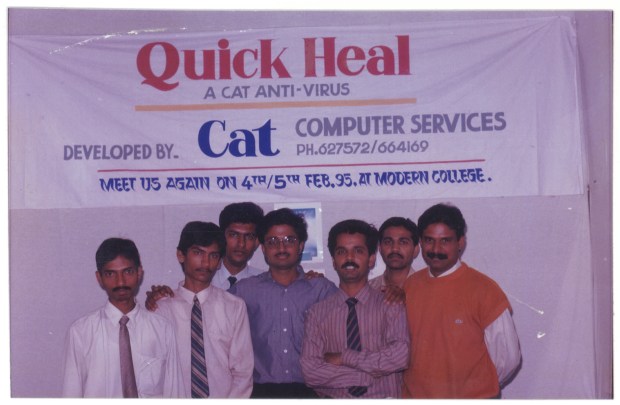
It worked. But growing beyond Pune brought different trouble – his Mumbai and Delhi partners sold a fraction of what Pune managed, mostly because a long-distance call back to Katkar for help was too expensive to attempt. So in 2002, instead of chasing the big cities, he went to Nashik, a smaller place whose culture he understood better.
Within a month, the Nashik office brought in over a lakh in revenue. Nagpur followed, then Indore, Vadodara, Surat, Kolhapur – each city lending confidence to the next, until the network reached every corner of the country- something he’d once assumed was not possible.
From Nashik to Sequoia: Scaling Quick Heal to a Rs 600 cr valuation
Growth outpaced the business’s ability to collect what it owed. Katkar shut his repair shop around 1998 to focus fully on the software, and almost immediately ran into a payment crisis.
Customers kept delaying payments, and no bank would lend him money since he had no shop or stock to show for it. Things got so tight that his wife started a small home bakery to help, and Sanjay even offered to move abroad and send money back.
What turned things around was an old friend at a large multinational, who told him plainly that he and Sanjay were trying to do everything themselves instead of hiring people who actually knew how to run a business.
That conversation, plus a stack of management books, led to the company’s first proper hires in 1999. Soon after, he learnt how to draw up a distribution contract properly. Payments started arriving on time, and the Nashik expansion picked up speed again.
Learning what equity meant
By the mid-2000s, as revenue kept growing, investors began approaching Katkar directly – a language he didn’t understand at all.
“That concept was above my understanding,” he said, referring to equity. It took a finance team from Bombay, who sat patiently near his reception asking for just five minutes that stretched into half an hour, to make him understand what dilution actually meant, and how giving away a part of his company could make the whole of it worth more.
That team spent six months going through the business before helping him put together a pitch – his first PowerPoint presentation, nearly thirty pages long. They coached him and Sanjay to present it themselves, since investors wanted to hear from the founders.
Sequoia Capital came on board around 2009-2010, at a valuation Katkar had pushed up from an early estimate of Rs 250-300 crore to close to Rs 600 crore. “I didn’t want money,” he said about agreeing to the deal. “Still I diluted it. What happened by diluting? The value of the company increased.” Another thing he learnt entirely on the job.
Going Public and stepping aside: Institutionalising Quick Heal like Tata
Katkar had never really planned to go public. His instinct was to bring in a new investor who could buy out Sequoia’s stake, rather than list the company. But Sequoia wanted a listing, and after a while, partly out of curiosity about the process, Katkar agreed.
Before going ahead, he sought out an entrepreneur who had listed his own company a year or two earlier, and was warned honestly that the road ahead would be rough. It was. The company’s accounting had to be rebuilt from the ground up, and Katkar brought in EY for it.

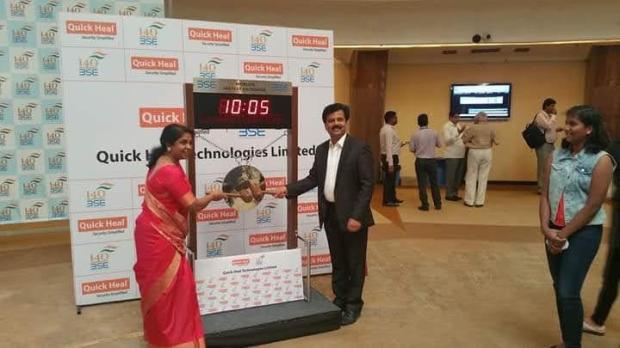
The company went public, and Katkar did something most founders find hard – he gave up control of it. People still refer to Quick Heal as a founder’s company, assuming he’s quietly holding every string. He deliberately let go of them, bringing in Vishal Salvi as CEO first, then Harish Kumar, because he wanted the company to be bigger than himself.
“I want to make this company an institution,” he told me, pointing to L&T as his model – a company with no single owner that still runs, and still lasts. Then he said the line that stayed with me after we hung up: “The company should be alive. It should run like Tata.”
Still learning
Katkar hasn’t stopped learning – he’s moved on to AI now. Asked if there was anything in his life he’d change, he said no, not really. “I have enjoyed my life so much that I believe in destiny,” he said.
A strange thing to hear from a man who’d built almost everything with his own two hands, who’d taught himself calculators, computers, contracts, and eventually equity, entirely on his own. But that is what he believed.
He ended the interview with the same twinkle in his eyes that has probably powered all his endeavours. Somewhere between a small house in a Pune chawl and a listed company with 33,000 partners, Kailash Katkar hopes that the company will run long after he has let go of it entirely. Like Tata.
Editorial Note: This profile is based on original reporting, including direct communication with Kailash Katkar. To ensure a comprehensive perspective, FinancialExpress.com corroborated this information with public records and third-party sources. FinancialExpress.com retains full editorial independence and final authority over all editorial decisions.