




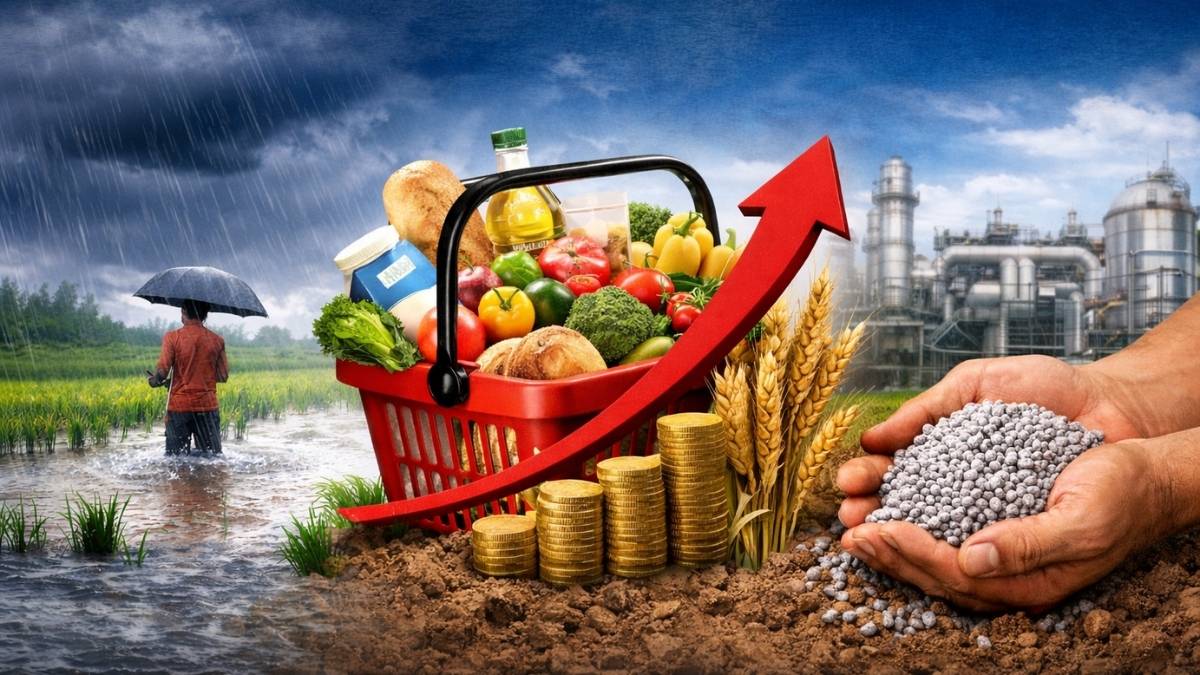
Food inflation, as measured by the recently revised consumer food price index, continued to move upwards to touch 5.32% in June, primarily because tomatoes and ginger became costlier.
Sequentially, the all-India Consumer Food Price Index (CFPI) rose by 1.7% last month from the May level. Food inflation was 4.78% in May 2026, and it was in the negative territory for seven months through December 2025.
Food inflation was 2.13% in January, when the new consumer price index (CPI) series with a base year of 2024 was introduced by the Ministry of Statistics and Programme Implementation. Using both the current and previous CPI series (the latter with 2012 as the base year), food inflation in June was the steepest in 17 months.
“Food prices will continue to increase as seen for vegetables and fruits in the market as well as pulses,” Madan Sabnavis, Chief Economist, Bank of Baroda, said.
Despite the rise in food inflation, prices of potato (-20.34%), peas (-9.67%) and cumin (jeera) declined in June 2026 on a year-on-year basis. These three commodities have a combined weightage of 1.24% in the CPI basket. However, inflation in tomato (31.92%) and ginger (50.41%) reported steep hikes, according to the official statement by the statistics ministry.
“Looking ahead, food inflation remains vulnerable to weather-related risks, including the possibility of El Niño affecting agricultural output,” Sujan Hajra, chief economist, Anand Rathi Group, said.
Due to the revival of monsoon this month after a huge rainfall deficit of 40% in June, the overall rainfall deficit on Monday was 19.4%, which has boosted kharif crop sowing.
Although overall sowing of kharif crops—mainly paddy, pulses, oilseeds, cotton and coarse cereals—has been delayed and still lags, rainfall in the later part of July and August is likely to impact the yield.
“Retail food prices have continued to harden sequentially in July 2026, reflecting the typical seasonal trends.,” Aditi Nayar, chief economist, ICRA said while adding that inflation in the food and beverage segment is set to inch up further in July 2026.
Nayar noted that the rainfall deficit for the southwest monsoon season has narrowed by July 12, 2026, owing to surplus rains in the early part of the ongoing month, which bodes well for kharif crop sowing trends and we expect it to pick up during the current monsoon season.
The India Meteorological Department earlier this month forecast ‘below-normal’ rainfall of less than 94% of the benchmark long period average (LPA) for July, citing El Nino conditions evolving over the Pacific ocean.
The met department stated that India is likely to experience ‘moderate to strong’ El Nino conditions during the southwest monsoon season (June-September).


