




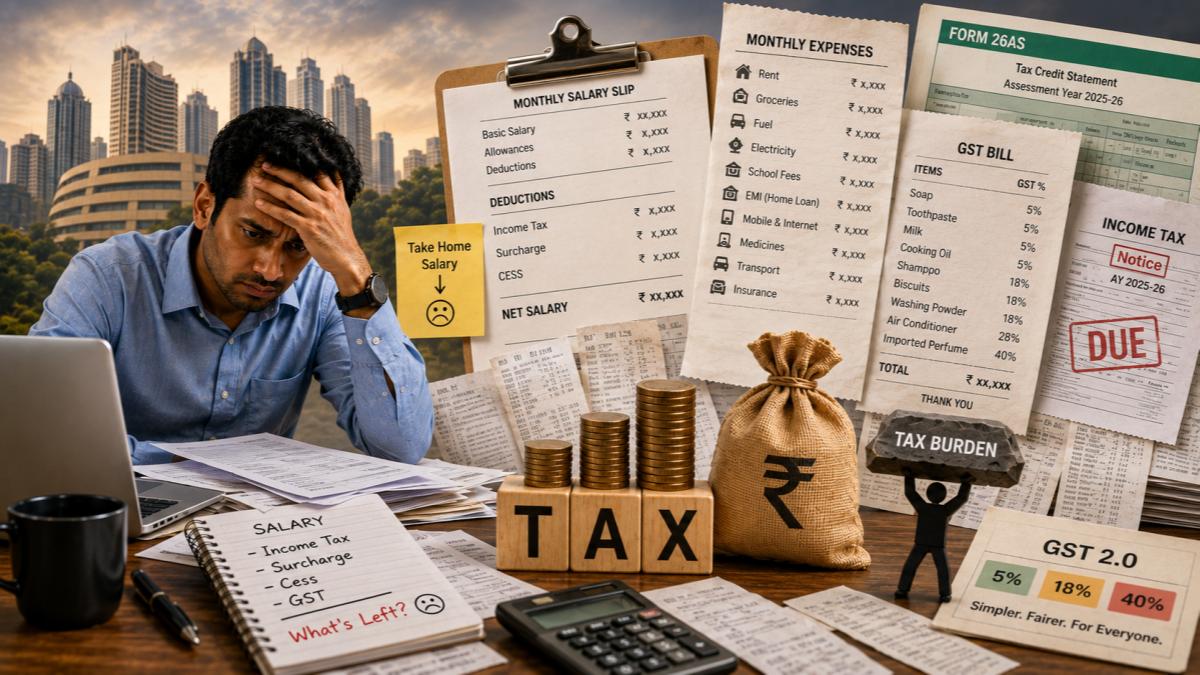
Ask a salaried professional in Mumbai or Bengaluru whether they feel overtaxed and the answer rarely comes with hesitation. Between income tax, surcharge, cess and the GST embedded in nearly every purchase, the sense of a heavy burden is widespread. Whether that feeling holds up against the numbers, and against what taxpayers elsewhere pay, is a more layered question. According to tax experts, the honest answer is ‘not exactly, but not entirely off the mark either’.
Personal tax picture: Expensive by regional standards
India’s headline income tax rates are not the outlier many assume. Sumeet Hemkar, Partner at Deloitte India, says India’s headline personal income tax rates “are not unusually high by global standards”. “But surcharge and cess push the effective marginal tax rate for high-income taxpayers close to 39 percent under the new tax regime, and even higher under certain provisions of the old regime (i.e., ~ 42 percent),” Hemkar adds.
That places India broadly in line with advanced economies such as the US, UK, China and Germany but at a disadvantage against regional competitors like Singapore and Indonesia, where effective personal tax rates run lower. According to Hemkar, tax is only one factor in where talent chooses to settle. But a system layered with add-ons, compliance requirements and litigation risk “does not provide India any competitive edge in attracting global professionals and entrepreneurs”.
Sanjiv Malhotra, Senior Advisor and Head of Tax Practice at Shardul Amarchand Mangaldas & Co., is pointed in his analysis. He says that India’s personal tax rates are “among the highest in the developing world”, pushing entrepreneurs, founders and professionals toward more tax-efficient jurisdictions for residency and business expansion.
The comparison depends heavily on the peer group chosen. Against Germany or the UK, India looks ordinary. Compared to Singapore or Vietnam, it looks expensive. Singapore’s top personal rate sits at 24%, genuinely lower. Vietnam and Indonesia both cap out at 35%, not far below India’s effective 39%.
Vietnam just moved on exactly this problem and the fix is instructive. In December 2025, its National Assembly passed a new Personal Income Tax Law cutting the number of tax brackets from seven to five and raising the threshold for the top 35% band from VND 80 million to VND 100 million a month (~₹2.93 lakh to ~₹3.66 lakh).
Vietnam didn’t touch its ceiling rate; it widened the road leading to it, easing the bracket-creep pressure that had been dragging middle earners into the top band.
On the other hand, India’s ₹50 lakh surcharge threshold has stood untouched for roughly a decade. To be fair, India has not stood entirely still. The ₹12 lakh rebate and restructured new-regime slabs introduced in an earlier budget did meaningfully ease the load for middle earners. But that relief tops out at the rebate threshold. Years of wage growth later, the surcharge slabs above it are pulling a wider slice of upper-middle earners into higher brackets than they were built to catch.
Global Personal Tax Comparison
| Country | Top Personal Tax |
| India | ~39% |
| Singapore | 24% |
| Vietnam | 35% |
| Germany | 45% |
| UK | 45% |
Corporate tax: Rare success story
If personal taxation draws the criticism, corporate taxation is where India has visibly moved. Corporate tax was cut from 30% to 22% for existing companies and to 15% for new manufacturers in 2019. “The concessional tax rate of ~17 percent for new manufacturing companies (set-up and started manufacturing by 31 March 2024) is among the most attractive in the region,” Hemkar explains.
On the other hand, the standard corporate tax rate of 25% is broadly comparable with Indonesia (22%) however, less favourable than the corporate tax rate in Vietnam and Singapore (where the tax rates are 20% and 17% respectively).
“India was once an outlier, with corporate tax rates of around 35%, but the reforms introduced by the current government have reduced these rates substantially. As a result, India is now much better positioned to compete for global investment and capital,” Malhotra frames the shift historically.
Both experts caution against reading headline rates in isolation. Investors weigh policy stability, regulatory certainty, ease of doing business and administrative efficiency and India has paired its rate cuts with free trade agreements, the Production Linked Incentive scheme, Make in India incentives and simplification of tax administration. Hemkar says this makes India’s overall competitiveness stronger than a rate-only comparison suggests.
How India’s Tax Rates Compare
| Country | Top Personal Tax | Corporate Tax |
| India | ~39% | 25% |
| Singapore | 24% | 17% |
| Vietnam | 35% | 20% |
| Indonesia | 35% | 22% |
| China | 45% | 25% |
| UK | 45% | 25% |
| Germany | 45% | ~30% |
GST 2.0: Cheaper on paper, still tilted at the base
The 2017 GST rollout replaced a tangle of central and state levies with a single system. Whether it made life cheaper for households has long been a separate question and the answer just got a fresh data point.
Under GST 2.0 announced in September 2025, the 12% and 28% slabs were scrapped and India moved to a structure built mainly around two rates — 5% and 18% — with a 40% band reserved for luxury and “sin” goods. Everyday items like soap, toothpaste, packaged food and dairy products moved down to 5%; several life-saving drugs and individual health and life insurance premiums were exempted entirely.
“The Government has recently initiated GST rate rationalisation through merger of tax slabs and this simplification has improved efficiency. However, their potential to influence household tax incidence will have to be assessed over time. Compared with major economies such as Singapore and Indonesia, India’s multi-rate GST is more complex, though it reflects socio-economic objectives,” Hemkar says.
According to Malhotra, the framework remains overly complex for both businesses and consumers. “Rationalising the multiple tax slabs, excluding essential products from GST such as petroleum and end-use housing, would make the system more efficient and reduce compliance costs,” he suggests.
Real fault line: A narrow base carrying more
Here the two experts converge and it reframes the entire question. Hemkar notes India’s tax challenge is less about the level of rates and more about the breadth of the base: compliant salaried taxpayers and formal-sector businesses carry a significant share of the direct tax burden, while a large part of economic activity stays outside the direct tax net. India’s tax-to-GDP ratio, though improving, remains below that of many developed economies.
This constrains the government’s ability to fund infrastructure, healthcare, education and social development. According to him, the policy focus should be on expanding the base through formalisation, stronger compliance and technology, rather than raising rates.
A Bank of Baroda report from January 2026 puts numbers on that gap. India’s combined tax-to-GDP ratio stands at 19.6%, ahead of emerging markets such as Hong Kong, Malaysia and Indonesia, but well behind Germany (38%) and the United States (25.6%).
This narrow-base story has an increasingly visible face in the form of the salaried taxpayer. A 2025 report by JM Financial Institutional Securities found that personal income tax collections overtook corporate tax collections in India for the first time in the country’s history in FY24. Personal income tax’s share of total direct taxes climbed from 38.1% in FY14 to 53.4% in FY24, while corporate tax’s share fell from 61.9% to 46.6% over the same decade, the report states.
Why salaried Indians feel overtaxed
| Tax Category | FY14 Share | FY24 Share | Percentage Point Change | % Change (Relative) |
| Personal Income Tax | 38.10% | 53.40% | (+) 15.3 pp | 0.402 |
| Corporate Tax | 61.90% | 46.60% | (−) 15.3 pp | −24.7% |
Malhotra identifies a different pressure point entirely: not the rate, but the unpredictability. He says that frequent legislative amendments, evolving interpretations and inconsistent administration create uncertainty and global investors “are not necessarily seeking the lowest-tax jurisdiction”, they value certainty and clarity.
Development economist Jayati Ghosh says that India’s tax-to-GDP ratio trails most comparable countries and that the deeper problem is the tax mix rather than the rate on paper. When a country leans more heavily on GST and less on income tax, a household earning ₹15,000 a month pays the same rate on soap and cooking oil as one earning ₹15 lakh a month — which, as a share of income, hits the poorer household far harder. That argument doesn’t contradict Hemkar’s base-breadth point so much as sit alongside it. A narrow direct-tax base and a consumption-heavy indirect-tax structure can both be true of the same system and both can make the same compliant, salaried taxpayer feel squeezed from two directions at once.
So, are Indians overtaxed?
Not dramatically, by rate. India’s corporate regime is now genuinely competitive and its personal rates sit close to those of large advanced economies. But against the peer Asian economies, the personal tax burden runs heavier and it falls on a narrow, formalised slice of the population that also absorbs GST on most of what it buys.
For the salaried professional adding up income tax, surcharge, cess and GST at the end of the month, none of this changes the sensation of being stretched thin. What it does explain is where that sensation actually comes from — not from India taxing more than its peers on paper, but from a system where too few people carry too much of the load.


