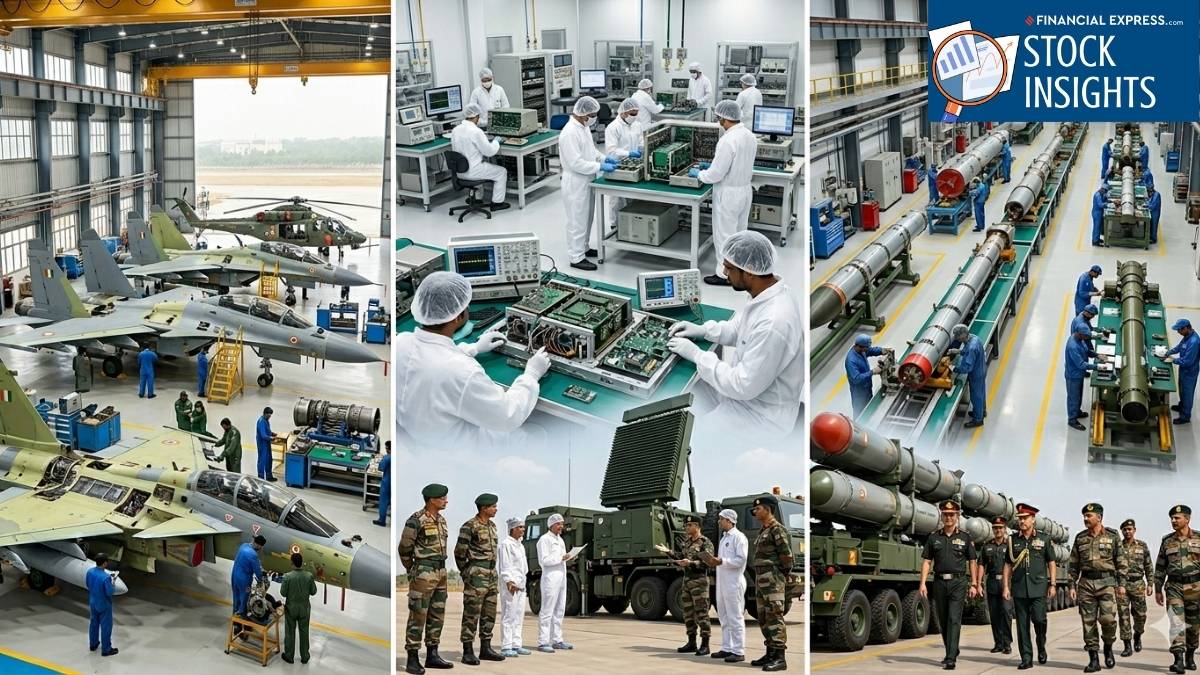
India’s defence sector is no longer only about imports and emergency purchases. The focus is shifting towards homeland production. More aircraft, missiles, electronics, ships and defence systems are now being designed and built within India. For a country with large security needs, this shift has become important.
The government has also pushed this change through policy support. Import restrictions, higher domestic procurement, indigenisation lists and defence production targets have changed the direction of the sector. Indian defence companies are now getting larger opportunities. Many of them are also moving from basic supply contracts to complex manufacturing and system integration work.
The current phase is therefore about execution. Defence companies are sitting on large order books. These orders give revenue visibility for the next few years. But they also bring pressure. Companies must deliver on time, manage capacity and protect margins. This article looks at three defence companies with some of the largest order books in India.
For this screen, we considered listed defence companies with a market capitalisation of more than Rs 5,000 crore. The focus was on companies where defence is a core business, not just a small linked opportunity. We then looked at the latest disclosed order books available around March 31, 2026, and shortlisted the companies with the highest order-book visibility.
#1 Hindustan Aeronautics: High Visibility vs Long Aircraft Delivery Gestation
Hindustan Aeronautics manufactures maintains, and overhauls defense aircraft and helicopters.
Hindustan Aeronautics Financial Performance
| Metric | Hindustan Aeronautics |
| Order book | Rs 2,54,538 crore |
| Order book growth (YoY) | 34% |
| FY26 revenue growth (YoY) | 7% |
| FY26 PAT growth (YoY) | 9% |
| RoCE | 32% |
| RoE | 24% |
| EV/EBITDA | 17.7x |
Hindustan Aeronautics enters FY27 with one of the strongest order books in India’s defence sector. Its order book rose 34% year-on-year (YoY) to Rs 2,54,538 crore at the end of FY26. Fresh orders during the year stood at Rs 97,028 crore. This included manufacturing orders of Rs 69,668 crore and repair and overhaul orders of Rs 26,539 crore.
Assessing the Core Aircraft Delivery Bottlenecks and GE Engine Dependencies
The size of the order book gives HAL strong visibility. But the pace of conversion is still the key issue. HAL’s sales have grown at a 3-year CAGR of around 7%, while profit has grown at 16%. This shows that earnings have improved faster than revenue. But it also shows that the large order book has not yet fully translated into high sales growth.
The reason lies in HAL’s delivery cycle. Management said manufacturing revenue is recognised against delivery, not on a percentage-completion basis. This makes revenue lumpy. It also makes engine supplies, testing and final aircraft acceptance important. For LCA Mark-1A, management expects deliveries to begin around August or September 2026. It plans to deliver around 15-20 LCA aircraft in FY27, depending on supplies from GE.
The company still reported a steady FY26 performance. Revenue from operations rose 7% to Rs 33,050 crore. Profit after tax rose 9% to Rs 9,116 crore. For Q4 FY26, consolidated revenue rose 1.7% YoY to Rs 13,942 crore, while net profit increased 5.5% YoY to Rs 4,196 crore.
Capital Allocation Strategy: Navigating the ₹12,000 Crore Production Ramping Phase
Manufacturing is the main near-term trigger. HAL said manufacturing revenue rose to Rs 9,227 crore in FY26 from Rs 7,957 crore. Repair and overhaul revenue stood at Rs 20,524 crore. Management expects manufacturing to play a larger role once LCA Mark-1A and HTT-40 deliveries begin. It guided for 10-12% revenue growth in FY27 and EBITDA margins of around 30-31%.
HAL is also investing for this next phase. It has established a third LCA Mark-1A production line at Nashik. It is ramping up LCA and HTT-40 manufacturing at Bengaluru and Nashik. LCH manufacturing at Bengaluru and Tumakuru will also remain a focus area. The company plans to invest around Rs 12,000 crore by 2030 in LCA Mark-II, GE 414 engines, IMRH engines, SSLV manufacturing and aero-engine indigenisation facilities.
The company is also widening its aerospace role. It signed an SSLV technology transfer agreement with ISRO, IN-SPACe and NSIL. It also signed an MoU with Russia’s United Aircraft Corporation for SJ-100 civil commuter aircraft production in India. Separately, HAL tied up with Safran Aircraft Engines for LEAP engine rotating parts used in Airbus A320neo and Boeing 737 MAX aircraft.
The stock trades at an EV/EBITDA of 17.7 times, against its five-year average of 14.8 times. Its return on capital employed (RoCE) stands at 32% and return on equity (RoE) at 24%. The return profile remains strong. Cash flow is also healthy, with FY26 operating cash flow of Rs 10,906 crore. But the valuation depends on execution. The next test is whether HAL can turn its order book into aircraft deliveries, higher manufacturing revenue and steady cash generation.
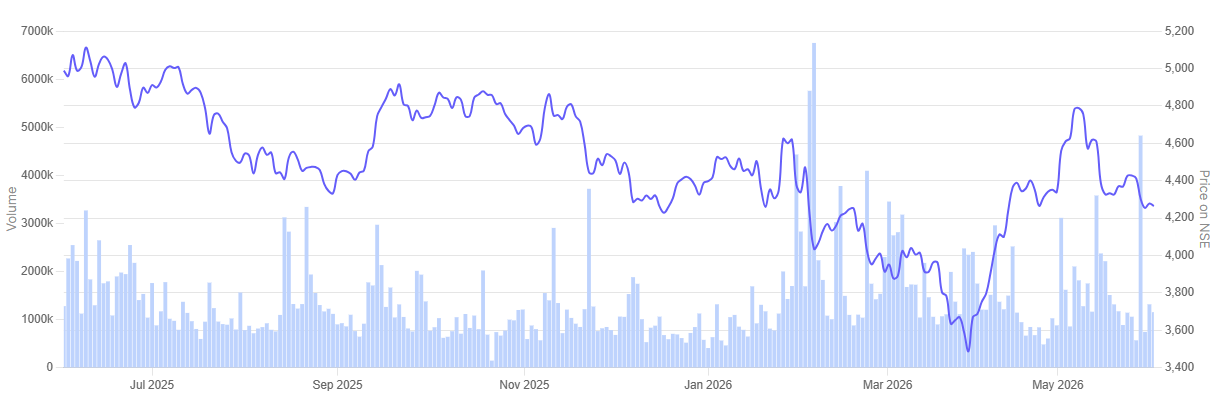
In the past year, the share price of Hindustan Aeronautics is down 13.9%.
Hindustan Aeronautics 1-Year Share Price Chart

#2 Bharat Electronics: Scale Wins in Defence Electronics Amid Working Capital Spikes
Incorporated in 1954, Bharat Electronics manufactures and supplies electronic equipment and systems to the defence sector. It also has a limited presence in the civilian market.
Bharat Electronics Financial Performance
Metric | Bharat Electronics |
| Order book | Rs 73,882 crore |
| Order book growth (YoY) | 3.6% |
| FY26 revenue growth | 16% |
| FY26 PAT growth | 14% |
| RoCE | 36.5% |
| RoE | 27.6% |
| EV/EBITDA | 33.5x |
Bharat Electronics closed FY26 with a defence electronics order book of Rs 73,882 crore as of April 1, 2026. It also received orders worth Rs 30,045 crore during the year. This gives BEL strong medium-term visibility. But the conversion will not be uniform across projects.
Order Backlog Dynamics: Dissecting the One-to-Three Year Project Execution Timeline
The order book includes electronic fuses, LRFM, LCA Mark-1 and Mark-1A LRUs for Tejas, DMP2 upgrade, Ashwini radar, EW suite for Mi-17 V5, spares and services. Management said most of these orders will be executed over the next one to three years. Electronic fuses will run for around seven years.
This makes BEL’s order book different from a simple one-year sales pipeline. Some projects can flow into revenue quickly. Others will support revenue over several years. Management also said the QRSAM order was expected shortly. After signing, BEL expects to deliver the first production model within 18 months.
The company’s FY26 performance remained steady. Revenue from operations rose 16% to Rs 27,480 crore, compared with Rs 23,658 crore in FY25. Profit after tax increased 14% to Rs 6,048 crore from Rs 5,288 crore. EBITDA margin improved to 30% from 29% a year earlier.
Working Capital Pressures: Assessing the Real Impact of the 342-Day Cash Cycle
BEL’s sales have compounded at 16% over three years, while profit has grown at 27%. However, operating cash flow was weaker in FY26 at Rs 1,541 crore compared to the net profit of Rs 6,048 crore for that year. The cash conversion cycle also rose to 342 days. This means working capital will remain important as execution scales up.
BEL is also preparing for the next phase of defence electronics demand. Management said it is working on drones, quantum technologies, secure communication and AI-led systems through DRDO, startups, academia and in-house teams. It has invested over Rs 100 crore in computing infrastructure in the last two years.
Large future opportunities may come from naval and air defence programmes. BEL expects electronics work from submarine and ship-based programmes, including P75I. It is also looking at Next Generation Corvette systems, Shakti Phase 4, naval radars, electronic warfare solutions and data centre opportunities.
The stock trades at an EV/EBITDA of 33.5 times, above its five-year average of 22.6 times and close to the industry median of 36.3 times. Its RoCE stands at 36.5% and RoE at 27.6%. The return profile is strong. But the key test is whether BEL can keep order inflows healthy and convert its Rs 73,882 crore backlog into revenue without stretching working capital further.
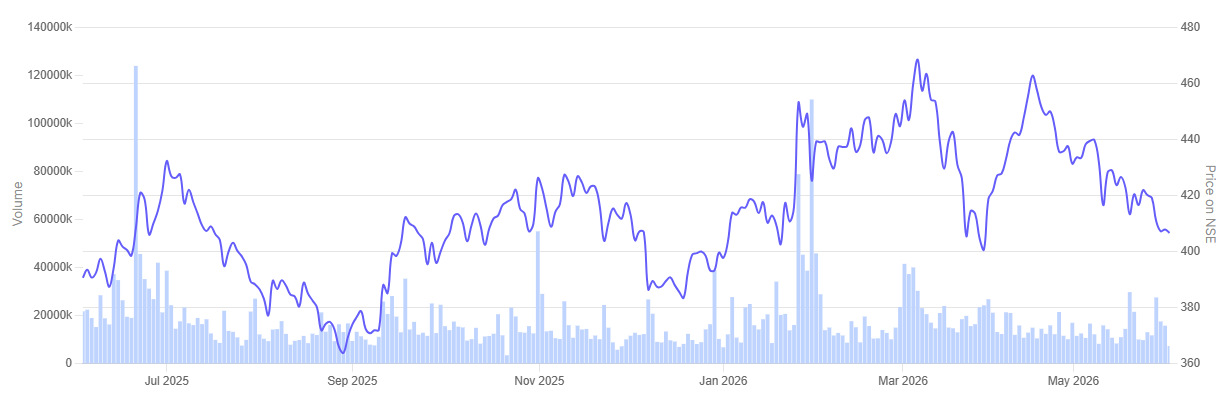
In the past year, the share price of Bharat Electronics is up 4.1%.
Bharat Electronics 1-Year Share Price Chart

#3 Bharat Dynamics: Evaluating the 1,381-Day Inventory Lag in Missile Backlogs
Bharat Dynamics (BDL), is a Government of India enterprise. It is engaged in the manufacturing of guided missiles and allied defence equipment.
Bharat Dynamics Financial Performance
| Metric | Bharat Dynamics |
| Current order book | Around Rs 26,000 crore |
| Order book growth (YoY) | 14% |
| FY26 revenue growth | -27% |
| FY26 net profit growth | -24% |
| RoCE | 13.8% |
| RoE | 10.2 |
| EV/EBITDA | 62.2x |
Bharat Dynamics enters FY27 with a large order book, but its latest financial performance shows the execution challenge. The company said in its March 25, 2026 exchange filing that its current order book was around Rs 26,000 crore. It also said additional orders of around Rs 15,000 crore were envisaged in FY27. These are future expected orders. They should not be added to the current order book.
The Operational Disconnect: Unpacking the Steep 27% Drop in FY26 Revenue
The order book gives BDL strong visibility. But the conversion into revenue has been slow. FY26 revenue from operations fell to Rs 2,441.8 crore from Rs 3,345.1 crore in FY25. Net profit declined to Rs 420.3 crore from Rs 549.6 crore. For Q4 FY26, revenue fell sharply to Rs 480.2 crore from Rs 1,777 crore a year earlier. Net profit also declined to Rs 113.2 crore from Rs 272.8 crore.
Strategic Scale-Up: Evaluating the 1,381-Day Inventory Lag and New Assembly Lines
This makes BDL different from a simple order-book story. The company has a large backlog, but sales have not yet followed the same direction. The company has logged a 3-year sales CAGR of -1% and 3-year profit CAGR of 6%. Inventory days also rose sharply to 1,381 days in FY26. This points to a long production and delivery cycle.
BDL is trying to address this through capacity expansion. The company is setting up two additional manufacturing facilities. One is at Ibrahimpatnam in Telangana. The other is at Jhansi in the Uttar Pradesh Defence Corridor. Production at these facilities is expected to start during FY27.
The Telangana facility will have eight assembly lines for new weapon systems. It will also have rocket motor testing and warhead penetration testing facilities. The Jhansi facility will focus on propellants, bulk manufacturing of GRAD rockets and in-house R&D for new energetics. These facilities are meant to support the current order book and future demand.
There was also progress on the Advanced Akash Weapon System. In a March 26, 2026 filing, BDL said it had completed the first-off production model of the upgraded system. The company said this would pave the way for commencement of deliveries to the armed forces shortly. This is important because it gives some visibility on near-term order conversion.
The stock trades at an EV/EBITDA of 62.2 times, against its five-year average of 35.1 times and an industry median of 36.3 times. Its RoCE stands at 13.8% and RoE at 10.2%. The valuation is rich compared with current return ratios. The key test is clear. BDL must turn its Rs 26,000 crore order book into deliveries, revenue and stronger cash generation.
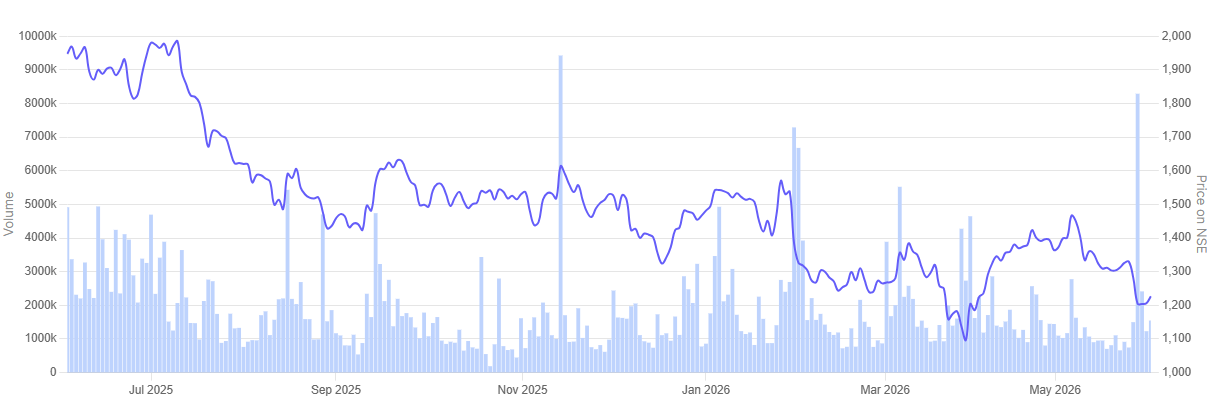
In the past year, the share price of Bharat Dynamics tumbled 37%.
Bharat Dynamics 1-Year Share Price Chart

Conclusion
The defence order-book story still looks strong, but the next phase will be about delivery. Large backlogs give companies revenue visibility, but investors will watch how quickly these orders turn into sales, profits and cash flow.
Companies that execute faster, protect margins and keep winning fresh orders are likely to stay in focus. In this sector, the size of the order book matters. But the speed of conversion will matter more.
Defence Order Book Stocks: Visibility vs Execution vs Valuation
| Metric | HAL | BEL | BDL |
| Latest order book | Rs 2,54,538 cr | Rs 73,882 cr | Rs 26,000 cr |
| FY26 revenue growth | 7% | 16% | -27% |
| FY26 profit growth | 9% | 14% | -24% |
| 3-year sales CAGR | 7% | 16% | -1% |
| 3-year profit CAGR | 16% | 27% | 6% |
| RoCE | 32% | 36.5% | 13.8% |
| RoE | 24% | 27.6% | 10.2% |
| EV/EBITDA | 17.7x | 33.5x | 62.2x |
| Key theme | Aircraft delivery cycle | Defence electronics execution | Missile order conversion |
For now, the defence order-book theme is still strong. The real test will be simple. Companies must convert large orders into timely deliveries, steady revenue and better cash flows.
You can track how these are progressing by adding stocks to your watchlist.
Disclaimer:
Note: We have relied on data from www.Screener.in throughout this article. Only in cases where the data was not available, have we used an alternate, but widely used and accepted source of information.
The purpose of this article is only to share interesting charts, data points and thought-provoking opinions. It is NOT a recommendation. If you wish to consider an investment, you are strongly advised to consult your advisor. This article is strictly for educative purposes only.
Ekta Sonecha Desai has a passion for writing and a deep interest in the equity markets. Combined with an analytical approach, she likes to deep dive into the world of companies, studying their performance, and uncovering insights that bring value to her readers.
Disclosure: The writer and her dependents do not hold the stocks discussed in this article.
The website managers, its employee(s), and contributors/writers/authors of articles have or may have an outstanding buy or sell position or holding in the securities, options on securities or other related investments of issuers and/or companies discussed therein. The content of the articles and the interpretation of data are solely the personal views of the contributors/ writers/authors. Investors must make their own investment decisions based on their specific objectives, resources and only after consulting such independent advisors as may be necessary.