
India’s defence manufacturing sector maintained its growth momentum in FY26. Annual defence production rose 15.6% to a record Rs 1.78 lakh crore. This was 110% higher than the Rs 84,643 crore recorded in FY21, according to the Ministry of Defence.
Defence exports also reached a record Rs 38,424 crore in FY26. This was an increase of 62.7% from Rs 23,622 crore in FY25. The private sector’s share of defence production increased from 22% to 24%, according to the Press Information Bureau.
The sector’s growth has drawn investor interest towards defence stocks. However, rising stock prices have also pushed up valuations. Investors may therefore need to assess how much they are paying for a company’s operating earnings.
We screened defence companies using EV/EBITDA to identify relatively cheaper stocks. Companies were required to have a market capitalisation of at least Rs 1,000 crore. Their latest quarterly sales had to be at least Rs 25 crore and show positive year-on-year growth. From this list, the stocks with the lowest EV/EBITDA ratios were selected.
#1 Hindustan Aeronautics: Tejas Delays Keep Valuation Below Peers
Hindustan Aeronautics (HAL) manufactures, repairs and maintains aircraft and helicopters.
Hindustan Aeronautics Financial Performance
| Metric | FY26 |
| Revenue growth | 6.8% |
| Net profit growth | 9.0% |
| Order book | Rs 2,54,538 crore |
| EV/EBITDA | 19.2x |
| RoCE | 32.0% |
HAL reported consolidated revenue from operations of Rs 33,089 crore in FY26. This was an increase of 6.8% year-on-year (YoY). Net profit rose 9% to Rs 9,116 crore.
HAL ended FY26 with an order book of Rs 2,54,538 crore. Fresh orders during the year stood at Rs 97,028 crore. This included an order for 97 Tejas Mark-1A aircraft. The company expects another Rs 90,000 crore of orders over the next two years. The pipeline includes 143 ALH helicopters, the Su-30 upgrade and the upgrading of 40 Dornier-228 aircraft.
Execution Bottlenecks: Deliveries Hold Key to Rerating
Execution of the Tejas order remains the main near-term issue. HAL had received six engines from GE as of 22nd May 2026. However, aircraft deliveries were held back by engine delays and pending technical refinements. Management expects deliveries to begin by August or September 2026. It plans to deliver around 20 Tejas aircraft in FY27. This target depends on GE supplying another 15 to 20 engines.
HAL is also expanding capacity. Its third Tejas production line at Nashik can manufacture eight aircraft a year. The company plans to invest around Rs 12,000 crore by 2030. The spending will support the Tejas Mark-2, GE F414 and IMRH engine programmes, helicopters and small satellite launch vehicles. The Tejas Mark-2 prototype is expected to be rolled out by March 2027.
Global Civil Aviation Push: Safran Partnership and Engine Manufacturing
The company is also widening its global and civil aviation presence. It has partnered with Safran to manufacture rotating parts for LEAP engines. These engines power aircraft such as the Airbus A320neo and Boeing 737 MAX. HAL has also signed an agreement with Russia’s United Aircraft Corporation to explore production of the SJ-100 civil aircraft in India.
19.2x EV/EBITDA: Cheaper Than Sector Peers, But Above Historical Averages
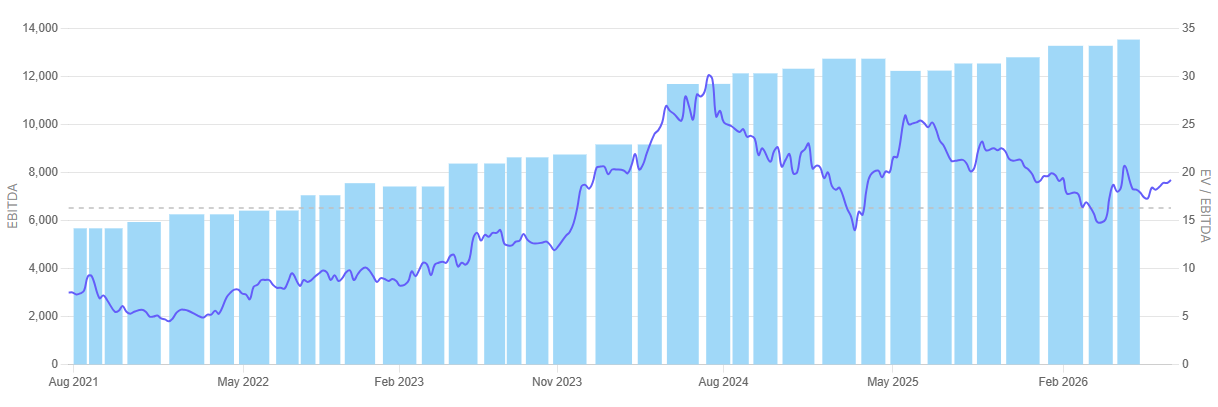
HAL trades at an EV/EBITDA multiple of 19.2x. This is well below the defence-sector peer median of 36.2x. However, it remains above HAL’s five-year median of 16.3x. The stock is therefore cheaper than peers, but not against its own history.
The relative discount reflects execution risks. Tejas deliveries have been delayed more than once. Revenue is recognised only when platforms are delivered. This makes earnings sensitive to certification, engine availability and delivery schedules. Still, an expanding order book, high return ratios and planned capacity additions provide long-term visibility. HAL’s return on capital employed (RoCE) stands at 32%, while return on equity (RoE) is 24%.
Below is the 5-year EV/EBITDA chart of Hindustan Aeronautics.
Hindustan Aeronautics 5-Year EV/EBITDA Chart

#2 Garden Reach Shipbuilders & Engineers: Cheaper Than Peers, but Order Replenishment Is Key
Garden Reach Shipbuilders & Engineers (GRSE) is a premier shipbuilding company in India under the administrative control of the Ministry of Defence, primarily catering to the shipbuilding requirements of the Indian Navy and the Indian Coast Guard.
Garden Reach Shipbuilders & Engineers Financial Performance
| Metric | FY26 |
| Revenue growth | 38.0% |
| Net profit growth | 42.0% |
| Order book | Rs 15,324 crore |
| EV/EBITDA | 24.9x |
| RoCE | 43.0% |
GRSE reported revenue from operations of Rs 7,002 crore in FY26. This was an increase of 38% from the previous year. Net profit rose 42% from Rs 527 crore to Rs 748 crore. EBITDA margin improved from 8.3% to 11.6%, according to the company’s FY26 earnings-call transcript.
The growth was supported by faster project execution. GRSE delivered eight warships to the Indian Navy during the year. It also delivered seven naval surface guns and 110 portable steel bridges. Export revenue crossed Rs 270 crore. The bridges division recorded revenue of more than Rs 200 crore for the first time.
Its order book stood at Rs 15,324 crore at the end of FY26. This included nine projects covering 39 platforms. Around 95% of the order book came from shipbuilding. However, the backlog fell below Rs 20,000 crore for the first time in five years. Management attributed this to faster execution.
Several vessels are approaching key milestones. The final P-17A frigate had achieved 74% physical progress and is scheduled for delivery in 2026. Four anti-submarine shallow-water craft are also due in FY27. Two of them had reached around 80% completion and finished basin trials.
Order Pipeline vs Execution: The Rs 33,000-Crore Corvette Trigger
GRSE is the lowest bidder for the Next Generation Corvette project. Price negotiations have been completed. The contract, valued at around Rs 33,000 crore, was expected to be signed in the June 2026 quarter. However, revenue recognition is likely to begin only in the second half of FY28. A larger contribution is expected from FY29 as vessel construction gathers pace.
The company is expanding ahead of future orders. Its capacity is expected to increase from 28 to 32 ships by the end of 2026. GRSE is also developing two brownfield facilities in West Bengal. Two greenfield facilities are planned in West Bengal and Gujarat.
Exports offer another growth route. GRSE is building 12 multipurpose vessels for a German customer. Keel laying for the first three ships has been completed. Management said it was also in discussions with other European shipowners for commercial vessel orders.
24.9x EV/EBITDA vs 43% RoCE: High Return Ratios vs Order Replenishment Risks
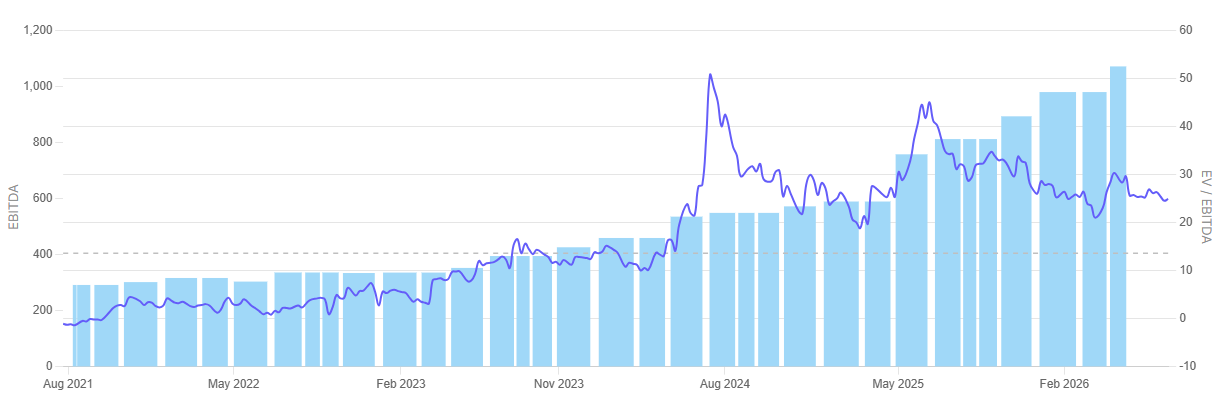
GRSE trades at an EV/EBITDA multiple of 24.9x. This is below the defence-sector peer median of 36.2x. However, it is well above the company’s five-year median of 13.6x. The stock is therefore relatively cheaper than peers, but expensive compared with its own trading history. Its RoCE stands at 43%, while RoE is 31.8%.
The discount to peers may reflect uncertainty over order replenishment. The existing order book is shrinking, while the large corvette contract is yet to be signed. Revenue from this project will also take time to build. Recent margins benefited from provision write-backs, although management expects similar margins in FY27. New orders and timely execution will decide whether current growth can be sustained.
Below is the 5-year EV/EBITDA chart of Garden Reach Shipbuilders & Engineers.
Garden Reach Shipbuilders & Engineers 5-Year EV/EBITDA Chart

#3 Mishra Dhatu Nigam: Raw-Material Risks Keep Valuation Below Peers
Mishra Dhatu Nigam, or MIDHANI, manufactures special metals for defence, aerospace, space and energy applications. Its products include titanium alloys, superalloys and high-strength steels. These materials are used in aircraft engines, missiles, satellites and other critical systems.
Mishra Dhatu Nigam Financial Performance
| Metric | FY26 |
| Revenue growth | 12.5% |
| Net profit growth | 18.8% |
| Order book | Rs 2,290 crore |
| EV/EBITDA | 28.7x |
| RoCE | 11.3% |
MIDHANI reported its highest-ever revenue of Rs 1,208.63 crore in FY26. This was an increase of 12.5% from Rs 1,074.1 crore in FY25. Net profit rose 18.8% from Rs 110.07 crore to Rs 130.79 crore.
Titanium was a major growth area. Production almost doubled to a record 700 tonnes in FY26. The company had titanium orders worth more than Rs 660 crore at the time of the earnings call. Its overall order book stood at Rs 2,290 crore as of 1 April 2026. Defence accounted for around 79% of the backlog.
MIDHANI also received airworthiness certification from CEMILAC for 10 aerospace-grade superalloys and steels. These materials can now enter production for advanced aircraft engines. The company also secured NADCAP certification for heat treatment. This allows global aerospace and defence companies to procure directly from the certified facility.
Capacity Expansion & Aerospace Certifications: Debottlenecking Growth
Expansion plans are aimed at removing production bottlenecks. MIDHANI plans to invest around Rs 1,000 crore over the next three years. The projects include new equipment for forging, bar rolling and other downstream operations. Detailed project reports are being prepared. The company expects greater clarity on the investments by the end of FY27.
A Rs 40-crore aerospace fastener plant has already begun operations. It will manufacture high-grade fasteners for missiles and space systems. Management expects annual orders of Rs 20-30 crore from this facility. MIDHANI is also developing superalloys and titanium alloys for the Advanced Medium Combat Aircraft programme.
Exports remain small but are gradually expanding. MIDHANI generated export revenue of Rs 78 crore in FY26. Audits by global aerospace companies are at an advanced stage. Management expects the NADCAP certification to support further overseas orders.
28.7x EV/EBITDA and Single-Digit RoE: Why Lagging Capital Efficiency Caps Valuation
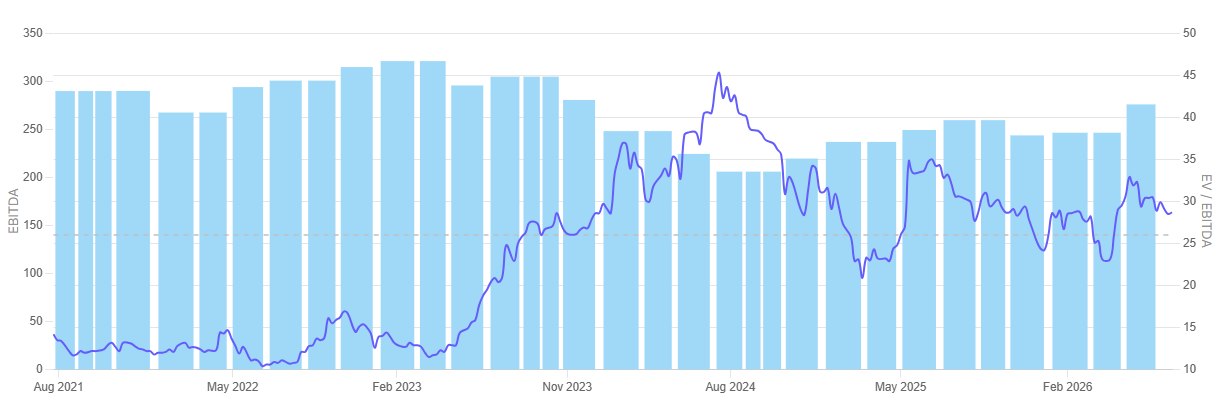
MIDHANI trades at an EV/EBITDA multiple of 28.7x. This is below the defence-sector peer median of 36.2x. However, it is above its five-year median of 26x. The stock is therefore cheaper than peers, but slightly more expensive than its own historical valuation. RoCE stands at 11.3%, while RoE is 8.9%.
The discount to peers may partly reflect these lower return ratios and MIDHANI’s modest revenue base. Raw-material availability is another risk. The company depends on imports of nickel, cobalt, titanium sponge and other critical inputs. Energy disruptions can also delay production. A planned metal bank should provide some protection, but execution will remain important. Higher titanium sales, new certifications and timely capacity expansion will determine whether returns improve from current levels.
Below is the 5-year EV/EBITDA chart of Mishra Dhatu Nigam.
Mishra Dhatu Nigam 5-Year EV/EBITDA Chart

Conclusion
The lower EV/EBITDA multiples do not make these stocks cheap in absolute terms. All three trade above their five-year median valuations. Their discount to the sector reflects execution delays, uneven order visibility, dependence on imported inputs and differences in return ratios.
Future performance will depend on converting large opportunities into revenue and profit. Timely deliveries, fresh order wins and access to critical materials will be important. Investors should also watch whether capacity additions improve execution and returns. Until these factors become clearer, the valuation discount to peers may continue.
India’s Cheapest Defence Stocks
| Metric | Hindustan Aeronautics | Garden Reach Shipbuilders | Mishra Dhatu Nigam |
| EV/EBITDA | 19.2x | 24.9x | 28.7x |
| Five-year median EV/EBITDA | 16.3x | 13.6x | 26.0x |
| FY26 revenue growth | 6.8% | 38.0% | 12.5% |
| FY26 net profit growth | 9.0% | 42.0% | 18.8% |
| RoCE | 32.0% | 43.0% | 11.3% |
| RoE | 24.0% | 31.8% | 8.9% |
Source: Screener.in and FY26 company results and earnings-call transcripts.
You can track how these are progressing by adding stocks to your watchlist.
Disclaimer:
Note: We have relied on data from www.Screener.in throughout this article. Only in cases where the data was not available, have we used an alternate, but widely used and accepted source of information.
The purpose of this article is only to share interesting charts, data points and thought-provoking opinions. It is NOT a recommendation. If you wish to consider an investment, you are strongly advised to consult your advisor. This article is strictly for educative purposes only.
Ekta Sonecha Desai has a passion for writing and a deep interest in the equity markets. Combined with an analytical approach, she likes to deep dive into the world of companies, studying their performance, and uncovering insights that bring value to her readers.
Disclosure: The writer and her dependents do not hold the stocks discussed in this article.
The website managers, its employee(s), and contributors/writers/authors of articles have or may have an outstanding buy or sell position or holding in the securities, options on securities or other related investments of issuers and/or companies discussed therein. The content of the articles and the interpretation of data are solely the personal views of the contributors/ writers/authors. Investors must make their own investment decisions based on their specific objectives, resources and only after consulting such independent advisors as may be necessary.