
Welcome to the latest edition of Dividend Hunter. Over the past few weeks, we have analyzed companies where strong cash flows could translate into consistent dividends going forward. In our previous edition, we covered a leading Public Sector Bank offering a 3.5% yield with dividend per share up 3X in 5 years.
Our focus today is a major player in the Indian agriculture industry with a rich legacy of 126 years. With an annual revenue from operations of ₹5,675 crore, the company is one of India’s leading agricultural institutions. The stock we focus on in this edition of Dividend Hunter is Bayer CropScience Limited.
The company has consistently maintained a strong dividend payout. Its Dividend Distribution Policy balances profit distribution with long-term business growth. For FY26, Bayer CropScience paid a dividend of ₹150 per share, translating to a dividend yield of 3.5%.
In FY26, the company reported a net profit of ₹689.2 crore and held cash and cash equivalents of ₹1,414.6 crore. The company has also been generating free cash flow for over a decade. But now the question is, can the company sustain its dividend payments? Let’s find out.
Business Model Breakdown: Crop Protection and Hybrid Seeds Drive ₹5,675 Crore Revenue
Bayer CropScience makes and sells products that protect crops from insects, diseases, and weeds. These products include weed killers, bug killers, and fungus treatments. Additionally, the company produces and sells hybrid corn seeds. The company also provides digital advisory tools to help farmers manage weather risks and make decisions.
The company earns most of its revenue from two main business segments. For FY26, Bayer CropScience reported a total operating revenue of ₹5,675 crore. The crop protection division is the largest part of the business, contributing 76% to the revenue. The hybrid seed division is the second largest part, contributing 19%. The remaining (5%) comes from other services.
In terms of geographic mix, domestic sales accounted for 95% of revenue and exports accounted for the remaining 5%. The company serves a variety of customers across the agricultural supply chain. It sells to a network of 3,500+ distributors and retail stores, who then sell these products to farmers. The company also sells its goods directly to government groups and food processing businesses.
Earnings Trajectory: Margin Expansion and 21% PAT Surge Support Payouts
Over the last 5 years, the company’s consolidated net profit grew at 7% CAGR, reaching ₹689 crore in FY26. Like all sustainable payouts, these dividends are supported by the net profit it generates. In FY26, Bayer CropScience recorded a strong financial performance.
Its revenue grew by 4% year-on-year to ₹5,675 crore in FY26. EBITDA (Earnings Before Interest, Tax, Depreciation and Amortization) rose 19.7% to ₹968.7 crore and margins expanded 280 bps to 17.1%. Declining input costs, higher profit growth from the corn seed portfolio, and cost optimization helped drive operational efficiency.
Consequently, net profit surged by 21% to ₹689.2 crore. This was also driven by stabilizing costs and a 14.1% surge in export sales, which reached ₹218.4 crore during the year. This also improved return ratios: Return on Net Worth increased from 19.9% to 23.7%, while Return on Capital Employed increased from 24.5% to 28.7%.
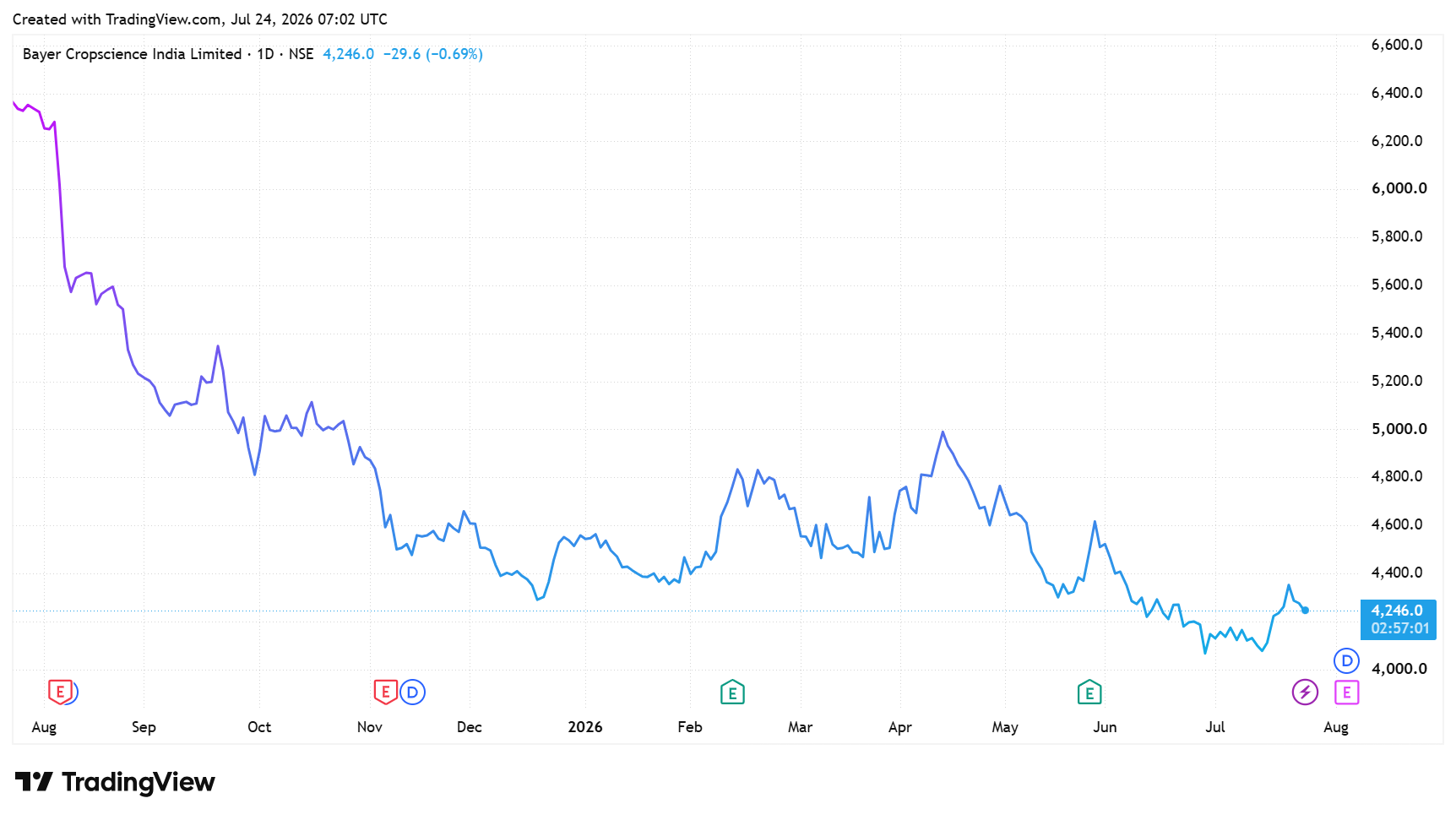
The company’s market cap is ₹19,050 crore, as of 23 July 2026.

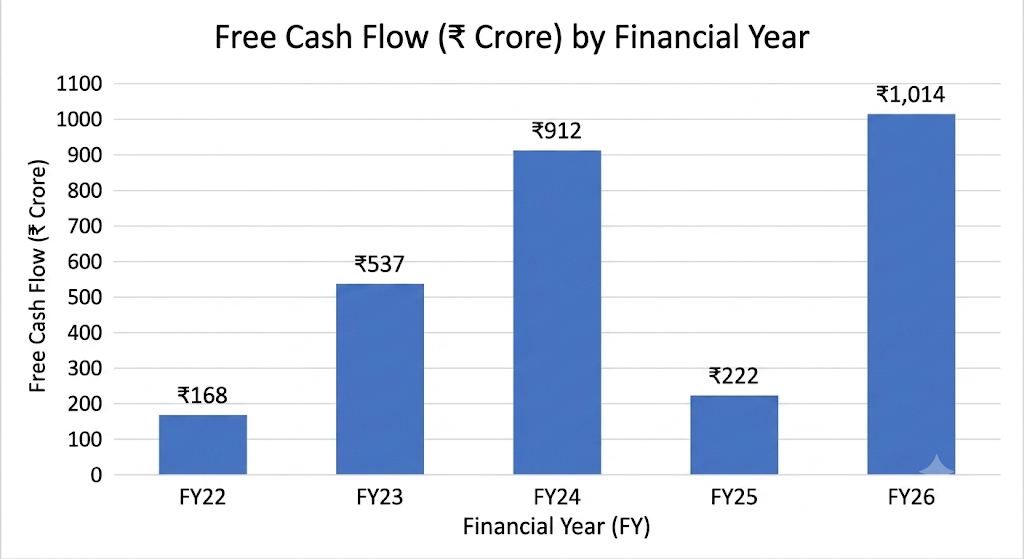
The Cash Flow Engine: How Inventory Liquidation Unlocked ₹1,014 Crore Free Cash
While net profit is the base, the true engine behind the high dividend payouts is the company’s high cash flow generation. The business generated net cash of ₹1,078.5 crore from operating activities in FY26, up from ₹262 crore in FY25. This marked the highest-ever operating cash flow in the company’s history.
This sharp jump in net cash generation was supported by efficient working capital management. The company’s operating profit before working capital changes was strong at ₹941.4 crore. However, unlike the previous year, when working capital consumed cash, in FY26 the company unlocked ₹300.6 crore from positive net changes in working capital.
A significant driver of this was a decrease in inventories, which freed up ₹199.9 crore in cash. In contrast, in FY25, inventory build-ups consumed ₹820.8 crore. The company also received ₹72 crore (net) from investing activities. Together, the operating and investing activities generated a net cash inflow of ₹1,150.5 crore.
Financing & Payout Mechanics: Spending ₹562 Crore to Reward Shareholders
With this cash, the company easily funded its shareholder payouts. Net cash used in financing activities was ₹623.8 crore, of which the majority (₹562.8 crore) was used to pay dividends directly to shareholders. Even after the payout, the company was left with net cash flow of ₹527 crore in FY26, up from negative cash of ₹272 crore in FY25.
As a result, the company ended FY26 with free cash flow of ₹1,014 crore, up from ₹222 crore in FY25. This also increased its cash and cash equivalents to ₹1,414.6 crore, up from ₹885.5 crore in FY25.
To sum up, Bayer CropScience’s ability to maintain its high dividend payout can be attributed to its strong sales and profit margins, which translate into cash.

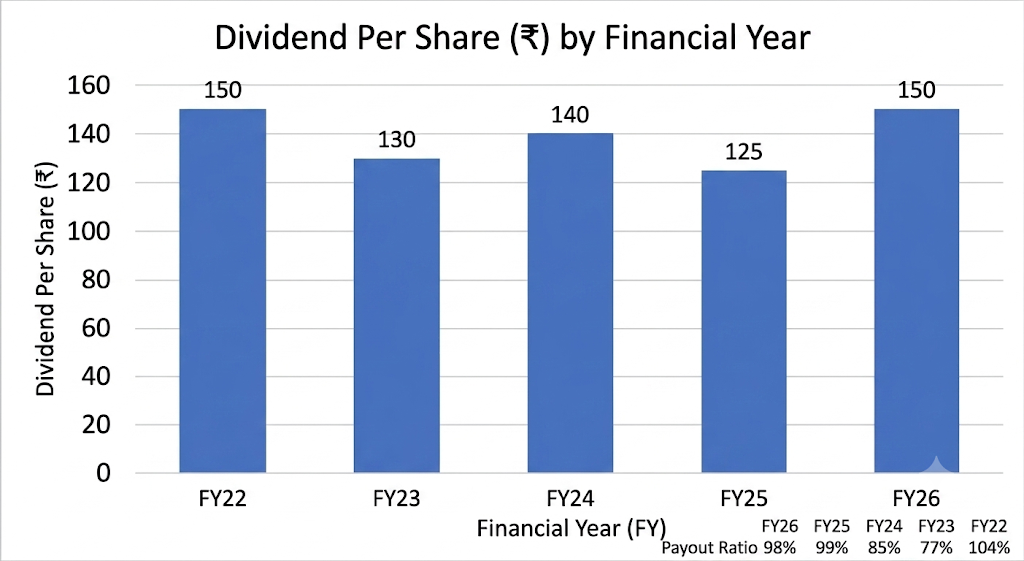
Dividend History & Yield Analysis: Evaluating the 3.5% Payout Track Record
Regarding its dividend per share, the company has recommended ₹150 per share for FY26. At the current share price of ₹4,250, the dividend yield is 3.5%. The company’s shares typically trade ex-dividend in August and November each year for its final dividend.
Prior to FY26, the company paid ₹125 per share for FY25, down from ₹140 in FY24, ₹130 in FY23 and ₹150 in FY22. The company currently pays only a final dividend once a financial year. The company distributes almost all of its profits as dividends, as evidenced by dividend payouts ranging between 77-104% over the past 5 years.

Bayer CropScience’s dividend distribution policy aims to balance rewarding shareholders with keeping enough money to fund future growth. Management stated that even during difficult market conditions, the board ensures that dividend distributions remain consistent.
Growth Catalysts: Expanding the High-Margin DEKALB Corn Seed Portfolio
Bayer CropScience aims to achieve high single-digit to low double-digit revenue growth over the next 3-5 years, while also expanding profit margins by 100 basis points. Increasing margins and profitability will allow the company to not only pay dividends but also increase them, given the high payout.
The hybrid corn seed business, marketed under the DEKALB brand, will drive this growth. Corn has rapidly become the third most important field crop in India. This is supported by rising demand for livestock feed, poultry, food processing, and ethanol blending.
Bayer CropScience plans to double its corn seed portfolio to meet this demand. The corn seed business is fully backward integrated and therefore offers high margins. As the segment grows, this could boost the company’s overall margins.
Alongside corn, the core crop protection business through proprietary products forms another key pillar of the growth strategy. The company is actively moving away from older products and introducing new solutions. These products address specific challenges faced by farmers while offering the company a better profitability profile.
Relative Valuation: Analyzing Bayer’s 27.6x P/E Multiple Against Industry Peers
Valuation-wise, Bayer CropScience trades at a Price-to-Equity (P/E) multiple of 27.6x, at a discount to its 10-year historical median (39.9x) but at a premium to the sector median (23.1x), and larger peers such as PI Industries (34.9x) and Sumitomo Chemical (46.8x).
The Dividend Hunter Verdict: Deep Liquidity Supports Long-Term Payout Safety
In short, Bayer CropScience could be expected to sustain regular dividend payments. The company generates reliable cash flow. This cash generation allows the company to easily cover its yearly dividend payouts. If operations remain stable, the company’s deep liquidity, holding ₹1,414.6 crore in cash and cash equivalents, ensures its dividend sustainability.
Furthermore, the board’s Dividend Distribution Policy suggests the company will continue rewarding shareholders. Dividend hunters should add this stock to their watchlist.
Disclaimer:
Note: Throughout this article, we have relied on data from http://www.Screener.in and the company’s investor presentation and conference call. Only in cases where the data were unavailable have we used an alternative, widely accepted source of information.
The purpose of this article is only to share interesting charts, data points, and thought-provoking opinions. It is NOT a recommendation. If you wish to consider an investment, you are strongly advised to consult your advisor. This article is strictly for educational purposes only.
About the Author: Madhvendra has been deeply immersed in the equity markets for over seven years, combining his passion for investing with his expertise in financial writing. With a knack for simplifying complex concepts, he enjoys sharing his honest perspectives on startups, listed Indian companies, and macroeconomic trends.
A dedicated reader and storyteller, Madhvendra thrives on uncovering insights that inspire his audience to deepen their understanding of the financial world.
Disclosure: The writer and his dependents do not hold the stocks discussed in this article.
The website managers, their employees (s), and contributors/writers/authors of articles have or may have an outstanding buy or sell position or holding in the securities, options on securities, or other related investments of issuers and/or companies discussed therein. The articles’ content and data interpretation are solely the personal views of the contributors/ writers/authors. Investors must make their own investment decisions based on their specific objectives, resources, and only after consulting such independent advisors as may be necessary.