
A market valued at $4.40 billion in 2025 is projected to reach $7.7 billion (₹74,000 crore) by 2031. However, the bigger story is not just the growth. It’s the structural shift in who stands to benefit. The video surveillance industry is undergoing a massive transformation, driven by rising demand and a rapidly changing regulatory landscape.
Globally, the video surveillance market is expected to grow at a CAGR of 10.36% during FY25-30. Domestically, India’s closed-circuit television (CCTV) industry is projected to see volume growth of 15% annually, with the advanced Internet Protocol camera segment expanding even faster at over 25%.
Regulatory Catalyst: How STQC Mandate Created a Domestic Moat
Simultaneously, a major regulatory change has fundamentally reshaped the Indian competitive market. Effective after 9 April 2025, the government made Standardisation Testing and Quality Certification mandatory for all network CCTV cameras sold in the country.
This certification ensures that devices meet stringent international cybersecurity, product integrity, and data privacy standards. This safeguards the market against low-cost, uncertified imports. As a result, several Chinese brands that previously accounted for an estimated one-third of the Indian market have gradually lost their presence.
This withdrawal created a vacuum in the market, shifting demand heavily toward trusted, domestic manufacturers. As a result, these companies are well placed to benefit from this transition.
#1 Aditya Infotech
Aditya Infotech , India’s largest manufacturer of surveillance products and the 3rd largest globally, has been the primary beneficiary of these industry tailwinds. Aditya Infotech’s market share in the Indian surveillance industry surged to 43.3% in FY26, up from 20.2% in FY25.
The company has a distribution network of 800+ distributors, 1,800+ system integrators, and 30,000+ channel partners across India, spread across more than 500 cities. Aditya Infotech provides a range of security solutions from professional enterprise ranges to consumer smart home IoT devices, video door phones, and dash cams.
How CP PLUS and IP Camera Shift Are Driving ASP Growth
Aditya Infotech’s flagship brand, CP PLUS, contributes 86% of the overall revenue, with Internet Protocol (IP) products making up 73% of the CP PLUS portfolio. This transition from traditional HD analogue cameras to intelligent IP systems is margin-accretive and is a central reason for the company’s rising Average Selling Price.
To capture market share across different socio-economic tiers, Aditya Infotech has adopted a multi-brand and multi-series strategy. The company has developed new brands (NEXIVUE and EYRA) to target the mass-market price-sensitive segment. Both these brands serve as alternatives to low-cost imported products.
Conversely, CP+ Pro Series targets enterprise and high-performance government applications to compete against global brands. To lead the shift to an intelligent, AI-powered connected ecosystem, Aditya Infotech is investing heavily in software and AI through strategic collaborations.
Edge AI & Indigenous Chips: Scaling the Qualcomm-Powered Vision Ecosystem
Aditya Infotech has collaborated with Qualcomm to integrate edge-based Vision AI analytics directly into mass-market systems. This will provide insight-driven solutions for public safety and enterprise applications. This partnership aims to integrate AI processors into commercial enterprise endpoints.
To strengthen its technological lead, Aditya Infotech is developing India’s first indigenous IP system-on-chips, powered by Vision AI. This partnership aims to power 90 lakh CP PLUS cameras over the next 3 years. The company is pioneering software-as-a-service and video-surveillance-as-a-service models.
Manufacturing Push: Doubling Capacity & Localizing 50% Bill of Materials
To support its 2X capacity expansion and reach its target of doubling overall production capacity by FY28, Aditya Infotech is setting up a new 3 lakh sq. ft. leased manufacturing facility in Noida. This new plant is expected to become operational by Q4FY27. Aditya Infotech’s capacity stands at 25 lakh units.
To safeguard its cost structure from freight volatility, the company is also backward integrating and localizing over 50% of its Bill of Materials. A joint venture with Orient Cables will manufacture LAN, coaxial, and CCTV cables at a new facility in Rajasthan, expected to be operational by mid-FY27.
A newly commissioned automated lens assembly line will initially produce 5 lakh lenses per month, scalable up to 10 lakh. Aditya Infotech is also setting up a greenfield plant to produce up to 300 lakh plastic and metal housings annually.
FY27 Growth Playbook: Target 50% Revenue Expansion & 15% EBITDA Margins
Financially, Aditya Infotech’s revenue grew by 35.6% year-on-year to ₹4,221 crore in FY26, driven by price hikes and volume growth. EBITDA grew by 124.4% to ₹579 crore with an improved margin of 13.7%. Net profit surged by 166.6% to ₹368 crore. The company expects 25-30% volume growth (higher than the industry) to lead to 50% revenue growth in FY27.
The Average Selling Price of cameras is anticipated to rise by approximately 25% in FY27 due to rising component costs and the shift toward premium IP cameras. Management has guided an EBITDA margin of 14% to 15% for FY27.
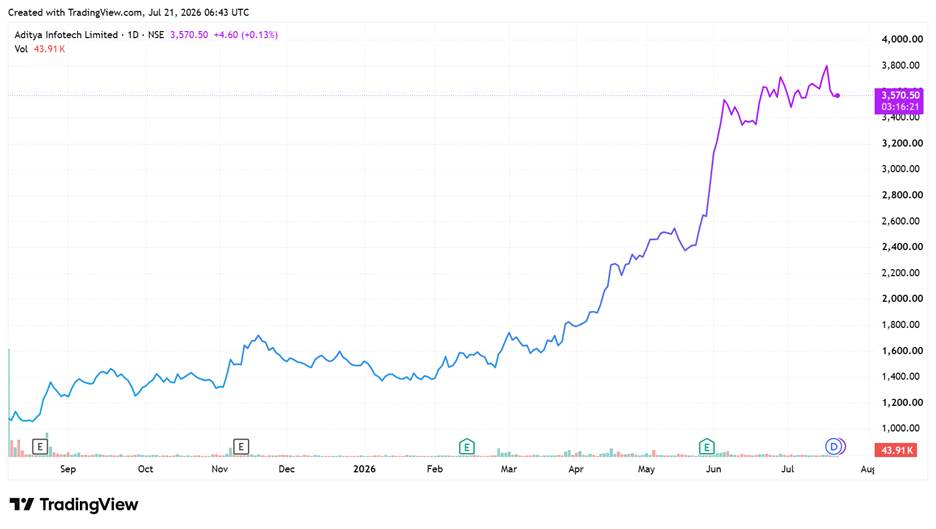
Aditya Infotech Share Price

#2 Prizor Viztech
Prizor Viztech is a fast-growing Indian manufacturer of security and surveillance solutions. It claims that its asset-light distribution strategy is difficult for competitors to copy overnight. The company has a presence in 21 states and relies on a network of over 11,000 dealers and 150+ distributors.
Expanding Distribution & AI Portfolio: From 11,000 Dealers to 4K Smart Cameras
Prizor offers a comprehensive ecosystem of products with over 1,281 SKUs. The core offerings include IP cameras, analog cameras, 4G/stand-alone cameras, and solar cameras. Prizor is advancing its technology with the PRIZOR PLUS AI series (ranging from 3MP to 12MP/4K), which features facial recognition, automatic number plate recognition, and behavior analysis.
Manufacturing Expansion: In-House Electronics & Indigenous Chip Design
Prizor operates a manufacturing facility in Gandhinagar and is actively transitioning from a simple import-and-assemble model to a high-capacity, fully backward-integrated ecosystem. The company operates two assembly lines capable of producing 8 lakh units per line, totaling 16 lakh CCTV cameras annually.
This annual capacity can be expanded to 40 lakh units with low incremental capital expenditure. The facility houses mold machines for camera bodies, laser branding machines, and a server room for P2P cloud and IP infrastructure. This integration boasts a capacity of 50 lakh PCB units per annum, enabling complete in-house electronics manufacturing.
Prizor is taking backward integration a step further. It has a Memorandum of Understanding in the pipeline with IndieSemic to jointly develop an indigenous System on Chip titled ISC-S2-PZ. This will completely secure the company’s supply chain. It expects to benefit from India’s booming infrastructure, with 250 lakh new homes expected by 2030.
FY26 Financial Breakdown: Revenue Surges 108% as EBITDA Margins Reach 22.5%
Financially, Prizor revenue grew by 108.1% year-on-year to ₹147.9 crore in FY26, driven by a structural shift toward indigenous security solutions and an expanding dealer network. EBITDA grew by 121% to ₹33.2 crore with a margin of 22.5%. Net profit surged 104.5% to ₹20.8 crore. The company sees Tier 2 and Tier 3 towns as its next growth frontier.

#3 D-Link
D-Link is a premier networking company engaged primarily in the marketing and distribution of networking products across India. The vast majority of its operational revenue comes from its hardware products. D-Link India’s business is deeply concentrated in the domestic market, with exports making up only a fraction of its total sales.
Local Manufacturing & Reach: Sourcing Two-Thirds Supply via 15,000+ Resellers
The company has expanded its domestic production capabilities. Currently, two-thirds of D-Link India’s product supply is sourced locally. The company maintains strategic partnerships with over 30 leading outsourced manufacturing partners across India. It has a deep market reach with over 15,000+ resellers.
IP Surveillance Integration: Expanding from Home Networks to Enterprise Solutions
D-Link is a major player in the networking market. It designs, manufactures, and distributes IP surveillance cameras as part of its expansive network equipment lineup. These cameras are sold in three main segments: home networks, small and medium-sized businesses looking for reliable monitoring solutions, and enterprise networks.
Its surveillance equipment is offered alongside other core networking parts, such as network switches, wireless routers, and structured cabling. This makes the company a comprehensive solutions provider for organizations building out their IT and security infrastructure.
FY26 Financial Metrics: Total Income Reaches ₹1,582 Crore Driven by Domestic Demand
Financially, D-Link consolidated revenue grew by 13.2% year-on-year to ₹1,566 crore in FY26, driven by a strong domestic market. Operating Profit grew by 3.9% to ₹132 crore with a margin of almost 8.4%. Net profit remained flat at ₹104.1 crore. It sees expanding enterprise solutions, hyperscale networking, and growing consumer adoption as its next growth frontier.
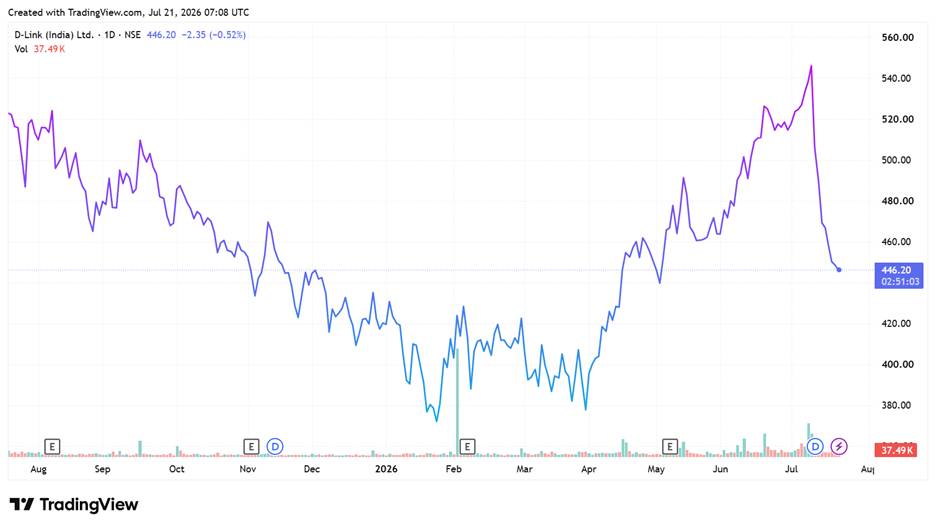
Competitive Landscape & Growth Outlook: Leader vs. Challengers
Prizor Viztech stands out for its strong Return on Capital Employed (ROCE) and Return on Equity (ROE), followed by Aditya Infotech and D-Link. Valuation-wise, Aditya Infotech and Prizor are trading at a premium to the industry median price-to-earnings (P/E) multiple. D-Link is trading at a slight premium to the 3-year median but at a discount to the industry median.
| Particulars | Price-to-Earnings Multiple (X) | Return Ratios | |||
| Company | 3Y Median | Industry | ROE (%) | ROCE (%) | |
| Aditya Infotech | 115.0 | NA | 31.8 | 25.4 | 28.6 |
| Prizor Viztech | 43.1 | NA | 31.8 | 35.5 | 37.7 |
| D-Link | 17.8 | 16.5 | 26.4 | 18.1 | 25.9 |
To conclude, India’s surveillance market is no longer driven solely by higher installations. The combination of faster industry growth, tighter certification norms, and the shift away from imported products has changed the competitive landscape.
While Aditya Infotech remains the clear market leader, Prizor offers a high-growth opportunity backed by capacity expansion and backward integration, while D-Link provides relatively stable exposure through its established networking and surveillance business. Keep these companies in your watchlist to analyse how they capture the industry tailwind.
Disclaimer
Note: Throughout this article, we have relied on data from http://www.Screener.in and the company’s investor presentation. Only in cases where the data were unavailable have we used an alternative, widely accepted source of information.
The purpose of this article is only to share interesting charts, data points, and thought-provoking opinions. It is NOT a recommendation. If you wish to consider an investment, you are strongly advised to consult your advisor. This article is strictly for educational purposes only.
About the Author: Madhvendra has been deeply immersed in the equity markets for over seven years, combining his passion for investing with his expertise in financial writing. With a knack for simplifying complex concepts, he enjoys sharing his honest perspectives on startups, listed Indian companies, and macroeconomic trends.
A dedicated reader and storyteller, Madhvendra thrives on uncovering insights that inspire his audience to deepen their understanding of the financial world.
Disclosure: The writer and his dependents do not hold the stocks discussed in this article.
The website managers, their employees (s), and contributors/writers/authors of articles have or may have an outstanding buy or sell position or holding in the securities, options on securities, or other related investments of issuers and/or companies discussed therein. The articles’ content and data interpretation are solely the personal views of the contributors/ writers/authors. Investors must make their own investment decisions based on their specific objectives, resources, and only after consulting such independent advisors as may be necessary.