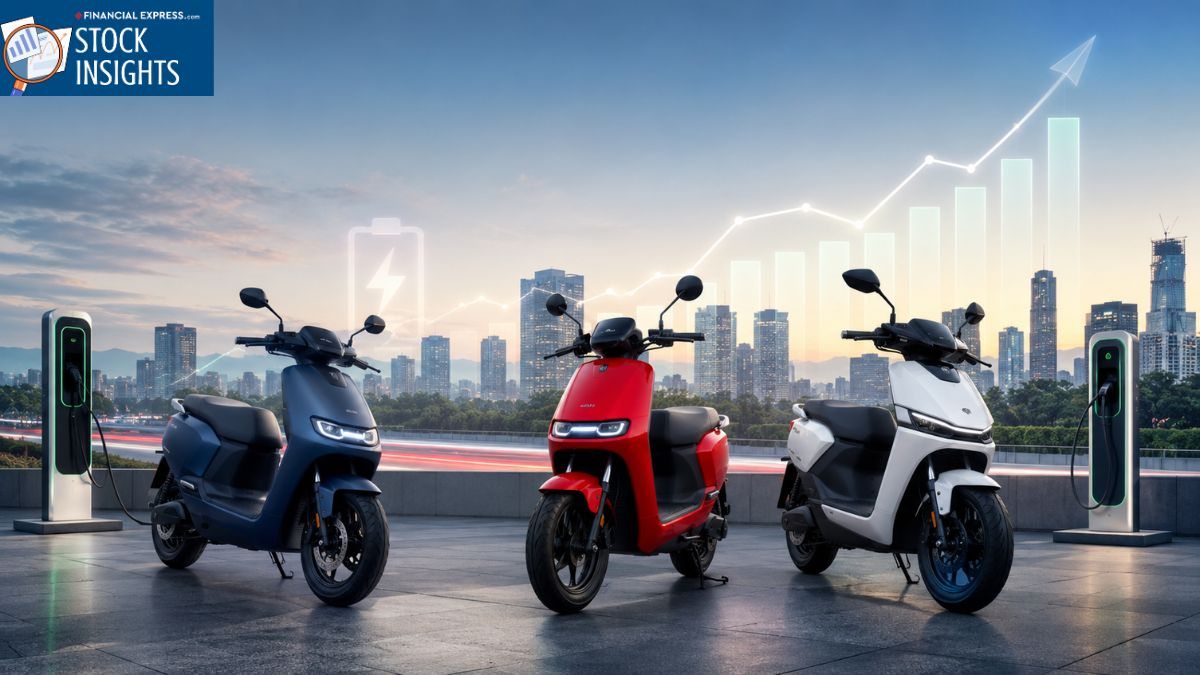
India’s electric two-wheeler (E2W) market is moving from early adoption to rapid scale-up.
What was once a niche segment is steadily becoming a meaningful part of the country’s automobile industry. E2W sales increased by 22% from around 11.5 lakh units in FY25 to over 14 lakh units in FY26. During the same period, market penetration improved from 6.6% of total 2W sales, up from 6.2% in FY25.
The strong growth has carried into FY27. E2W sales crossed 5.3 lakh units by the end of June 2026. This means the industry has already achieved nearly 38% of FY26’s total sales in just the first three months of the financial year. In June, E2W penetration deepened further to 10.6%.

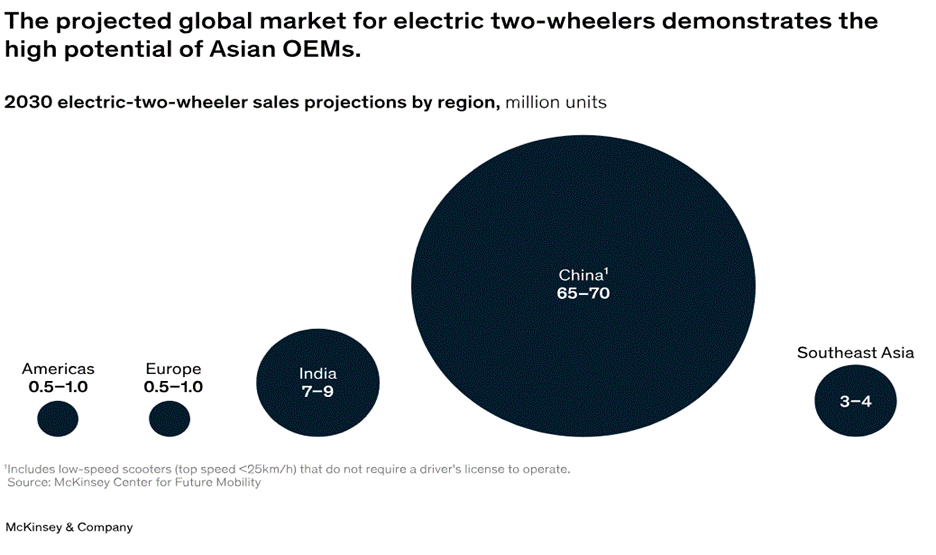
Rising EV penetration bodes well for the electric two-wheeler industry, which remains largely dominated by the top three players. The growth runway remains significant. According to McKinsey, annual sales in India could reach 70-90 lakh units by 2030, which is nearly a 5x increase from current levels. This creates a multi-year opportunity for leading manufacturers.
According to Kearney, E2W could account for around 30% of new two-wheeler sales by 2030. Falling battery costs, lower running expenses amid high fuel prices, expanding charging infrastructure, new model launches, and supportive government policies are driving this shift.
Three leading manufacturers remain well-positioned to capture this demand.
#1 TVS Motors: The Market Leader Scaling for the Next Phase
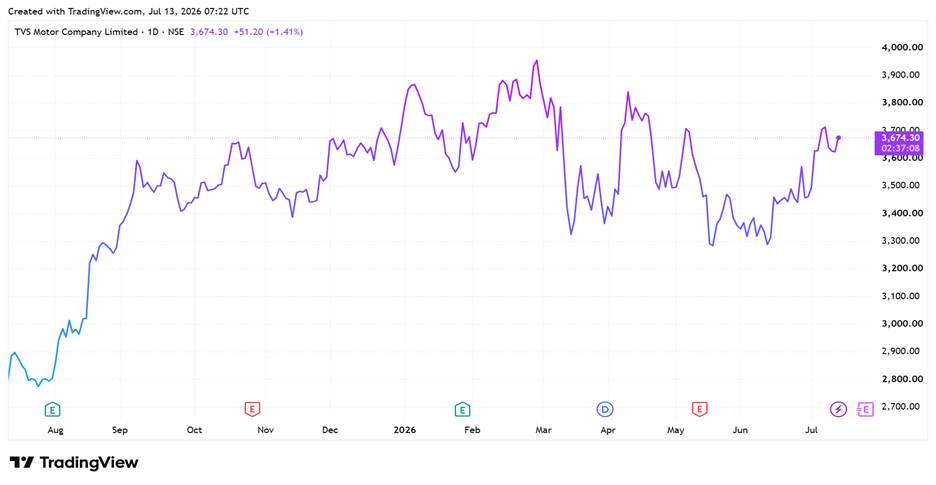
TVS Motors, part of the TVS Group, is the world’s third-largest two-wheeler (2W) manufacturer. The company sold 58.9 lakh vehicles in FY26, up 24% year-on-year; delivered 30% revenue growth; achieved an EBITDA margin of 12.9%; and net profit of ₹3,615 crore, up 37%.
The EV Growth Engine: Why Scooters Drive 38% of TVS’s Portfolio
The company was the #1 player in the E2W market during FY26. Its EV sales growth outpaced the broader industry during FY26. E2W sales surged 32.1% to reach a record 3.7 lakh units during the year, up from 2.8 lakh units in the previous year.
Management projects that the E2W segment will continue to perform well in India. Currently, scooters (including EVs) make up about 38% of TVS’s portfolio. TVS expects this share to grow past 40%. The robust sales translated into around ₹5,000 crore from the EV business in FY26, accounting for 10.6% of the total revenue of ₹47,270 crore.
Production Scale & Supply Chain Run Rates
To sustain this growth, TVS has rapidly scaled its production capabilities. The company averaged 30,000-32,000 EV units per month in FY25 and has since scaled to 40,000. The production run rate is expected to reach 50,000 EVs per month. TVS has strategically diversified its EV portfolio to target different consumer demographics.
Expanding the iQube Portfolio and Battery Offerings
The company’s leading electric scooter is leading EV adoption for TVS. It has secured a customer base of 900,000+ Indian riders. The iQube portfolio now offers 5 specialized variants. This includes the 2.2 kWh variant (94 km range), 3.1 kWh variant (123 km), 3.5 kWh (145 km), 4.7 kWh (175 km range), and the premium iQube ST 5.3 kWh (up to 212 km).
Commercial Electric Mobility & Battery-as-a-Service
The company’s other product portfolio includes the TVS Orbiter range and the TVS X. Further, TVS is also present in commercial logistics, with an E3W market share of over 11%. This could be a key growth driver because E3W adoption is rising fast, with industry-wide EV (L5) penetration jumping from 22% to 32%.
To further accelerate its commercial EV ambitions, TVS has partnered with Hyundai Motors to co-create and commercialize E3W. To ease the higher upfront purchase cost, TVS launched a Battery-as-a-Service (BaaS) model. It debuted with the Orbiter V1 and is expanding across its portfolio.
This model allows customers to pay for battery usage via a subscription rather than purchasing the battery. This lowers the initial purchase price and makes premium EVs accessible. TVS has expanded its physical footprint. It now operates a network of over 1,000 EV-specific dealers and provides access to approximately 5,000 public charging touchpoints.
Global Export Strategy and Future Capex
Internationally, the company’s EV expansion is gaining momentum, especially in Asian markets. The TVS iQube has received a strong response, and TVS is now bringing the Orbiter range to these regions.
To support rising demand, the company is expanding its total vehicle production capacity by 15 lakh units, bringing it to approximately 83 lakh units. The company is investing ₹3,500 crore for this expansion. Additionally, this capex will also include investments in R&D, connected services, and software for the EV pipeline.

#2 Bajaj Auto: The Profit-Led EV Growth Story
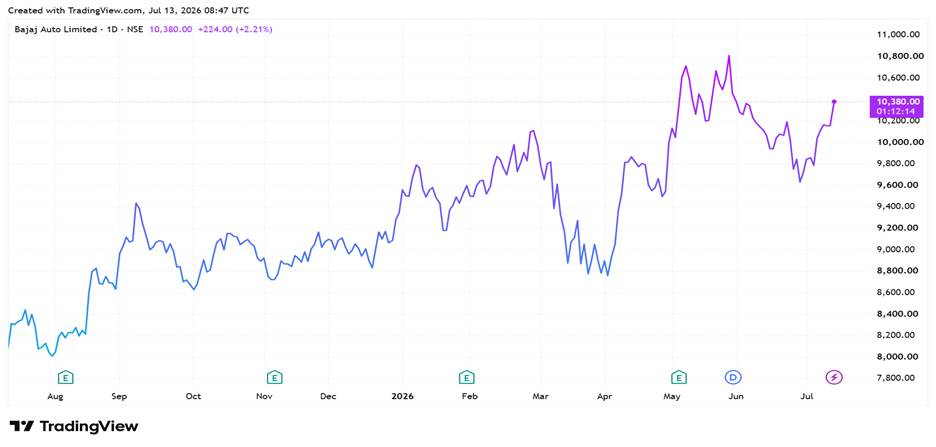
Bajaj Auto, part of the Bajaj Group, is India’s second-largest 2W company, India’s #1 motorcycle exporter, and the world’s largest three-wheeler (3W) manufacturer. It sold 51.1 lakh units in FY26 (its highest ever), including 43.1 lakh 2W units and 8 lakh CV units. The company’s revenue grew 17.4% in FY26, while margins stood at 20.5% and net profit surged 20.5% to ₹9,825 crore.
Record FY26 Volumes and Financial Performance
The EV segment, in which it had a 20.7% market share in FY26, has become a key growth driver. The EV portfolio now generates over ₹8,000 crore in revenue, accounting for 13.6% of the ₹58,732 crore in revenue. In domestic sales, the EV business now accounts for over 20%. The EV business overall became profitable and achieved a double-digit margin in FY26, as the Chetak scooter’s unit economics improved.
The EV Growth Engine and Chetak’s Resurgence
The Chetak brand recorded its best annual performance in FY26, generating revenue of ₹4,000 crore. Domestic sales grew 16% year-on-year to 302,674 units, helping it surpass 700,000 sales since its inception. To further streamline its footprint, Bajaj launched the Chetak C25. Bajaj expects to rapidly increase Chetak’s market share with this launch.
Expanding International Footprint and Capacity
Chetak’s retail presence expanded to over 500 exclusive experience centres and is shared across 3,000+ motorcycle stores in over 850 cities. Furthermore, Chetak expanded into international markets in Q4FY26, with initial exports to Sri Lanka, the Philippines, and Nepal. The company is looking to expand its current monthly production capacity of 50,000 units to meet demand.
Dominating the Electric Three-Wheeler (E3W) Market
Further, Bajaj Auto leads the E3W market with 33.5% market share. Bajaj is also facing capacity constraints in its E3W segment. To address this, it is actively expanding manufacturing capacity, particularly for its larger-format electric three-wheelers (such as the WEGO 7 and 9 series).
Bajaj also forayed into the e-rickshaw (L3) category by introducing the Riki brand in July 2025 and the E-Kart in December 2025. The business has already expanded into more than 100 cities. Management sees strong market potential in the industry that can clock almost 30,000 units a month.
FY27 Guidance and Future Capex
Looking ahead, Bajaj Auto plans to invest ₹500 crore in FY27, with ₹250 crore earmarked for the EV business. The company projects that the EV business will not only sustain but also accelerate its growth.

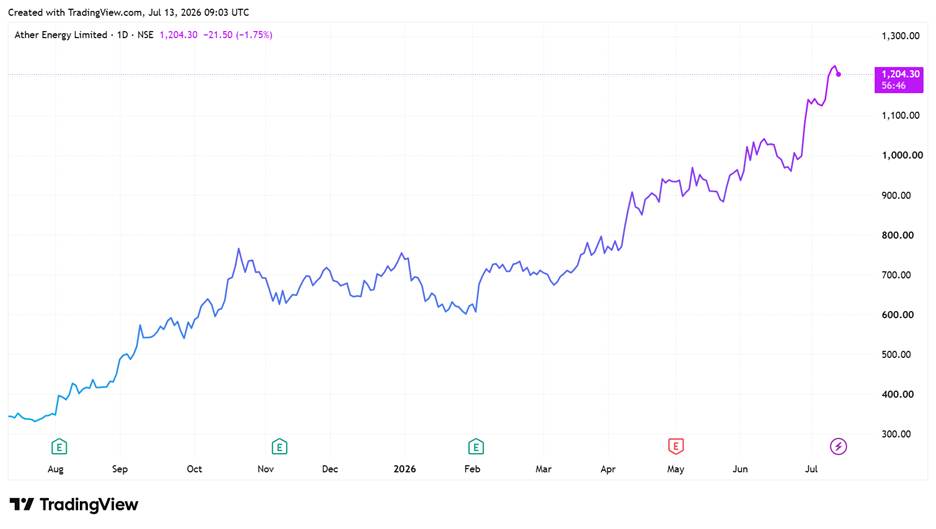
#3 Ather Energy: The Challenger Expanding Beyond the Premium Segment
Ather Energy is a leading Indian E2W company with 17.4% market share in FY26. It achieved this through a targeted regional strategy. Ather focused heavily on Middle India, comprising states like Gujarat, Maharashtra, Odisha, Madhya Pradesh, and Chhattisgarh. Ather’s market share in Middle India has more than quadrupled to 17.3%.
Revenue Surge and Margin Expansion in FY26
Revenue grew by 62.8% year-on-year to ₹3,672 crore, driven by the sale of 263,000 units, up 69%. In the revenue mix, new vehicle sales accounted for 87% of revenue, and non-vehicle sources accounted for 13%. The margin also improved as the cost of goods sold per unti reduced 9% to ₹110,199.
As a result, EBITDA margin improved to -6.7% from -24% in FY25, driven by operating leverage. Consequently, net loss narrowed to ₹517 crore, down from a loss of ₹812 crore in FY25. Its Rizta family scooter accounted for nearly three-quarters of total sales. To deepen growth, it also launched the high-end 450 models. Ather’s software and ecosystem strategy are also helping margins.
The company added 349 new experience centres, bringing the total to 700 by March 2026. About 75% of these new stores were opened by existing dealer partners, showing strong market confidence. Going forward, new store expansion is expected to continue at the current pace.
Furthermore, Ather’s service network doubled to 548 service centres nationwide. To sustain market momentum, Ather is expanding its product portfolio and expanding capacity.
Breaking into the Mass Market with the ‘EL’ Platform
Ather’s key growth lever in the near future is the introduction of its new “EL Scooter Platform”, scheduled for launch around the festive season before the end of the year. Currently, Ather dominates the premium and mass-premium EV segments (above ₹1.25 lakh) but has zero presence in the mass market (₹1.00-1.25 lakh).
Scaling Capacity: Factory 3.0 Expansion
The mass segment accounts for 45-50% of the E2W industry. The EL Scooter Platform portfolio aims to capture this market segment. Moreover, with 35,000 units per month, the Ather Hosur plant is currently operating at 90-95% utilisation. To manufacture the EL platform and sustain growth, the company is building Factory 3.0 in Chhatrapati Sambhajinagar.
This is Ather’s largest manufacturing plant to date, with a planned annual production capacity of 10 lakh units. The capacity will be added in two phases, with 5 lakh units in each phase. Trial production for phase I is expected to begin in Q3FY27. It will add an incremental capacity of around 42,000 units per month.

Here is a summary of where these three players stand in the E2W industry.
| Particulars | TVS Motor | Bajaj Auto | Ather Energy |
| FY26 E2W Sales | 3.7 lakh | 3.0 lakh | 2.6 lakh |
| YoY Volume Growth | 32.1% | 16.0% | 69% |
| FY26 Market Share | #1 | 20.7% | 17.4% |
| Key EV Brand | iQube | Chetak | Rizta & 450 |
| EV Revenue | ₹5,000 crore | ₹8,000+ crore | ₹3,672 crore |
| Key Growth Trigger | Capacity expansion | EV profitability | Factory 3.0 + EL platform |
Indeed, TVS Motor continues to lead in volume, followed by Bajaj Auto and Ather, which is growing very fast.
Structural Valuation: Returns Analysis vs Peer Averages
Bajaj Auto has a higher Return on Capital Employed (ROCE) and Return on Equity (ROE) than TVS Motors. Ather is currently loss-making, so data is not available. Thus, for better valuation assessment, we have used the price-to-sales (P/S) multiple.
Accordingly, all three companies trade at a premium to the industry’s median P/S multiple. TVS Motor and Bajaj Auto also command a premium to their respective five-year historical average valuations.
| Peer Comparison (X) | ||||
| Company | Price-to-Sales Multiple | Return Ratios | ||
| Company | 5Y Median | ROCE (%) | ROE (%) | |
| TVS Motors | 3.1 | 2.6 | 17.4 | 33.6 |
| Bajaj Auto | 4.6 | 4.3 | 28.2 | 29.2 |
| Ather | 12.4 | NA | NA | NA |
| Industry | 3.8 | NA | 15.3 | 24.0 |
To conclude, with E2W sales already exceeding 5.3 lakh units in Q1FY27 and penetration reaching 10.6% in June, the industry’s growth is accelerating. As annual volumes move towards an estimated 70-90 lakh units, market leadership, execution, and profitability will become increasingly important.
Add these names to your watchlist to track how the penetration progresses in the coming years
Disclaimer
Note: Throughout this article, we have relied on data from http://www.Screener.in and the company’s investor presentation. Only in cases where the data was unavailable have we used an alternative, widely used, and accepted source of information.
The purpose of this article is only to share interesting charts, data points, and thought-provoking opinions. It is NOT a recommendation. If you wish to consider an investment, you are strongly advised to consult your advisor. This article is strictly for educational purposes only.
About the Author: Madhvendra has been deeply immersed in the equity markets for over seven years, combining his passion for investing with his expertise in financial writing. With a knack for simplifying complex concepts, he enjoys sharing his honest perspectives on startups, listed Indian companies, and macroeconomic trends.
A dedicated reader and storyteller, Madhvendra thrives on uncovering insights that inspire his audience to deepen their understanding of the financial world.
Disclosure: The writer and his dependents do not hold the stocks discussed in this article.
The website managers, its employee(s), and contributors/writers/authors of articles have or may have an outstanding buy or sell position or holding in the securities, options on securities, or other related investments of issuers and/or companies discussed therein. The articles’ content and data interpretation are solely the personal views of the contributors/ writers/authors. Investors must make their own investment decisions based on their specific objectives, resources, and only after consulting such independent advisors as may be necessary.