




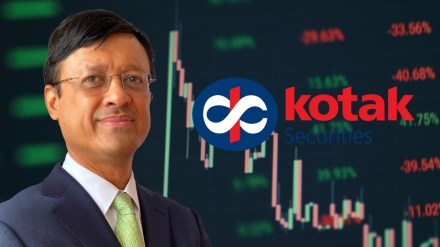
2025 hasn’t really been a standout year in terms of returns. The Nifty 50 delivered under 10% growth, and the much-anticipated earnings pickup is expected in the subsequent quarters. However, what did stand out was the IPO gold rush. Over Rs 1.75 lakh crore raised in 12 months. Sanjeev Prasad, MD, Kotak Institutional Equities, however, raised concerns about how the fund has been used. According to him, the “IPO market is being used to monetise some portion of (promoter) holding.” Speaking on the overall market, he is structurally positive and believes that the “private sector capex cycle” kicking off in a bigger way will be a key driver going forward.
As we stand at the doorstep of a brand new year, Sanjeev Prasad pointed out the gradual shift and the key drivers of growth going forward in 2026, “from a macro perspective, the big thing is when the private sector capex cycle kicks off in a bigger way. Between FY21-FY25, the drivers of the economy include high government spending, good real estate and also consumption in the past years. This time round, we could see a different story – Better numbers for the consumption story and hopefully some more recovery in private capex. That’s a clear shift going into the new year.”
Sanjeev Prasad’s 5 key market insights
He shared his outlook on the Nifty, earnings and key insights on the current IPO rush and India’s valuations compared to its peers. A look at 5 key market insights that investors can’t ignore
#1 The IPO tsunami: Asset creation Vs promoter exit
One of the most prominent developments in 2025 has been the huge IPO rush seen for the second consecutive year. Sanjeev Prasad highlighted that the total IPO size between 2021-2025 has been “roughly $110 billion”, but “the OFS part, which is straight off of a sale, is about $40 billion.” He pointed out that “all the fundraisers which have happened – it’s not as if the entire amount has gone into asset creation. Out of the $110 billion, $40 billion comprises an offer for sale. This means $70 billion is money that has gone to the company through a fresh issue of QIP. The money that has gone into the creation of new assets varies between 8-28% in the last 5 years. So, if you take an average – about 15-20%- it’s not a very high number that has gone into actual asset creation.”
He highlighted that it also indicates that “the IPO market is also being used in a way for promoters, which could be both the promoters or individual promoters, looking to encash or monetise some portion of the holding.” He added that the “same thing is happening in the secondary market. There is a huge amount of selling by the promoters and PEs.”
#2 The 2026 outlook: The big drivers
Prasad is, however, optimistic about the market going into 2026. He believes that, “at least for the next few months, the market structure looks a lot better compared to what we have seen over the last 12-18 months, where the market has not given any returns.”
He listed out 3 factors favouring this, “Firstly, we are starting to see some earnings stability after a lot of earnings downgrades over the last 18 months. Number two, FY27 earnings look better compared to FY25 and FY26, led by some recovery in domestic consumption and recovery in some sectors, which had a poor FY26, namely IT and pharma. We’re looking at, for now, about 18% growth in the net profits of the Nifty 50.”
“Third would be, probably, we are seeing the worst impact of the external part in terms of pressure on exports and continued high imports. Hopefully, that could change as and when the India-US trade deal is in place,”
According to him, another key concern is, “India has been a big underperformer with the markets. One of the reasons for the big underperformance of India is that it has no real AI story or AI play. Unlike a lot of other GEM markets, particularly China, South Korea, and Taiwan, which have a lot of AI play, some of those markets have done a lot better this year. And of course, the US itself has done very well.”
#3 The big earnings uptick: 18% profit growth?
The question then is, can this help the big earnings recovery that everyone’s waiting for? Sanjeev Prasad says he is “more confident about the earnings numbers coming through for a change.” He pointed out that even if it is “not the 18% that we’re looking at, it could still be in the ballpark of about 15% or so. This compares with about 7% for FY26. So that’s a decent recovery. And second, the more important point is that it is very broad-based.”
He pointed out that the earnings recovery is expected across sectors. “We are looking at high single-digit for sectors like IT, pharma. Low double-digit growth for sectors like consumers, paints, and banks. Mid-teens growth for banks. And even higher growth for some other sectors, such as retail, auto,” he added.
#4 The valuation bet – India ‘expensive’
However, valuation-wise, India still edges on the higher side. Prasad explained that “in terms of valuation, India would always look higher compared to most peers.” He pointed out the relative valuation of some of the Asian peers like Korea, China, Taiwan, “so India will always look expensive. So that is what has worked against India. We still have very high valuations. Now, whether their interest in Asia will continue, we will wait and see.”
#5 When will FIIs return
India’s relative valuation has also impacted the direction of foreign flows in India. He expects that “if the rupee starts coming back to some extent, that could at least take away one of the worries that foreigners have probably at this point in time. And all I can say is that at this point in time, FPIs have started to at least turn a little bit more positive from being extremely negative. And you can see that in the flow. We have seen negative flows in the market for a long time now.”
He pointed out that, “If you look at the overall FPI numbers, let’s say the last five years, we have negative numbers. If I add up all five years, $40 billion negative in the secondary market, by the way, over a five-year time frame.”
He, however, concluded on an optimistic note, expecting better returns in 2026 compared to 2025. The structural improvement is what he is betting on going forward.


