




By Surendra M Vaidya
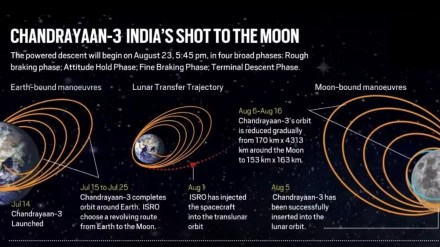
Wednesday, August 23, 2023, will be written in golden ink at 6:04 pm as Chandrayaan will make a smooth landing. This confidence comes from the stupendous work/ simulations and analysis done by team ISRO after we had a setback in Chandrayaan-2. Additional pay load capacity that we got on Chandrayaan-3 has been used to have redundancy and improved version of the landing sequence with its own AI are some of the confidence builders for this very high success probability mission.
This is our second attempt to land, and we will be the 4th country in the world to reach moon. Most important is that we are the first Nation to land on the south pole and we will be landing with the minimum cost. Visualizing and planning such missions requires expertise in many disciplines like normal Engineering, Astronomy, Physics, Chemistry, Mathematical equations and so many. There are at least 15-20 departments of ISRO, many academicians, researchers, technologist, logistic are involved and work end to end as once output is second departments input and it must be seamless.
Overall mission from the day of launch to landing for us with limited liftoff capacity takes 40-45 days and mission needs to be monitored for such a long period. Moon has no atmosphere and hence landing is in almost vacuum, makes it complex. Terrain on the Moon is rough and irregular with lots of valleys- crevices and hills. We need a flat space and less dusty to land and selection of final landing spot is decided by onboard computer based on the data fed from past record and the observations made by Chandrayaan-3 so far. However, as the Yaan will move closer, it may find some differences and hence, scientist must make lot of assumptions, hypothesis and generate corrective actions.
With such and many more complexities, we are fortunate to have a live feed today from 5:30 pm onwards of most exciting mission which is going to be for 17-18 minutes and has 7-8 important steps from making Yaan to turn by 90 degree and bring down velocity to zero as it touches the surface of the moon to achieve smooth landing. Imagine we have a bag of about 40-50 kgs and need to keep it down from our car, if we are alone, we will not be able to lift it so easily and if we attempt to lift and move surely, we will drop it on the ground. If we are landing in plane or helicopter or paragliding then we will have large wings or rotor that will make us float, but this requires air to be displaced.
On Moon since we have near vacuum such techniques does not work. So, what we are going to see is use of engines/ rockets which are like take off but have a fine-tuned controls which will be fired in the same direction of take-off and will develop thrust which is just more than gravitational force of the Moon. This is like breaking but as we know breaks cannot be applied aggressively as it will make structure of Yaan to destabilize. On the other hand, to keep Yaan rotating till if finds a right spot, we need to have a speed to generate centrifugal force. This force will keep Yaan rotating against Moon and in this direction, we cannot reach Moon as we need to come down that means change of direction is required and every turn for any vehicle is critical. So, we are going to see not only descent but also change of direction and all with small thrusters on the Yaan.
When we decide to purchase, new vehicle we always see what fuel efficiency/ tank capacity is and if we are on long journey then we plan for the stops where we can refuel. Now for Chandrayaan we have only one chance to fuel it, load all the instrument and sensors which are must for manipulating and carry one experiments once landed. Also, we know we have limited take off payload capacity and some of the fuel will be used till we reach 25-30 kms so we have a finite fuel that we can consume, and balance fuel will make us deploy the same for additional life of the Yaan.
Hence sequencing and landing is with minimum fuel so decision making must be fast, gradual, and once decent starts it must gradual like aircraft lands at just 2Deg angle. We are almost 5 kms away from airport when we are at a height of 500 mts. We will be observing this fine control today as Yaan makes a vertical landing. It is going to be like Helicopter landing with its blades rotating but in absence of air, we will be using thrust developed by hot gas by burning Fuel and Oxidiser carried from earth.
There are going to be two rockets which will ensure a balance and near straight landing as if we have a tilt which is more than what shock absorbers put in landing legs can absorb, we may land but topple and then rover to come out will be difficult as it has a ramp only in one direction and mechanism to lower the rover on the ramp.
After touch down there will be bouncing as last 10 mts it is going to be a free fall and both the engines are going to be stopped. After bouncing to make a vertical landing once again we need to have a good balance on center of gravity of the Yaan.
I hope with these insights you will be able to see these 17-18 minutes with passion and it is not going to be editing/ mixing of various videos taken at different times with several retakes. This is going to be live as it happens and thank God that we are given this chance to witness it live. On successful landing on settling of dust Magnificent Rover Pragyan will crawl on the surface of the Moon and both Lander Vikram and Rover Pragyan will take each other’s photograph to communicate us their positions and health. India with limited budget and resources but with great determination is going to successfully complete this mission and hence we all are proud of our scientist from ISRO and other R&D, Academia and industry that supports such projects of National Importance.
As an engineer once I got into Aerospace, I never asked a question “why in school and college we need to learn so many subjects which we did not use in practice as we get into professional assignments?”. I hope above justifies having all disciplines to be taught in school as it is too early for one to choose his/her discipline.
The author is Advisor – Technical, Godrej & Boyce and former Executive Vice President and Business Head, Godrej Aerospace.
Disclaimer: Views expressed are personal and do not reflect the official position or policy of Financial Express Online. Reproducing this content without permission is prohibited.


