




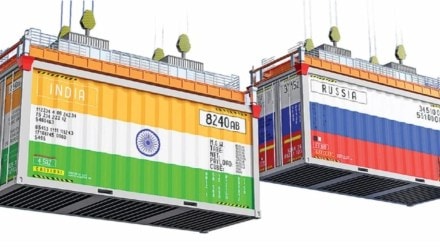
As the top leadership of India and Russia engage for a more balanced trade, the government has identified engineering goods, pharma, chemicals and agri products as sectors that will be leading the charge.
“The complementarity between India’s global export strengths and Russia’s demand profile offers significant headroom and these sectors are natural fits for expansion,” officials said.
Trade balance between India-Russia
Of the total trade of $ 68.7 billion, India’s exports are just $ 4.8 billion and imports are $ 63.8 billion leading to a trade deficit of $ 59 billion. Of the total imports from Russia, $ 56.8 billion is just oil imports. India accounts for just 2.3% of Russia’s imports.
The agenda for the two-day state visit of Russian President Vladimir Putin to India starting is mostly focussed on trade; the strategic and defence partnership continues on its own steam, another official said. During the visit Putin and Prime Minister Narendra Modi will also co-chair 23rd India-Russia Annual Summit.
Agri products present a strong promise
Agriculture products have particularly a strong promise. India currently exports $ 452 million of products to Russia against their global import demand of $ 4.0 billion.
Engineering goods exports to Russia are just $ 90 million as against its total imports of $ 2.7 billion. “This sector presents one of the widest gaps with growing room as Russia diversifies away from China,” they said.
A similar pattern is seen in chemicals and plastics show a similar pattern, with India contributing $135 million to a demand of $4.0 billion. Pharmaceuticals remain a strategic corridor too. India supplies $ 546 million worth of pharma goods to Russia while its total pharma import bill touches $ 9.7 billion, making generics and Active Pharma Ingredients (API) a significant growth lever.
Beyond these high-value sectors, India’s labour-intensive industries including textiles, apparel, leather goods, handicrafts, processed foods and light engineering holds substantial promise given Russia’s large consumer base and India’s cost competitiveness. Electronics and textiles currently have a market share below 1%, yet demand is sizeable, offering space for scale if supported by stronger distribution networks.
India–Russia trade is moving from a narrow, energy-heavy engagement toward a more layered and resilient economic relationship. The next chapter depends on India’s ability to deepen export penetration, especially in sectors where it has proven global competitiveness.


