




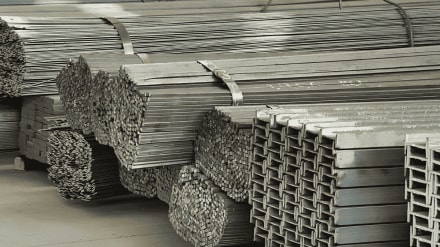
The traditional titans of the Indian steel industry, Tata Steel and Steel Authority of India (SAIL), are currently caught in a vice. Domestic steel prices have fallen by over 5% in the past quarter, according to Elara Securities. But Steel consumption continues to grow, with supply expanding faster than demand. At the same time, input costs such as coking coal have risen, preventing costs from easing in line with prices.
Research from key research firms, Kotak Institutional Equities, ICRA and Emkay Global Financial Services Research suggests that this is not a short-lived dip, but the first visible sign of deeper pressure building across the industry. What’s the road ahead then, while balancing these short-term swings with the longer-term challenges?
Here are the 9 critical forces now shaping the future of Indian steel sector demand, and what investors must watch:
1. The margin squeeze is tightening
Steel producers are being squeezed from both ends. Elara Securities notes that domestic Hot Rolled Coil prices declined about 2% month-on-month to a fiscal-year low of nearly Rs 46,750 per tonne in November 2025. At the same time, input costs have moved higher. Australian coking coal prices, a key raw material for blast furnace steelmaking, rose roughly 7% over the same period, according to Elara. This gap between selling prices and production costs has directly compressed operating margins across producers such as Tata Steel and SAIL.
2. Excess supply caps pricing power
Demand has not collapsed, ICRA continues to project steel consumption growth of about 8% in FY26, supported by infrastructure and manufacturing. The problem is supply. Elara Securities highlights that year-to-date HRC production has jumped about 13%, indicating a wave of capacity additions over the past three to four quarters. This surplus has created a hard ceiling on prices. Even when costs rise, Elara notes that the market is unable to absorb price hikes beyond Rs 500 to Rs 1,000 per tonne.
3. Tata Steel’s iron ore cliff after FY30
For decades, Tata Steel benefited from captive iron ore mines that ensured cost stability. That advantage is set to weaken sharply. Kotak Institutional Equities warns that key captive iron ore leases will expire after FY30 under the MMDR Act. Post-2030, Tata Steel’s existing leases are estimated to cover only about 31% of its iron ore requirement, forcing the company to depend on market purchases or fresh auctions, bringing uncertainty in procurement prices.
4. The auction premium risk
Those auctions are unlikely to be cheap. Kotak points out that iron ore auctions conducted over the last decade have seen a weighted average bid premium of about 120%. Paying such premiums permanently raises the cost base. While peers like JSW Steel have secured more leases to cover future needs, Kotak notes that Tata Steel and SAIL remain far more exposed to this cost reset. Depending on auction outcomes, Kotak estimates that 20–40% of Tata Steel’s EBITDA could be at risk post-FY30.
5. A Rs 4 lakh crore expansion bill
Even as margins weaken, steelmakers are committing to aggressive expansion. According to ICRA, Indian producers plan to add 80–85 million tonnes of capacity by FY31. The investment required is estimated at $45–50 billion, or roughly Rs 3.7–Rs 4.1 lakh crore. With operating profits expected to remain flat, ICRA projects industry leverage to rise to about 3.4 times in FY26, increasing balance sheet stress for large producers including Tata Steel and SAIL.
6. Europe’s carbon barrier
Export markets are becoming less forgiving. Emkay Research explains that Europe’s Carbon Border Adjustment Mechanism, or CBAM, effectively imposes a carbon-linked charge on imported steel. For Indian producers using traditional, carbon-intensive routes, this could translate into a cost of up to €222 per tonne, or nearly Rs 20,000. Elara Securities notes that after a brief export push ahead of CBAM, overseas orders have slowed as buyers reassess landed costs and compliance risks.
7. The global move to electric steel
Steelmaking itself is changing. Emkay Research highlights a structural move toward Electric Arc Furnaces, which rely on steel scrap rather than iron ore and emit far less carbon. By the end of the decade, nearly 40% of global steel output could come from EAFs. For integrated producers like Tata Steel and SAIL, this shift challenges the economics of coal-based blast furnace operations.
8. India’s scrap shortage
The transition to electric steel is constrained by raw material availability. Emkay Research estimates that India currently faces a scrap shortfall of about 10 million tonnes, which is expected to widen to roughly 15 million tonnes by 2030. As other countries retain scrap to meet their own decarbonisation targets, Indian producers are likely to face higher import dependence and sharper price volatility.
9. The rise of electrode makers
As integrated steel producers such as Tata Steel and SAIL struggle with rising costs and heavy capital commitments, a different part of the metals chain is gaining strength. Emkay Research describes the graphite electrode industry as undergoing a “Darwinian reset”, where weak, high-cost capacity has exited, leaving low-cost producers in control. This matters because graphite electrodes are essential consumables for Electric Arc Furnaces, the cleaner steelmaking route that is steadily gaining share globally. As EAF adoption rises, electrode demand increases by default. Emkay notes that Indian producers such as Graphite India and HEG are expanding at far lower capital cost than global peers. Graphite India’s debottlenecking is estimated at about $2,247 per tonne, while HEG’s brownfield expansion is near $4,869 per tonne, well below the global benchmark of $10,000–$12,000 per tonne. For steelmakers, this turns electrodes into a firmer input cost. For electrode makers, it creates pricing power.
Moving beyond steel
What’s the strategy to deal with the challenges then? Some companies are reducing exposure to steel altogether. Emkay Research notes that Graphite India has signed an MoU to invest Rs 47.6 billion in a synthetic graphite anode facility in Nashik, while HEG Greentech is setting up a 20,000-tonne anode plant. Graphite anodes are a core input for lithium-ion batteries used in electric vehicles. This links these companies directly to EV demand rather than construction-led steel consumption. The implication is straightforward. While steel earnings remain exposed to cycles, carbon costs and leverage, battery materials offer a more durable demand stream. Over time, this creates a clear split within the metals space between traditional steel producers and specialised materials companies.
The next decade will not be decided by short-term price swings, but by which companies can navigate these structural forces without breaking their balance sheets.


