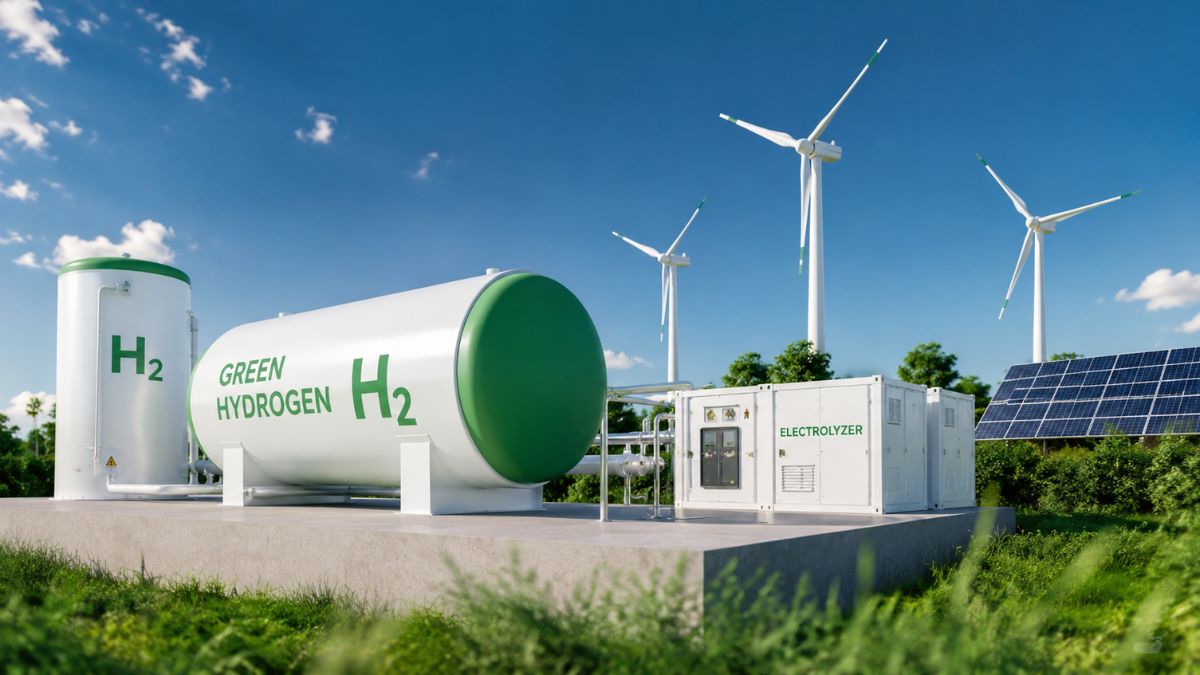
The production costs for green hydrogen are set to fall from Rs 410 per kg in 2023 to just Rs 180 per kg by 2030, less than half of what it costs today. That price drop is expected to fuel explosive growth in the domestic market, which could balloon nearly 14 times to reach $2.8 billion by 2030 from $ 0.195 billion in 2024.
To put that in perspective: India’s green hydrogen market is projected to grow at a 56% growth annually till 2030 on a compounded basis, outpacing the 36% CAGR expected for the global market through 2034. These projections are by Equirus Capital as per the July 2026 sector report.
Why green hydrogen cost will see a sharp drop
Competitive renewable energy tariffs and high solar irradiation are cited as the primary drivers behind the cost decline. The National Green Hydrogen Mission, launched in 2023 with an outlay of Rs 19,744 crore, targets annual production of at least 5 million metric tonnes of green hydrogen, 125 GW of dedicated renewable capacity, and Rs 8 lakh crore in mobilised investment by 2030.
Of the mission’s Strategic Interventions for Green Hydrogen Transition (SIGHT) scheme, worth $2.1 billion, $1.57 billion is earmarked for production support and $535 million for electrolyser manufacturing, the report noted.
Beyond SIGHT, the mission has also set aside smaller pools of capital for pilot projects and emerging technology: $175 million for pilot projects split across the transport, steel and shipping sectors, $50 million for hydrogen hubs and emerging technologies, $50 million for research and development, and $4 million for skill development, according to the report. According to the report, the mission’s broader 2030 targets also include preventing 50 million tonnes of CO2 emissions annually and generating half a million jobs.
Recent government moves have added to the momentum. Renewable energy minister Pralhad Joshi said in June that India’s non-fossil fuel-based power capacity, currently at 291.5 GW, would cross 300 GW by September, against a 2030 target of 500 GW. Later that month, the government announced plans to boost domestic manufacturing of solar and hydrogen components, including electrolysers and fuel cells, to cut import dependence.
Joshi had also noted that incentives under the SIGHT scheme have so far been awarded for 862,000 tonnes a year of green hydrogen production capacity, which is a fraction of the mission’s 5 million tonne target. Separately, industry body India Energy Storage Alliance has projected that India’s commercial and industrial energy storage market will expand from under 1 GWh in 2025 to 22-31 GWh by 2032.
Renewables dominate deal tables
Renewables accounted for a large share of both deal volume and value in the infrastructure space since 2024, the report’s transaction data shows, followed by EPC. Inox Clean Energy’s $627 million acquisition of Vena Energy’s India platform in June was among the largest deals tracked, adding 6 GW to its portfolio; the company had earlier bought Vibrant Energy from Macquarie for $200 million in January.
Other notable transactions include CPPIB’s $588 million investment for an 8 per cent stake in CtrlS Data Centres in June, and Vinci Highways’ $1.7 billion acquisition of Safeway Concessions, a road portfolio owned by Macquarie Asset Management, in April. In ports, Adani Ports and Special Economic Zone’s $2.54 billion purchase of the North Queensland Export Terminal in April 2025 ranked among the largest deals in the two-year window covered.
Average deal size in the sector climbed to $203 million in 2023 before easing to $104 million in 2024 and $115 million in 2025, even as deal volumes rose steadily; renewable energy transactions alone increased from 19 in 2020 to 49 in 2025, as per the data.
The pattern suggests capital has broadened across a larger number of smaller renewable deals rather than concentrating in a handful of large ones. An example of the same is that renewables deal value rose from $1,212 million in 2020 to a peak of $6,001 million in 2023 before settling at $5,308 million in 2025, the report’s six-year sector breakdown shows.
Alongside this private dealmaking, companies in the sector have also turned increasingly to public markets to raise funds, with the report’s data showing a sharp rise in equity issuance over the same period, particularly through infrastructure investment trusts.
Capital markets stay active
Equity fundraising in the infrastructure sector has kept pace with deal activity on the private side. Total ECM issuance rose from Rs 1,956.5 crore in 2022 to Rs 66,027.4 crore in 2024, before moderating to Rs 28,529.6 crore in 2025. Infrastructure investment trusts (InvITs) led cumulative issuance by sector at Rs 42,669 crore since 2020, ahead of renewables at Rs 32,510.1 crore, as per the report.
Among recent issuances, Adani Enterprises raised Rs 15,000 crore through a qualified institutional placement in July, while JSW Infrastructure raised Rs 7,503 crore through a QIP in June. Raajmarg Infra Investment Trust’s Rs 6,000 crore initial public offering in March was among the largest InvIT listings tracked. Renewable energy firms Acme Solar Holdings and Clean Max Enviro Energy Solutions also tapped public markets during the period.
Grid rules and asset monetisation in focus
The report flags two regulatory developments likely to influence investor sentiment. Tighter grid discipline rules for solar and wind projects, due to take effect in April 2027, will raise penalties on renewable producers who fail to meet delivery commitments. Industry estimates cited in the report suggest the new rules could cut revenue by about 11% for solar projects and as much as 48% for wind farms.
Investor presentations and industry executives cited in the report have described the rules as among the most closely watched regulatory changes in the sector, given the scale of clean energy capacity India is seeking to add over the rest of the decade.
Separately, the National Highways Authority of India kicked off its asset monetisation drive for the current fiscal year in June, inviting bids for two highway stretches in Tamil Nadu under the toll-operate-transfer model. The road transport ministry has set a target of raising Rs 30,000-35,000 crore through such monetisation in 2026-27, up from Rs 28,307 crore raised in the previous fiscal year, according to the report.
Green hydrogen growth: Key factors to watch
To conclude, the report showed that falling technology costs and sustained policy support have kept both private capital and public market issuance flowing steadily since 2024. It further noted that the tighter grid rules due in 2027, alongside the pace of highway asset monetisation this fiscal year, are likely to be the two variables worth watching most closely.
Disclaimer: This article provides factual analysis only and is not, and should not be construed as, an offer, solicitation, or recommendation to buy or sell securities. Investors must conduct their own independent due diligence and seek advice from a SEBI-registered financial advisor.