
By K Ganesh
A sense of realism was the overriding sentiment in the start-up ecosystem as 2017 drew to close. After the exuberance of 2015 when Indian internet businesses raised $8 billion, 2016 saw a marked downturn in terms of the funding environment with just $4.4 billion in investment. Although 2017 has seen a 125% increase in funding with nearly $10 billion in new investments, the number of deals (843) and companies that were the beneficiaries (827) were far lower than last year; 1,233 deals were concluded and 1,128 companies that received funding, and according to Tracxn. While early-stage funding deals halved, the lion’s share of investments were in fact snagged by those raising follow-on funds rather than early-stage cash, with Flipkart. Ola, Oyo Rooms, Paytm and Paytm Mall raising nearly $6.5 billion or ~ 60 % of the total funding raised in 2017. Companies that raised funds in 2017 had to fight hard to get the investors to loosen their purse strings with focus shifting to sustainable business models and positive unit metrics. Investors have pushed for results and execution, rather than just paper plans. In this environment, valuations and average ticket sizes reverted to 2014 levels, which is a positive for everybody. Going forward, we will see more sane behaviour from entrepreneurs/investors/angels/advisors. For entrepreneurs, there is no time like now to build solid businesses where there are reasonable valuations and expectations all around. This also means that only serious entrepreneurs will now look at starting up. The ecosystem will also benefit from having many seasoned entrepreneurs. While metros continue to grab attention, Tier-II and Tier-III cities will also emerge as strong start-up destinations. Just like FANG (FB, Amazon, NetFlix, Google-Alphabet) stocks have dominated the US stock market, India’s own FAAPO companies (Flipkart, Amazon, Alibaba, Paytm, Ola), are dominating the start-up landscape.


They have absorbed billions in investments and it is highly likely these three or four companies/ stacks will dominate everything. (In fact, this is already happening; Amazon, Flipkart, Paytm/Alibaba dominate e-commerce, Uber and Ola own taxi space, Zomato and Swiggy the food delivery space, and so on). Life is getting tougher for other start-ups to compete and survive in these spaces. The coming year should see start-ups trying to carve out new and different spaces that are not directly in conflict with these companies or work with these companies to survive and grow. You can either work with one of the stacks or find your own niche. 2018 will see a lot of action with cutting-edge technologies. While ML, AI, crypto, voice interface and fintech dominate the list, it is critical to understand technologies by themselves rarely lead to successful companies. There are too many people with a hammer (cool new technology) looking for a nail (a successful business model). But my belief is that founders should instead start with a consumer or a business problem and then use appropriate technologies to solve the problem – not be enamoured by the technology itself.
2018 should also see the return of B2C businesses. While it takes a lot of capital to build a consumer business, it is high risk. But, the effort is worth it since the payoffs are huge – exponential growth, high valuations, the chance of being the dominant brand in India etc. More recently, although VCs and founders have played it safe by focusing on B2B companies which have more linear growth, 2018 will see the return of B2C – a lot of companies building cool new products and services that are unique to the Indian market. 2018 will see the emergence of celebrity-driven companies – celebrity commerce, celebrity bots, celebrity-designed services (fitness regimen designed by John Abraham?). Celebrities are very effective in breaking through the marketing clutter. Large well-funded companies will continue using digital and mass media but for most other start-ups, celebrities and influencers will be more effective to get the word out and to build their brand.
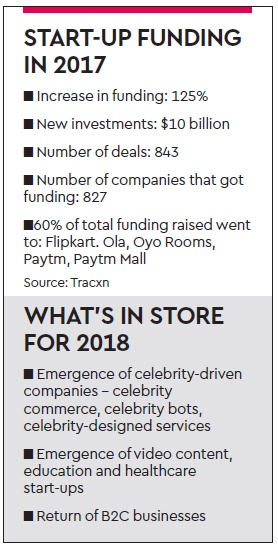

Smartphone penetration and affordable bandwidth have created millions of new internet users. Witness the explosion in YouTube users, the dominance of WhatsApp across India. While most of the new users still don’t have much purchasing power, they will consume content (think YouTube, Newshunt, and Sharechat), spend on education (think Byju’s) and communicate like crazy on WhatsApp. 2018 will see the emergence of more such companies – video content companies especially in regional languages, education companies that help students across India, healthcare companies that bring affordable healthcare to the masses…all leveraging the millions of internet users in India who are looking for ways to communicate, consume and entertain themselves. All in all, there’s plenty of action in store. But, that’s only to be expected in the start-up domain where innovation is the abiding mantra.
The writer is a serial entrepreneur and partner, GrowthStory, a venture-building platform.