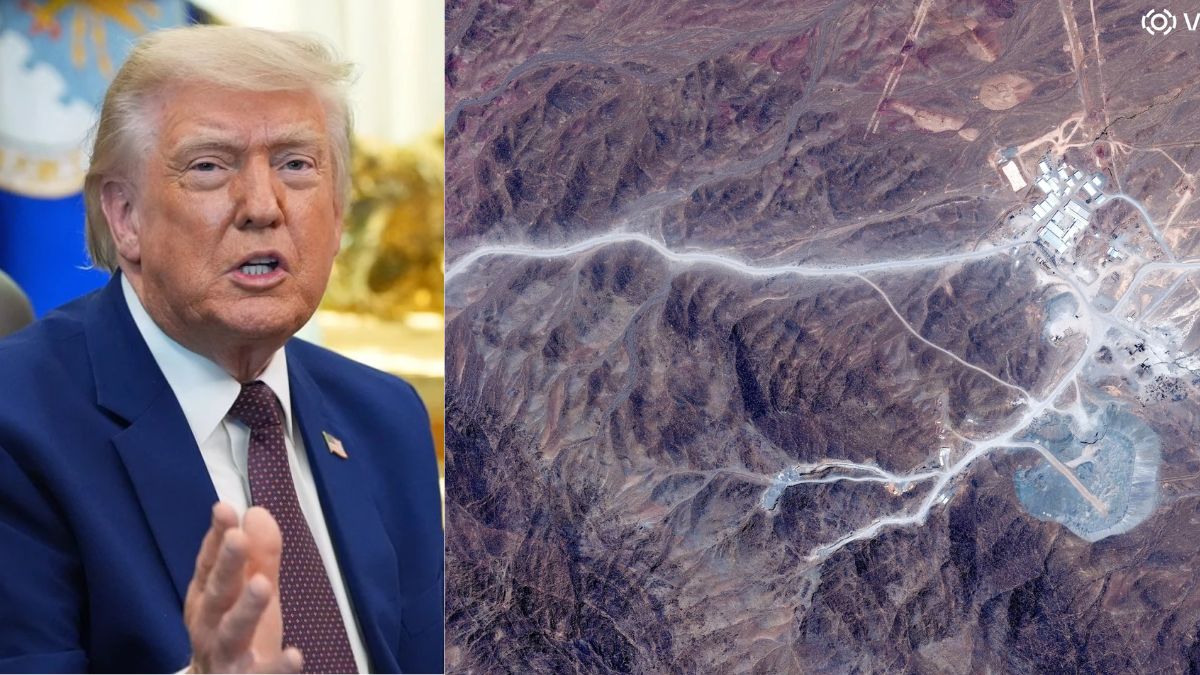
As tensions between the United States and Iran escalate once again, a little-known mountain in central Iran has become a major discussion point. President Donald Trump has repeatedly threatened to strike Pickaxe Mountain, known in Iran as Kuh-e Kolang Gaz La describing it as a key nuclear-related site that could soon face heavy US military action.
“We’ll be hitting that area very probably pretty soon, and there’s not a thing they can do about it. Normally I wouldn’t say that; if I thought they could do something about it I would never say that, but we’ll be hitting that area pretty soon, and very heavily,” Trump told reporters at the White House on Tuesday.
The focus comes even though the US and Iran signed an interim memorandum of understanding on June 17 that paused military operations and reopened the Strait of Hormuz while giving both sides 60 days to negotiate a broader agreement on Iran’s nuclear programme. The future of Hormuz, however, remains unresolved, and fresh military threats have again put Iran’s nuclear infrastructure under the focus.
A mountain beside Natanz
Pickaxe Mountain lies about 220 kilometres south of Tehran and roughly 2 kilometres from Iran’s Natanz nuclear facility, one of the country’s most important uranium enrichment centres. Natanz has been targeted repeatedly in recent years, including during the 2025 conflict and earlier rounds of US-Israeli strikes.
Unlike Natanz, however, the underground complex inside Pickaxe Mountain has never been directly attacked.
The facility is believed to be buried nearly 100 metres beneath the mountain, making it one of Iran’s deepest known underground nuclear-related projects. Analysts say its depth makes it significantly harder to destroy than conventional nuclear facilities.
Why was it built?
Construction began in 2020, shortly after an explosion at Natanz that Iran blamed on sabotage.
Following the incident, then-Iranian nuclear chief Ali Akbar Salehi announced that Tehran was constructing a “modern, larger and more comprehensive hall in all dimensions in the heart of the mountain near Natanz” to manufacture advanced centrifuges machines used to enrich uranium for nuclear fuel.
International Atomic Energy Agency (IAEA) chief Rafael Grossi later said Iran had openly indicated its intention to carry out nuclear activities at the mountain.
“This was part of their quite systematic intention to put their most sensitive facilities underground,” Grossi said in March.
What is inside the mountain?
Very little is publicly known about what exists beneath Pickaxe Mountain. As reported by Reuters, satellite imagery analysed by the Institute for Science and International Security (ISIS) shows the site has two pairs of tunnel entrances, newly completed security walls and expanded infrastructure. Recent images also suggest Iran has reinforced some tunnel entrances and partially blocked vehicle access, a move experts believe is aimed at making future attacks more difficult. Researchers believe construction is continuing, although there is no clear evidence that the underground complex has become operational.
Is it an active nuclear facility?
That remains one of the biggest unanswered questions. The ISIS think tank says the facility is still under construction and that satellite imagery alone cannot determine when it may become operational. It also remains unclear whether Iran still plans to establish a large centrifuge assembly plant inside the mountain.
The organisation says if Iran eventually rebuilds its damaged centrifuge manufacturing capability, the underground site could potentially house a smaller assembly facility capable of supporting a future nuclear weapons programme.
US intelligence, however, has publicly indicated that there is currently no visible activity at the site.
Speaking earlier this month, Trump said, “We’re watching [Pickaxe Mountain] closely. We see no activity there. They’re not doing well with their nuclear situation. Every time we hear about it, we blow it up. So they don’t like talking about it. But we’ll probably give Pickaxe a shot relatively soon.”
Why is Trump focusing on it now?
Nuclear weapons expert David Albright, founder of the Institute for Science and International Security, believes the mountain is large enough to accommodate both uranium enrichment facilities and activities related to nuclear weaponisation.
“Recently, we were told that the site was not attacked in the two previous wars because nothing of sufficient value was inside it. Perhaps that assessment has changed,” Albright wrote on X.
“But just as likely, Trump does not want to leave Iran with a deeply buried nuclear-related site, as the regime appears to be sending signals it is starting to rebuild its nuclear weapons capabilities aimed at making nuclear weapons.”
Military experts believe Pickaxe Mountain would be one of the most difficult nuclear sites in Iran to attack. Because the complex is estimated to lie around 100 metres beneath solid rock, many analysts believe it sits beyond the effective reach of even America’s most powerful bunker-buster bombs.
The ISIS think tank says the facility may ultimately be more vulnerable to sabotage or specialised ground operations than conventional air strikes, although aerial attacks using deep earth-penetrating weapons could still exploit certain structural weaknesses if they exist. Even then, assessing damage would be extremely difficult without intelligence gathered from inside the site.
Iran warns of conflict
Iran has dismissed US claims about the mountain and warned that any strike would dramatically escalate the conflict. “If the U.S. were to proceed with such an attack, it will be considered as ‘an explosion of war in the region,'” Iran’s Khatam Al-Anbiya military command said, warning that “all the interests of America, the allies and supporters” would become targets of “a powerful attack by the armed forces of the Islamic Republic of Iran.”
Iranian Foreign Ministry spokesperson Esmaeil Baqaei also rejected US allegations that the mountain houses active nuclear operations. “Washington’s obsessive focus on Kolang Kouh, where no nuclear activity is taking place, is nothing more than a fabricated pretext for aggression, destruction, and sabotage,” he said.