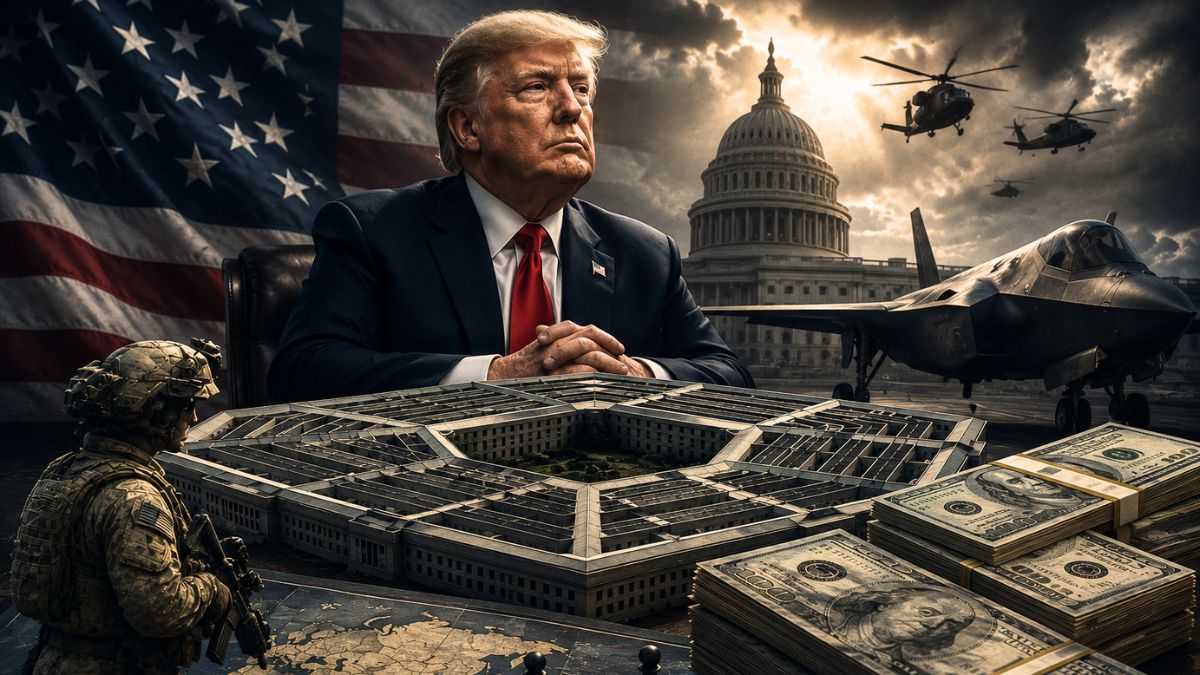
The United States is edging closer to approving a peacetime military budget nearing $1.5 trillion but the path is proving far rockier than past defense spending fights. President Donald Trump‘s ambitious Pentagon plan is colliding with a Congress reshaped by the ongoing Iran war, deficit-conscious Republicans and a Democratic caucus increasingly unwilling to back military funding without stronger oversight.
This week, the House cleared a $1.15 trillion National Defense Authorization Act (NDAA) and advanced a separate budget framework tied to financing the Iran conflict, but both votes underscored how fragile support has become. Once one of Washington’s most reliably bipartisan measures, the defense bill passed with only a handful of Democrats on board, while several Republicans broke ranks in opposition.
The fight now extends beyond dollar figures to deeper questions about how the country pays for war, how much authority Congress retains over military action and whether Trump’s proposed expansion of the Pentagon can withstand the pressures of an election year.
A record budget built around three different bills
Unlike previous Pentagon budgets, the administration’s request has been divided into multiple pieces rather than one straightforward spending package.
The White House is seeking roughly $1.567 trillion for national defense through three separate measures, a $1.15 trillion base defense budget, $350 billion through the reconciliation process that allows Republicans to bypass the Senate’s 60-vote threshold, and another $67.1 billion emergency supplemental package, much of which would pay for military operations linked to Iran.
On paper, the strategy gives Republicans several routes to deliver Trump’s defense agenda. In practice, however, each path has become politically complicated.
The House approved the defense authorization bill by 216-212, with only six Democrats supporting it while seven Republicans opposed it. It also narrowly passed a reconciliation framework by 216-214 that includes $60 billion in military funding—far below the administration’s original $350 billion reconciliation request. That reduced figure alone shows how much resistance the White House is encountering, even within Republican ranks.
The Iran war has changed the politics of defense spending
For decades, Congress has almost never failed to pass the NDAA. Defense legislation typically survives partisan disagreements because lawmakers generally separate military readiness from political fights. That consensus has weakened sharply this year.
The administration’s expanding military campaign against Iran has fundamentally changed the debate. Democrats argue Congress is approving military spending without placing meaningful checks on the White House’s use of force, while some Republicans object to increasing defense spending without offsetting budget cuts elsewhere.
The fighting itself has also grown more expensive than many lawmakers anticipated.
Following the collapse of negotiations between Washington and Tehran, US military operations resumed, with airstrikes continuing for days and tensions spreading across the region. Iran’s renewed closure of the Strait of Hormuz has disrupted energy markets, while Iran-backed Houthi rebels have threatened shipping in the Red Sea, adding another layer of regional instability.
Where exactly is the money going?
Defense Secretary Pete Hegseth recently estimated that the Iran conflict would cost about $37.5 billion through September 30, covering military pay, operations, maintenance and related expenses. But even during Senate testimony, the details remained vague.
Becca Wasser of the Center for a New American Security noted that Hegseth’s comments appeared to indicate “the war is still probably going to be going on by September 30.”
Lawmakers have also questioned whether every item included in the emergency request is actually connected to the Iran war.
Democratic Senator Patty Murray pointed to funding requests including “$800m for the national guard to patrol DC even longer,” “$1bn for the army to patrol the southern border,” and “$900m to support the administration’s illegal boat strikes in the Caribbean.”
Hegseth defended the proposal, responding simply, “Why this kind of spending is needed is because of the gross negligence and neglect of the Biden administration.”
From budget cuts to historic expansion
The most striking aspect of the Pentagon’s current budget request is how dramatically it differs from where the administration began.
Earlier in 2025, Hegseth instructed Pentagon officials to identify annual spending cuts of 8% over five years a proposal that briefly rattled defense contractors before quietly disappearing.
Today, the administration is pursuing the opposite strategy. Instead of shrinking the Pentagon, it is asking Congress for an additional $454 billion for fiscal 2027, pushing total planned military spending close to $1.5 trillion. Hegseth has described the proposal as a “generational investment.”
Congress still has unanswered questions
Adding to lawmakers’ concerns is the fact that the Pentagon has yet to fully spend money it has already received. The Defense Department obtained an additional $156 billion through last year’s One Big Beautiful Bill Act.
According to lawmakers, roughly $75 billion of that funding remains unobligated, with limited public explanation of exactly how it will eventually be used.
When questioned during Senate testimony, Hegseth acknowledged he did not have the figures immediately available, saying, “I’d have to get you the exact numbers.” That uncertainty has made several lawmakers reluctant to approve even more funding before existing appropriations are fully accounted for.
A bigger Pentagon and a different Pentagon
While traditional military procurement still dominates the proposed budget, Trump’s defense strategy also shows a shift toward technology and private-sector investment.
The administration plans to allocate $58.5 billion for artificial intelligence initiatives while directing another $20 billion to the Pentagon’s Office of Strategic Capital, which finances defense-related private investment projects.
At the same time, the White House says it has identified $1.6 billion in savings by eliminating diversity, equity and inclusion programmes, presenting those cuts as part of its effort to reduce what it describes as unnecessary government spending.
An uncertain road ahead
The Senate has yet to advance its own defense appropriations package, and several analysts quoted in the source material believe the original $350 billion reconciliation request is unlikely to survive. Todd Harrison of the American Enterprise Institute summed up the unusual situation, “It’s really a mess. Like, an unprecedented level of mess.”
It captures a transformation in Washington’s approach to national security spending. What was once one of Congress’s most predictable annual exercises has become intertwined with the politics of an ongoing Middle East war, budget deficits, election-year calculations and growing questions about executive military power.