




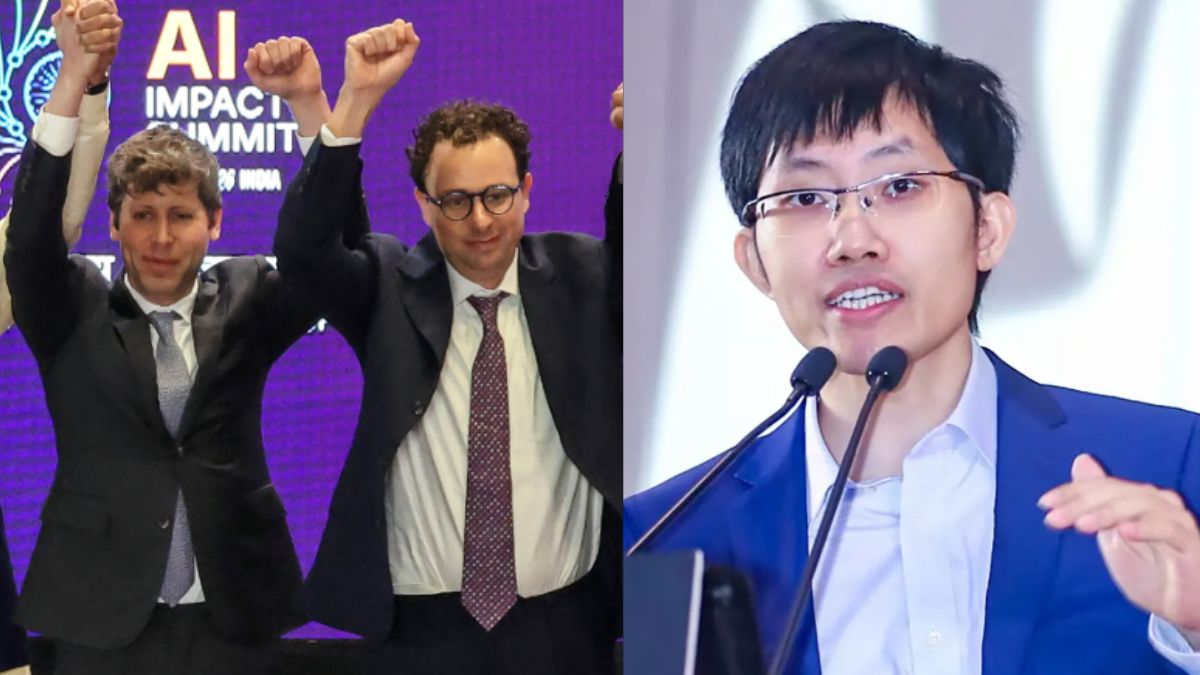
One would think that the brains behind the top rivalling artificial intelligence startups on the rise, Anthropic and OpenAI, are the richest AI founders in the world. Shockingly, neither Dario Amodei nor Sam Altman make the cut. Ironically, OpenAI’s Samuel Altman is actually far behind in that race; Bloomberg’s Billionaires Index does not even list him among the Top 500 richest people.
Although the ChatGPT maker’s co-founder and president, Greg Brockman, still rounds out that the Top 100 billionaires tally, Chinese AI rival DeepSeek founder Liang Wenfeng easily left all these names behind this week.
Thanks to a recent company funding round, the Chinese entrepreneur celebrated a two-fold boost in his net worth, which has risen from $16.7 billion to $36 billion, according to the Bloomberg Billionaires Index. The fortune boom helped Liang climb to No 67 on the business site’s rankings, placing him well above fellow creators of AI models.
Bloomberg’s latest net worth comparison restricts the analysis to companies whose primary business and majority of revenue come directly from artificial intelligence. Therefore, it excludes even other businesses in the AI supply chain (data centres and semiconductors), ruling out Big Tech founders such as Tesla and SpaceX’s Elon Musk, Google’s Larry Page, Amazon’s Jeff Bezos, Meta’s Mark Zuckerberg and Nvidia’s Jensen Huang from the race.
Understanding DeepSeek founder Liang Wenfeng’s net worth boost
According to Bloomberg, the 41-year-old founder of China’s DeepSeek is now worth $36 billion (Forbes estimates his net worth is $11.5 billion). Liang Wenfeng’s controlling stake in the company is largely responsible for the staggering rise of about $19 billion in his fortune.
In a June 2026 funding round, the Chinese AI company raised more than $7.4 billion at a valuation of about $50 billion. Liang is believed to have invested $3 billion in that particular round, which, in turn, diluted his stake to 78%, Bloomberg reported.
After graduating in 2007, Liang pursued artificial intelligence applications in finance. Thus, his first investment firm followed in 2013. The Chinese AI founder subsequently co-founded the Ningbo High-Flyer Quantitative Investment Management Partnership in 2016, where he also used AI to build a fortune. Upon DeepSeek’s establishment in 2023, Liang announced he intended to develop human-level AI.
Merely two years later, his company managed to launch its low-cost R-1 model. The advancement put the company on par with industry leaders like OpenAI.
Although previously using Nvidia and Huawei chips, the Chinese startup is believed to be developing its own AI chip, according to an early July report by Reuters. The ambitious switchover has inevitably put Silicon Valley on edge as it could help consolidate China’s position as an AI champion and reduce international reliance while also posing additional challenges for Chinese tech giant Huawei.
Even DeepSeek’s cutting-edge and low-cost R1 model released last year sparked frenzy in Silicon Valley about whether better-sourced US AI companies, including Anthropic and Meta, can stay on top of the competitive race.
Where do the other AI model creators stand on the billionaires tally?
Leaders of the eventually IPO-bound US companies, Anthropic and OpenAI, stand at significantly lower positions on the Bloomberg Billionaires Index. OpenAI President Greg Brockman (No 100) is estimated to have a net worth of $25.5 billion; Anthropic’s Dario Amodei’s (No 491) fortune stands at $7.98 billion.
OpenAI CEO Sam Altman, on the other hand, is way behind with an estimated $3.4 billion net worth, according to Forbes’ real-time rankings.


