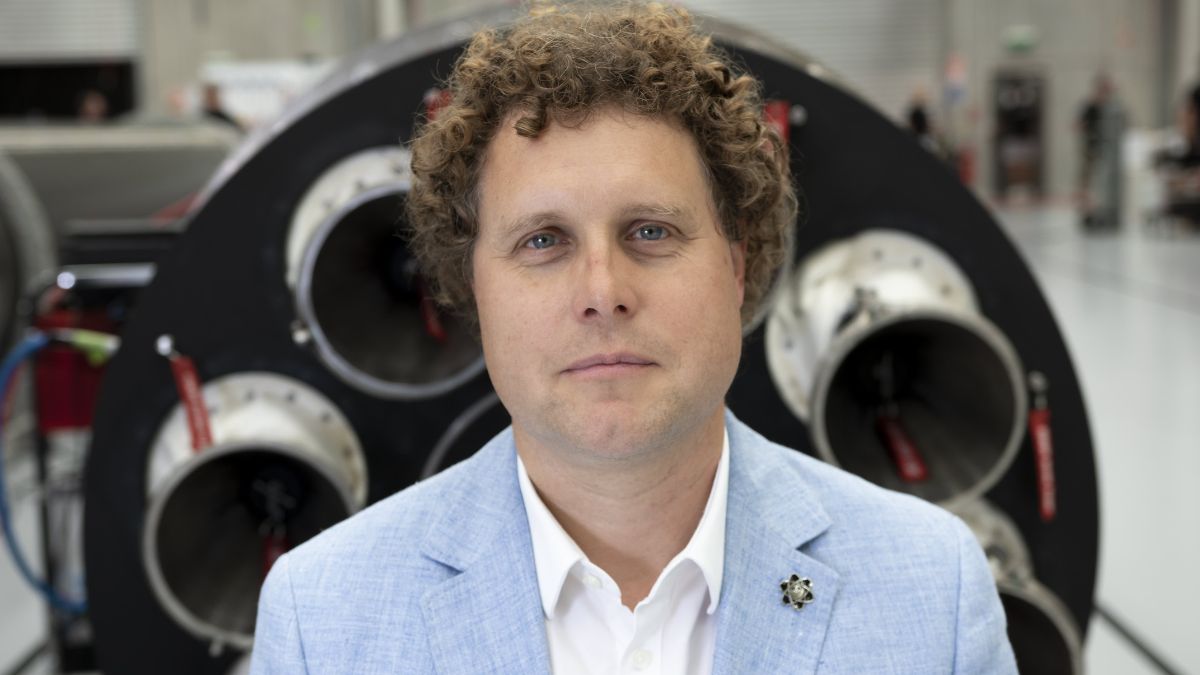
At the southern tip of New Zealand’s South Island lies Invercargill, a city known more for sheep farms than rockets. It is an unlikely birthplace for one of the world’s most ambitious space entrepreneurs.
As a teenager, Peter Beck spent his days taking apart the family’s Mini, rebuilding it with a homemade turbocharger, and experimenting with water rockets and jet packs in his parents’ garage. His father was a museum director and gemologist, his mother a schoolteacher, but Beck’s fascination was always with machines that could fly.
Four decades later, that same curiosity has turned into Rocket Lab, one of the world’s leading private space companies and one of the few firms attempting to compete in an industry dominated by Elon Musk‘s SpaceX and Jeff Bezos’ Blue Origin. That enabled him to be a billionaire. Forbes’ real-time tracker puts Peter Beck’s net worth at $4 billion.
A founder who skipped university but not his dream
Unlike many leaders in the aerospace industry, Beck never attended university. He began his career in 1993 as a tool-and-die apprentice at appliance manufacturer Fisher & Paykel before moving to a government research institute, where he worked on advanced composite materials.
By his own account, he repeatedly failed to secure jobs at NASA or Boeing because he lacked a formal engineering degree. Rather than abandoning his ambition, he decided to build his own space company.
In 2006, at just 29 years old, Beck founded Rocket Lab in Auckland after spotting a gap in the market. Satellites were becoming dramatically smaller and cheaper, but the rockets launching them remained large, expensive and inefficient.
Rocket Lab shifted its headquarters to California in 2013, giving the company easier access to customers, talent and investors. Eight years later, it went public through a SPAC merger that valued the company at roughly $4.1 billion, with Beck remaining both chief executive and chairman.
Rocket Lab has grown into a global space company
Nearly two decades after its founding, Rocket Lab has evolved far beyond a startup. Its Electron rocket has become the world’s most frequently launched dedicated small orbital rocket, making Rocket Lab the third most active orbital launch provider globally, behind only SpaceX and China’s state-backed launch programme.
By mid-2024, Electron had carried nearly 200 satellites into orbit across more than 50 missions, a launch pace Beck has described as one of the fastest ever achieved by a private space company.
The business has also expanded well beyond rocket launches. Today Rocket Lab designs satellites, manufactures spacecraft components and develops complete space systems for commercial and government customers.
Among its biggest projects is a contract worth more than $500 million from the US Space Development Agency to build missile-tracking satellites. The company is also involved in the United States’ “Golden Dome” missile defence programme.
Rocket Lab generated roughly $600 million in revenue during 2025 and now employs between 2,000 and 2,500 people across the United States, Canada and New Zealand.
Beck still owns close to 10% of the company. Depending on Rocket Lab’s fluctuating Nasdaq share price, the company’s market value has ranged between roughly $15 billion and $23 billion over the past year, while estimates of Beck’s personal fortune have varied from around $3.7 billion to more than $6 billion.
Neutron is the rocket that could change everything
Neutron is designed to carry up to 13,000 kilograms into low Earth orbit, placing it firmly in the same category as SpaceX’s Falcon 9 and making it Rocket Lab’s most ambitious project to date.
The 43-metre reusable rocket will use the company’s methane-fuelled Archimedes engines and is central to Rocket Lab’s plans to compete for larger commercial, government and national security missions.
But Neutron has faced repeated delays.
During an investor call in late 2025, Beck confirmed that the rocket’s first launch would slip into 2026 as engineers completed qualification testing. By mid-2026, the vehicle had reached Rocket Lab’s new launch complex at Wallops Island, Virginia, where integrated testing was underway while engine qualification continued at NASA’s Stennis Space Center.
Beck has repeatedly insisted that Rocket Lab will not rush the programme simply to claim an early milestone.
“You won’t see us minimising some qualifier about us just clearing the pad and claiming success,” he told investors, making clear that Rocket Lab’s goal is not merely to launch but to prove the rocket can operate reliably and be reused.
Taking on billionaires with a fraction of the resources
Beck has never claimed the competition is equal. “Some of our competitors have essentially infinite capital to burn,” he said in an interview with the New Zealand Herald, acknowledging the enormous financial advantage enjoyed by Musk and Bezos.
Even so, he has consistently rejected the idea that the rivalry is hostile.
In a July 2026 interview, Beck described SpaceX as a “friendly rival” and pointed out that Rocket Lab has survived while more than 100 competitors that once pursued the same market have disappeared.
Industry analysts broadly agree that Rocket Lab’s opportunity lies not in matching SpaceX dollar for dollar but in carving out profitable markets where a smaller, more focused company can compete effectively.
Bloomberg recently noted that Rocket Lab is steadily “ratcheting up its SpaceX challenge,” while Aerospace America argued that the company’s strategy reflects what is realistically achievable without the backing of the world’s richest individuals.
Delays, lawsuits and growing confidence
The journey has not been entirely smooth. In March 2025, shareholders filed a class-action lawsuit alleging Rocket Lab and Beck had misled investors about Neutron’s development schedule. A US District Court judge dismissed the case later that year.
Operationally, however, confidence in the company has continued to grow.
In May 2026, Rocket Lab announced the largest launch agreement in its history, securing a contract covering five Neutron launches and three Electron missions between 2026 and 2029. The deal effectively signals that customers believe the delayed rocket will soon be ready for service.
Becoming Sir Peter Beck
Recognition has also arrived at home. In 2024, Beck was appointed a Knight Companion of the New Zealand Order of Merit for his contributions to the country, becoming Sir Peter Beck. He had earlier been named New Zealander of the Year.
Beck has spoken openly about New Zealand’s so-called “tall poppy syndrome,” the tendency to criticise people who become highly successful. It is something he says he has personally experienced while building Rocket Lab into a global company.
Perhaps surprisingly for someone leading dozens of rocket launches, Beck admits launch days are among the most stressful moments of his life.
Rather than sitting in mission control, he often watches launches from his office.
“They’re not for fun,” he has said, describing the anxiety that accompanies every mission despite Rocket Lab’s growing experience.
Telling Rocket Lab’s own story
In late 2025, Rocket Lab published The Launch of Rocket Lab, a richly illustrated history written by New Zealand journalist Peter Griffin with an introduction by Beck.
The 300-page book traces the company’s journey from a garage startup to a Nasdaq-listed aerospace manufacturer. Reviewers have noted its unusually informal style, with employees referred to by first names rather than titles, reflecting the company’s culture.
The book also embraces the same narrative that has followed Beck for years, the underdog entrepreneur from rural New Zealand building a company capable of challenging the world’s wealthiest space founders.
The next chapter depends on Neutron
For all of Rocket Lab’s achievements, analysts agree the company’s next defining moment still lies ahead.
Electron has established Rocket Lab as a reliable launch provider. The company has diversified into satellites, defence contracts and spacecraft manufacturing. It has secured billion-dollar opportunities and built relationships with some of the world’s largest government agencies. But Neutron remains the missing piece.
A successful debut would move Rocket Lab into direct competition for the heavy-lift missions that have long been dominated by SpaceX, bringing Beck’s ambition of becoming a genuine third force in commercial spaceflight much closer to reality.
Until then, the company has the contracts, the credibility and the underdog story. What it does not yet have is the rocket capable of fully delivering on the comparisons with Musk and Bezos.