




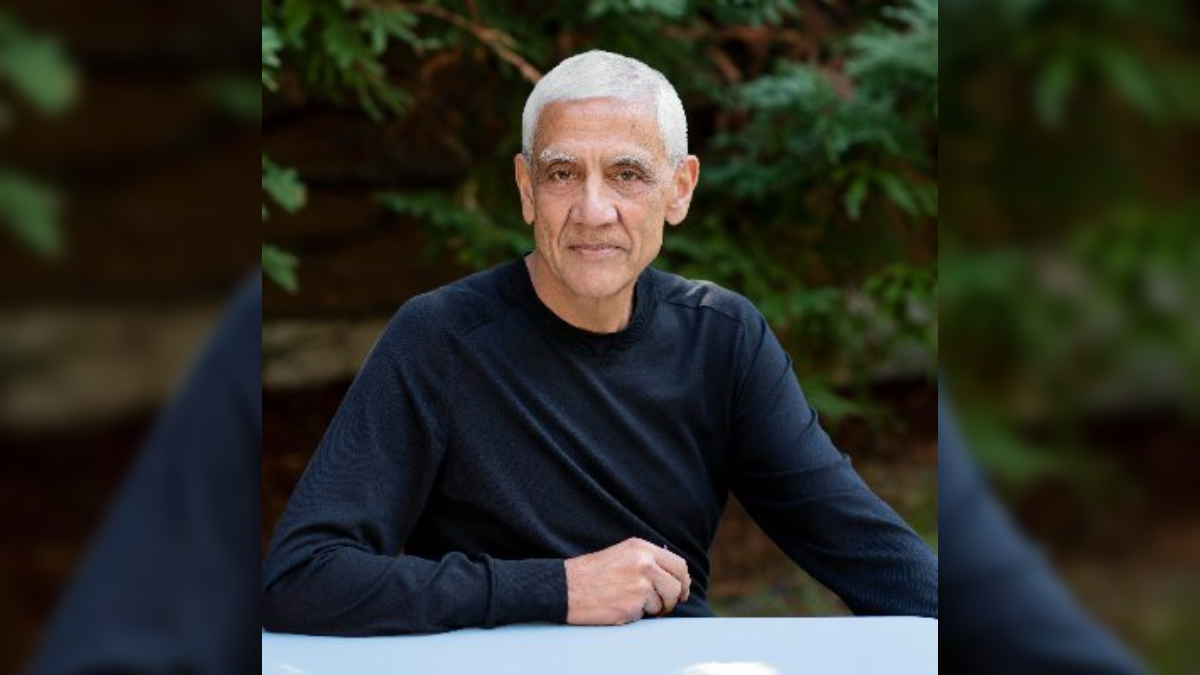
Early venture capital investments in software and technologies contributed to the billionaire status of Indian-origin Vinod Khosla, who is the co-founder of Sun Microsystems and the founder of Khosla Ventures. This past week, Forbes ranked him atop its 2026 Midas List, positioning him as the world’s best venture capital investor of the year. From Pune to the United States, Khosla continues to bask in the glory of his own highest-ranked fame among 100 people—something that hasn’t just been a long time coming but is also a repeat of a 2001 marvel.
This is not the first time the 71-year-old IIT graduate has claimed the top spot on Forbes’ Midas List, which launched in 2001. Just like his triumphant victory in 2026, Khosla stood atop the inaugural list at the time, too, as a then Kleiner Perkins partner. The 2026 victory also marks his overall 19th appearance on the list.
With OpenAI marked as his “Notable Deal,” the Khosla Ventures boss, currently based in Portola Valley, California, is also one of the 17 Indian-American venture capitalists to earn a spot on the Forbes 2026 Midas List.
Although the venture capitalist has his own early bets on “startups building the infrastructure that underpinned the early internet” to thank for his rise in the industry, the most notable check of all remains the one he wrote for OpenAI in 2019, when Sam Altman’s AI giant was still just a not-for-profit research organisation.
How Vinod Khosla became the world’s best venture capitalist
The self-proclaimed “entrepreneurship zealot” holds a Bachelor of Technology in Electrical Engineering from the Indian Institute of Technology (IIT) Delhi, a Master’s degree in Biomedical Engineering from Carnegie Mellon University, and an MBA from the Stanford Graduate School of Business. Khosla’s education at these high-profile schools across borders paved the way for his professional career, as he co-founded Sun Microsystems in 1982.
However, this startup also traces its roots back to a preceding venture, Daisy Systems, which Khosla co-founded after his MBA at Stanford. At the time, his team at Daisy ended up spending 80% of their resources building custom computer hardware to run Computer-Aided Design (CAD) software. The move ultimately inspired the Indian-born businessman to create Sun Microsystems, which made the general-purpose computers Daisy Systems needed.
Four years after co-founding Sun Microsystems with Scott McNealy, Andy Bechtolsheim, and Bill Joy, Khosla joined the venture capital firm Kleiner Perkins, aspiring to become a “venture assistant” to help other entrepreneurs start their companies. He spent 18 years at the firm before setting the launchpad for his own fund.
In the lead-up to establishing Khosla Ventures in 2004, the venture capitalist led wide-ranging investments. “Nexgen, the only successful clone of the monopolistic Intel microprocessor, was sold to AMD for just under 30% of their public market cap. Starting in 1994, I mentored the founders of Excite until the company’s sale to @Home for $7B,” he shared his story on LinkedIn.

Then, in the early days of the internet, he invested in Google and Amazon while focusing on telecommunications and fiber optic networking. Detailing his journey ahead, Khosla admits on LinkedIn, “I incubated Juniper Networks – one of the largest venture returns ever – with a $3M investment earning $7B (2500x), invested in Cerent (acquired by Cisco for $8B) and Siara Systems (acquired by Redback Networks for $4.3B).”
Finally, it was time to invest in more science-based experimental technologies that could be both profitable and have a social impact. After starting Khosla Ventures, he invested in climate, with early investments in LanzaTech, QuantumScape and Mainspring; food, emerging as the first investor in Instacart, DoorDash, and Impossible Foods; fintech with early investments in Square, Stripe, and Affirm, and other areas, including health and robotics.
Underscoring their investment thesis, Khosla went on to pen “Reinventing Societal Infrastructure with Technology” in 2018, positing that one “technology with outsized force multiplication is AI.” Consequently, his company became the first check into OpenAI in 2019. He confessed to having been “incubating and investing” in artificial intelligence categories with “promise to positively impact humanity” since then.
Vinod Khosla became OpenAI’s ‘white knight’
Describing himself as a “technology optimist,” Khosla believes that “entrepreneur instigators,” who “are willing to try (and fail) but not fail to try… to make the impossible happen” are responsible for creating abundance for all while addressing our most pressing challenges. It is this same set of beliefs that led Vinod Khosla to emerge as OpenAI’s first VC bet after Elon Musk walked out.
Shedding light on the high-stakes investment, Khosla once told Fortune that his decision to bet on OpenAI in 2019, which had no commercial model at the time, set the stage for the largest initial check he’d written in 40 years. Backing the Sam Altman-led company with a $50 million check for a 5% stake at a $1 billion valuation, Khosla even had to pen an apology letter to leadership, admitting he was entering a deal despite how “foolhardy” it looked.
Cut to 2026, Khosla’s estimated net worth is now nearly $15 billion (Forbes). Meanwhile, OpenAI, the company for which he put his reputation on the line, is valued at $852 billion as of March 2026, following a record-breaking $122 billion funding round.
Celebrating his triumph of being honoured as the world’s best venture capital investor of the year, Khosla wrote on social media, “25 years ago was the first time I appeared on the Forbes Midas List. The technologies change. The game doesn’t. Most important breakthroughs look unreasonable at first, until entrepreneurs make them inevitable.”
Indian Americans on the Forbes Midas List 2026
In collaboration with TrueBridge, Forbes’ months-long, painstaking process to produce rankings for the Midas List indicated that AI accounted for nearly two-thirds of total venture deal value. Even therein, “a concentrated group of private companies commanding valuations that are reshaping pricing benchmarks across every stage of the market,” Forbes reported. “That concentration of capital — and the investors positioned behind it — is increasingly reflected in the movement of the rankings themselves.”
Except for Khosla, 16 other Indian Americans to have made the cut for their respective indispensable deals are:
- Benchmark Capital’s Eric Vishria (Cerebras)
- Shardul Shah of Index Ventures (Wiz)
- DST Global’s Saurabh Gupta (Chime)
- Ravi Mhatre of Lightspeed Venture Partners (Anthropic)
- General Catalyst’s Hemant Taneja (Stripe)
- Antonio Gracias of Valor Equity Partners (SpaceX)
- Greenoaks’ Neil Mehta (Stripe)
- SV Angel’s Ashvin Bachireddy (OpenAI)
- Mayfield Fund’s Navin Chaddha (xAI)
- Asheem Chandna of Greylock Partners (Rubrik)
- Dharmesh Thakker of Battery Ventures (Databricks)
- Benchmark Capital’s Chetan Puttangunta (Cursor)
- Soma Capital’s Aneel Ranadive (Deel)
- Semil Shah of Haystack Ventures (Figma)
- DST Global’s Rahul Mehta (Robinhood)
- Uncorrelated’s Salil Deshpande (Crusoe Energy)


