




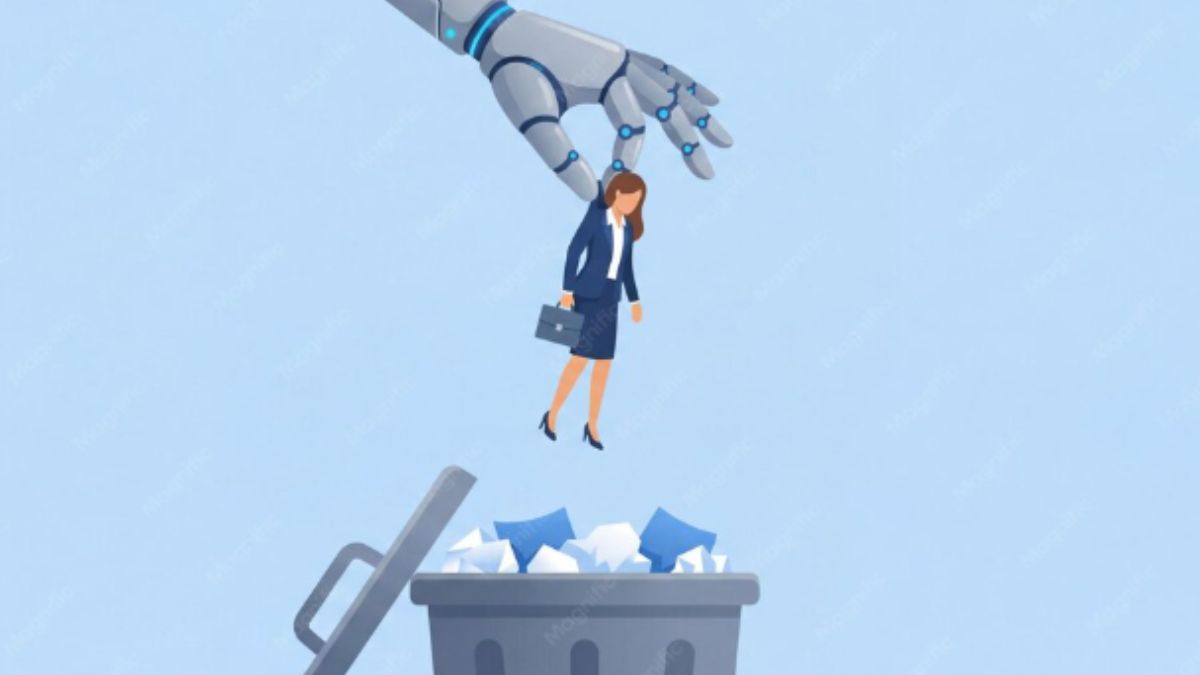
Back in May, former Google CEO Eric Schmidt was among several tech executives booed at US university graduation ceremonies for bringing up artificial intelligence during his commencement address. Now, he’s among more than 200 industry leaders, top economists, researchers and Nobel Prize winners who signed a letter warning the world about the advanced tech’s potential threat to jobs.
Titled “We Must Act Now,” the letter, publicly available online, lays out a statement on “AI’s Transformation of the Economy. The 88-word-message has been detailed as a three-point listing that warns everyone about the possibility of AI becoming “radically more powerful over the next 10 years.”
It has been released at a time when employees across sectors are facing the ravages of the AI boom in the form of severely devastating job cuts. According to the live layoff tracker Layoff.fyi, nearly 121,000 tech employees have been laid off at 233 tech companies this year, as of this week.
Who signed the letter warning about AI’s threat to jobs?
In addition to ex-Google CEO Eric Schmidt, LinkedIn co-founder Reid Hoffman, Google AI lead Jeff Dean, Anthropic co-founder Jack Clark, OpenAI finance boss Sarah Friar and Nobel laureates Joseph Stiglitz, Daron Acemoglu, and Simon Johnson are some high-profile figures who signed the “We Must Act Now” letter organised by the Stanford Digital Economy Lab.
Read the letter’s full text
Subtitled “A Statement on AI’s Transformation of the Economy,” the letter states:
“1. AI may become radically more powerful over the next 10 years.
2. This could drive an unprecedented transformation of our economy, larger than the Industrial Revolution, but unfolding over a vastly shorter time frame. It could bring risks, including large-scale job displacement, as well as opportunities such as major gains in living standards.
3. Economists, policymakers and technology leaders must act now to understand the economics of transformative AI and to build the incentives, guardrails, and institutions needed to steer AI in a direction that complements humans and benefits society.”
AI-driven layoffs debate continues
Tech leaders continue to trade exchanges in an ongoing war of words about artificial intelligence. While several top executives have openly attributed recent workforce shuffling and layoffs to the AI race, others have blasted such arguments and challenged those who blame cost-cutting and job losses on the advanced tech.
Anthropic CEO and co-founder Dario Amodei previously predicted that artificial intelligence could eliminate up to half of entry-level white-collar jobs within five years. On the contrary, Nvidia CEO Jensen Huang believes AI is “insanely profitable.” The billionaire chip maker even rebuked all those CEOs playing the AI blame game by dismissing it as a “lazy” ploy to “sound smart” while announcing layoffs.
“I think the narrative that connects AI to job loss for many of the CEOs that are doing it, it is just too lazy,” Huang said in an interview with CNA in May. “AI has just arrived. How is it possible they’re already losing jobs?…. How is it possible that AI became productive and useful only six months ago, and they were somehow laying people off two years ago because of AI?”
Remarks highlighted in the recently signed warning letter echo what Eric Schmidt said at the University of Arizona’s graduation ceremony in May.
“There is a fear in your generation that the future has already been written, that the machines are coming, that the jobs are evaporating, that the climate is breaking, that politics are fractured, and that you are inheriting a mess that you did not create,” he said at the time. “The question is not whether AI will shape the world. It will. The question is whether you will have shaped artificial intelligence.”
Similarly, Gloria Caulfield, a real estate development executive, struck a nerve by comparing the rise of AI to the “next Industrial Revolution” at the University of Central Florida’s 2026 graduation around the same time. Like Schmidt, her address was also drowned out by loud boos.
As Meta announced its decision to lay off 8,000 employees in May, CEO Mark Zuckerberg joined the bandwagon by telling affected workers, “AI is the most consequential technology of our lifetime” in a memo note, adding that “success isn’t a given” in the competitive AI-focussed industry.
That same month, Cisco Systems’ CEO Chuck Robbins told employees in a memo that “the companies that will win in the AI era will be those with focus, urgency, and the discipline to continuously shift investment,” but it required “making hard decisions.” His company eventually announced its decision to cut under 4,000 jobs.
Amid the surging contradictory arguments about AI and jobs, Corporate card firm Ramp and workforce analytics firm Revelio Labs released a study titled “A New Look at AI’s Impact on Jobs,” which analysed the workings of 21,559 firms in the US from January 2021 through February 2026, revealing that companies spending most on AI are also hiring the most.
Offering an entirely flipped worldview, the other side of the coin reflected companies that laid off workers citing AI were regretting their decisions and rehiring employees. Automaker Ford is one such high-profile name to have “reversed” the layoff strategy by bringing back hundreds of experienced human engineers to work on quality issues AI couldn’t handle.
As the debate shows no signs of slowing down, many aren’t shying away from protesting the AI era either. This past weekend, about 400 protestors marched outside the offices of OpenAI, Anthropic and Google DeepMind in San Francisco, urging tech giants to “Stop the AI Race,” as people grapple with rising rents, job cuts, existential risk and environmental harm.


