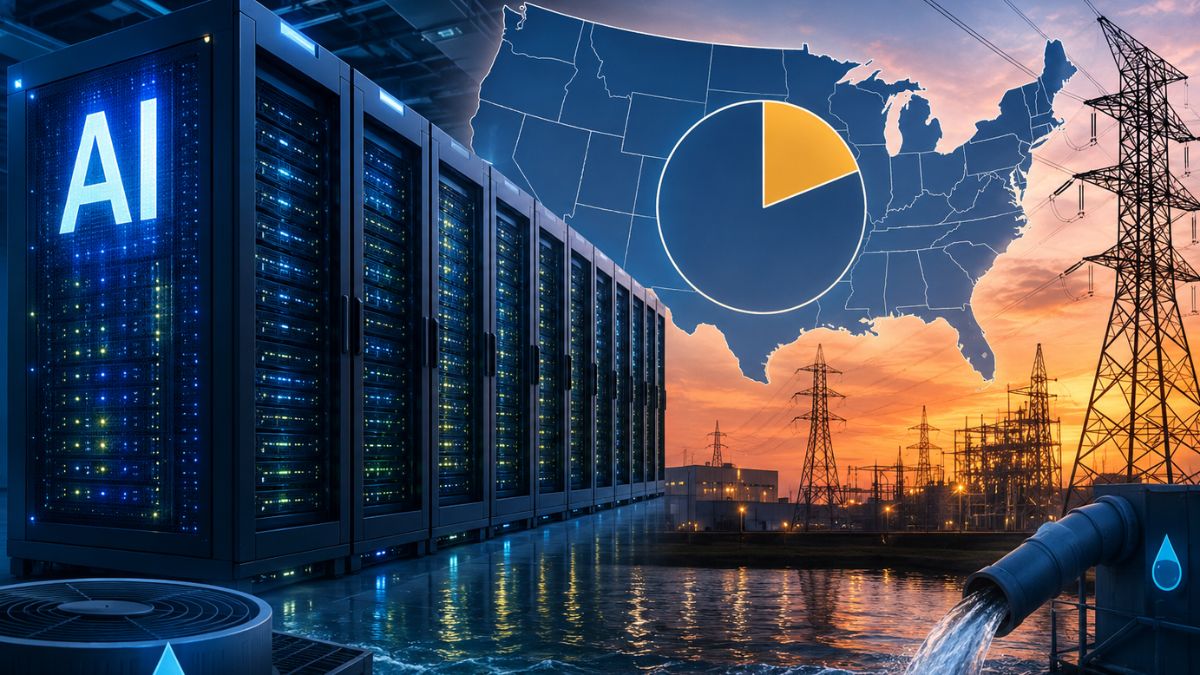
Artificial intelligence is set to dramatically reshape how electricity is used in the United States. By 2035, data centres are expected to consume about 20% of the country’s electricity, up sharply from 5.9% today, according to a new report by BloombergNEF (BNEF).
The report estimates that data centres will account for around 12% of US electricity demand by 2030, with the share rising even further over the following five years. States such as Virginia and Texas, where large numbers of data centres are already operating, are expected to see an even bigger impact.
AI data centre demand is rising much faster than expected
BNEF now expects US data centre power demand to reach 194 gigawatts by 2035, an increase of 83%compared with its forecast released in December. The revision shows the growing number of AI-focused facilities planned across the country. For comparison, one gigawatt is roughly equal to the generating capacity of a traditional nuclear reactor.
The rapid expansion of AI infrastructure is putting pressure on electricity grids that had seen little demand growth for nearly two decades. Utilities and data centre operators are now racing to secure enough power for future projects while also dealing with delays caused by permitting restrictions, local opposition and concerns over environmental impacts.
Grid is already struggling to keep pace
BNEF analyst Lloyd Arnold said the scale of electricity demand from AI will affect the wider energy system.
“Every coal plant, every gas plant, every solar farm in the US — one unit of energy out of five generated by them is going to data centers,” Arnold said. “So that’s the same energy that’s going to be going into powering electric vehicles, powering cities, et cetera.”
According to the report, the highest amount of data centre capacity connected to the US grid in a single year so far is 7.1 gigawatts. Even if that pace continues, the country could still face a 19-gigawatt power shortfall by 2035 under BNEF’s base-case scenario.
UN report says AI’s environmental impact goes beyond electricity
The rising electricity demand comes as a separate report by the United Nations University Institute for Water, Environment and Health (UNU-INWEH) warns that AI’s environmental impact extends far beyond carbon emissions.
The report projects that by 2030, AI-powered data centres worldwide will consume 945 terawatt-hours of electricity every year. That is nearly three times the combined annual electricity consumption of Pakistan, Bangladesh and Nigeria, countries with a combined population of more than 650 million people. Researchers say looking only at electricity use does not capture AI’s full environmental cost.
AI’s growing thirst for water
One of the biggest concerns is the amount of water needed to cool high-performance servers inside AI data centres. The report estimates that a single ChatGPT-style text prompt has a water footprint of about 29 millilitres, roughly two tablespoons. While that may seem small, the numbers add up quickly. With an estimated 2.5 billion AI prompts sent every day, text-based AI could consume around 3.8 billion litres of water annually, enough to meet the domestic water needs of about 500,000 people in Sub-Saharan Africa for a year.
Generating AI images uses a similar amount of water, but video generation requires far more. According to the report, producing one complex AI-generated video can consume around 4.1 litres of water, nearly enough for one person’s drinking needs for two days.
If just 20% of daily AI video requests are high-complexity videos, their annual water footprint could exceed 13 billion litres, the report estimates. The UN report says switching AI infrastructure to renewable energy addresses only part of the challenge because water and land use remain significant concerns.
“If we keep judging AI sustainability by carbon alone, we might think that renewables make AI infrastructure clean, but that is solving one problem while creating other problems, often in places that didn’t ask for it,” said Miriam Aczel, lead author of the UNU-INWEH report.