




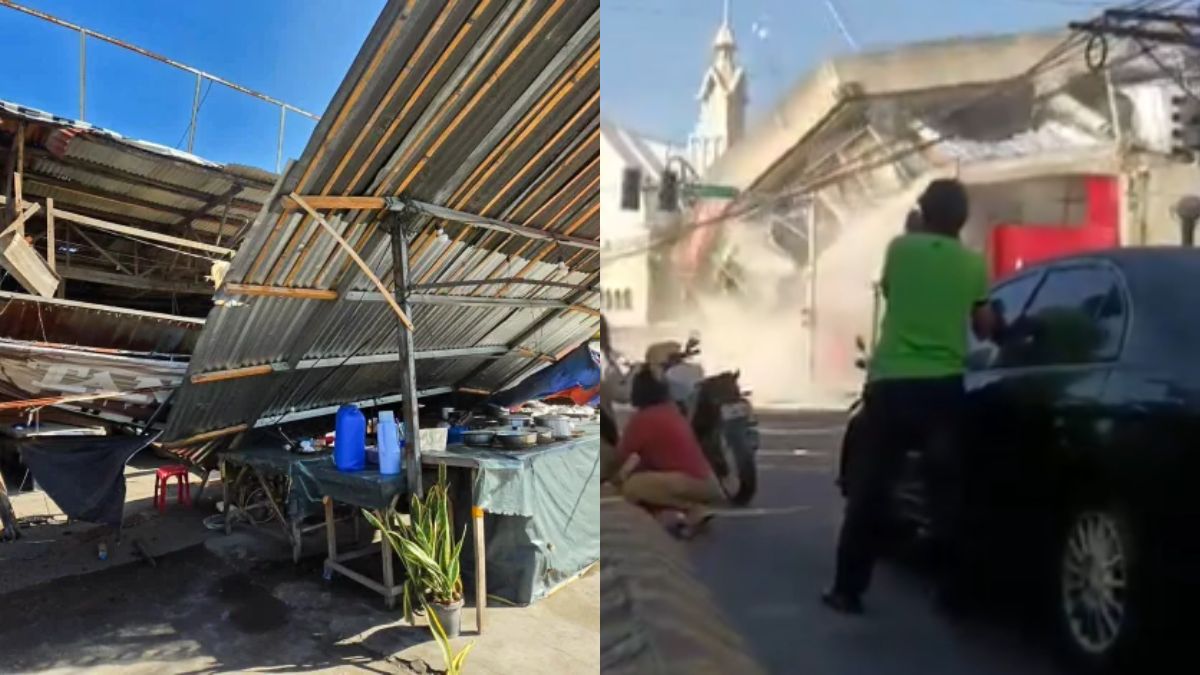
A powerful 7.8-magnitude earthquake struck the southern Philippines on Monday morning, killing at least one person, injuring several others and triggering tsunami warnings across parts of Asia.
The earthquake hit the Mindanao region at around 7:37 am local time, according to the United States Geological Survey (USGS). The tremor occurred at a depth of about 35 kilometres (21.7 miles), making it strong enough to be felt across a wide area.
Authorities in the Philippines, Indonesia and Japan issued alerts as emergency teams began assessing the impact of the quake.
UPDATE | Death toll may rise, tsunami waves hit Philippine coast
Authorities in the Philippines are verifying reports that at least five people may have died on Monday. A Philippine disaster official said authorities are currently checking reports of the fatalities as rescue and assessment operations continue.
Meanwhile, tsunami waves measuring up to 3 feet (about 1 metre) have already reached some coastal areas of the Philippines, according to the Associated Press. Philippine President Ferdinand Marcos Jr. appealed to people living in coastal areas to heed tsunami warnings and move to higher ground without delay.
“Do not wait. Life is more important than anything left behind,” Marcos said, urging people to heed tsunami warnings and head to higher ground.
WATCH: Building collapses after magnitude 7.8 earthquake strikes the Philippines pic.twitter.com/8Q9XFK6Gf8
— BNO News Live (@BNODesk) June 8, 2026
Aftershocks recorded in Philippines
Multiple aftershocks, at least 16 of them, have been recorded since the initial quake that struck off the coast. These range from magnitudes of 1.3 to 6.7, according to the Philippine Institute of Volcanology and Seismology.
Phivolcs said the earthquake struck off the coast of General Santos City in Sarangani province, located at the southern tip of Mindanao island. Soon after the quake, the agency issued a tsunami warning and urged residents living along the coast to move to safer areas.
According to the US Tsunami Warning System, tsunami waves between one and three meters above normal tide levels could hit parts of the Philippines. Authorities warned people not to take chances and to follow evacuation orders immediately.
President Marcos orders immediate response
Philippine President Ferdinand Marcos Jr. said he had instructed government agencies to begin emergency operations without delay. In a statement, Marcos urged residents in affected areas to prioritise their safety.
“I have directed all relevant government agencies to act immediately” to evacuate residents and begin rescue efforts, he said.
Addressing people living in areas under tsunami warning, the president added: “To our kababayans [countrymen] in the affected provinces, please heed the tsunami warning. Move to higher ground now. Do not wait. Your life is more important than anything left behind.”
Buildings damaged, people shaken by strong tremors
Images shared by the local information office in General Santos City showed damage to buildings and convenience stores after the earthquake. Benjie Ancheta, police chief of Alabel town in Sarangani province, said the quake struck while officials were attending a flag-raising ceremony.
Another video captures the Jollibee building collapse in General Santos, Philippines following powerful earthquake. No word on casualties. https://t.co/LJEVl0qTjC pic.twitter.com/DgixNijwoY
— AZ Intel (@AZ_Intel_) June 8, 2026
He told Reuters that the local police building developed cracks immediately after the earthquake.
Ancheta said there were no immediate reports of deaths or injuries, though some people fainted due to the intensity of the shaking. “This is the strongest earthquake we’ve experienced,” he told Reuters by phone.
Yet another recently surfaced and unsettling video pictured damage at the General Santos International Airport in General Santos. As the earthquake leaving the whole site in a dishevelled state, the clip spotted stranded trolleys and some luggage in the way. A different camera angle even shed light on the massive debris on the floor after the ceiling was believed to have collapsed to some extent.
BREAKING: Massive damage seen at General Santos International Airport in General Santos, Philippines after the powerful earthquake.
— Scope Report (@ScopeReportLive) June 8, 2026
pic.twitter.com/nmzwACVtZs
Indonesia and Japan also issue tsunami alerts
The effects of the earthquake were not limited to the Philippines. Indonesia issued a tsunami warning for parts of its northeastern coastline, according to Reuters. Meanwhile, Japan’s public broadcaster NHK reported that a tsunami advisory had been issued for the country’s southern coastline, stretching from Ibaraki Prefecture to Okinawa Prefecture. Authorities in both countries began monitoring sea conditions and advised coastal residents to remain alert.
The Philippines, Indonesia and Japan are all located along the Pacific “Ring of Fire,” a vast belt of fault lines surrounding the Pacific Ocean. The region is one of the most seismically active places in the world and frequently experiences powerful earthquakes and volcanic eruptions due to the movement of tectonic plates.
Indonesia issues tsunami advisory after powerful Philippines earthquake
Indonesian authorities have issued a tsunami advisory after the powerful earthquake that struck the Mindanao region of the Philippines earlier on Monday.
Indonesia: A Tsunami Advisory Warning has been issued by Indonesian authorities, following a major earthquake that occurred in Mindanao, Philippines earlier this morning.
— TravelGov (@TravelGov) June 8, 2026
The areas of Gorontalo, East Kalimantan, North Maluku, Southeast Sulawesi and North Sulawesi have received… pic.twitter.com/TZthJJYDZK
Officials warned that several coastal areas could experience tsunami activity and urged residents to remain alert. The advisory covers parts of Gorontalo, East Kalimantan, North Maluku, Southeast Sulawesi and North Sulawesi, where authorities are closely monitoring sea conditions following the quake. Residents in these regions have been advised to follow official updates and take precautions as the situation develops.


