Picture an ordinary day at CompUSA in the early 1990s. A small crowd gathers around two identical-looking computers as a man rings a hand bell, daring shoppers to spot the difference. One machine is running a game or a video clip at a crawl; the other, at speeds that make people audibly gasp.
Before they leave, each shopper is handed a free souvenir, a keychain, its centrepiece a tiny silicon wafer. What almost none of them realise is that the chip dangling from their car keys is a Pentium processor that failed quality control on the factory floor, too flawed to ever power a real computer, but perfectly good, it turns out, as bait to make the world’s biggest PC manufacturers feel a demand they had been refusing to create themselves.
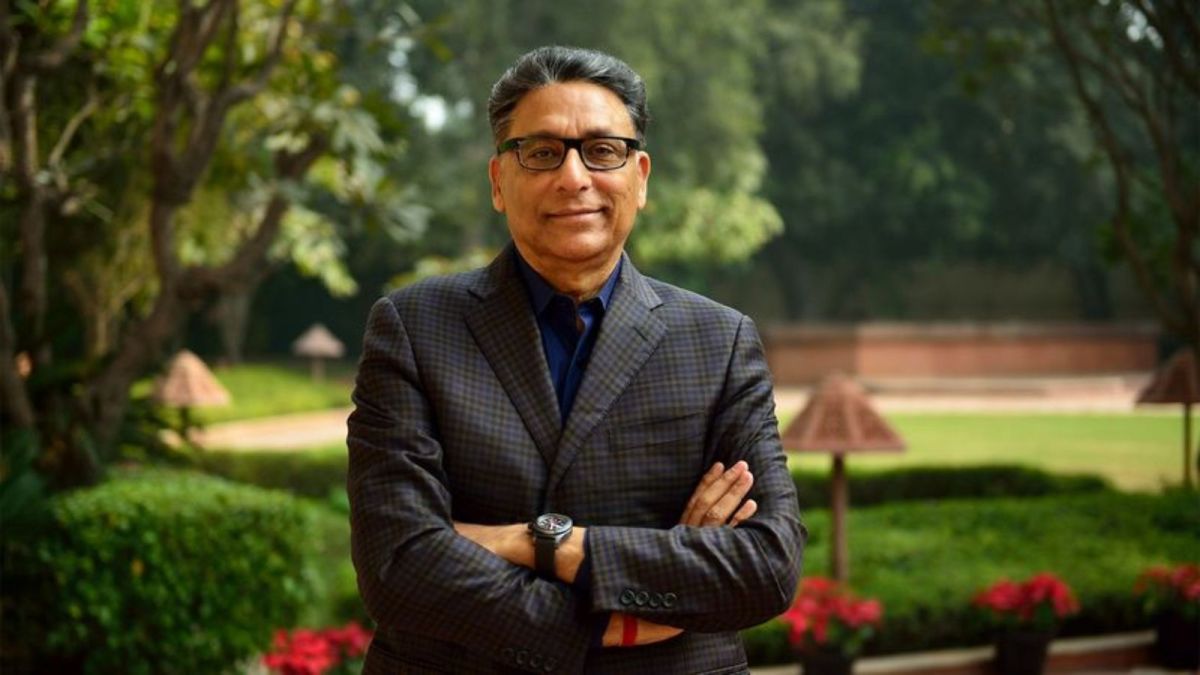
The man who engineered that brilliant act of guerrilla marketing, chip reject and all, is the same man who had engineered the processor inside it: Vinod Dham. “Careers are rarely built by avoiding risk. They are built by embracing thoughtful risk at the moments that matter most,” Dham told Financial Express during an exclusive conversation, a philosophy that has defined much of his remarkable journey.
Today, people across the technology industry know him as the “Father of the Pentium.” But that title tells only part of his story. Over the years, Dham has left his mark on some of the biggest breakthroughs in the semiconductor industry.
He helped develop Intel’s first flash memory technology, played an important role in creating the Intel 386 and 486 processors, which helped make Intel the world’s leading chip company during the 1980s.
Later, he worked on the processor that allowed AMD to briefly move ahead of Intel in the late 1990s. He also built a voice-over-internet chip through his own company, Silicon Spice, which Broadcom bought in 2000 for more than one billion dollars.
In April 2025, seventy-five years after his birth into a family that had been forced to rebuild its life after Partition, Vinod Dham received the Padma Bhushan at Rashtrapati Bhavan. It is India’s third-highest civilian honour and one of the country’s biggest recognitions for outstanding contributions.
A childhood built on displacement
Dham’s journey did not begin in Silicon Valley. It began much earlier, with a family that had lost everything during the Partition of India. His parents lived in Rawalpindi, which is now in Pakistan. During Partition, they had to leave their home and move to India along with their three sons and a daughter. The family settled in Pune and started their lives all over again.
Vinod was born there in 1950. He was the fourth son in the family. His father worked as a civilian employee with the Army. His mother managed the home and raised the children. All of Vinod’s siblings built successful careers.
Looking back, Dham has often described his family as a middle-class family that rebuilt its life from nothing. That experience of beginning again would later become an important part of his own journey too.
Dham has often described himself as “quite a fearless” student. He was never someone who simply followed every rule. If he found a class boring, he sometimes skipped it.
Once, Dham walked into a class just as it was ending, and the professor mocked him in front of everyone. Later, despite writing the right answers in the final exam, the same professor gave him lower marks, saying he was judging discipline, not knowledge. Dham didn’t hold a grudge. Instead, he saw it as an early lesson that success isn’t always about being right, it also depends on understanding how institutions work.
In 1971, when he was just 21 years old, Dham completed his Electrical Engineering degree from Delhi Technological University. Soon after graduating, he joined Continental Devices, a small semiconductor start-up in Delhi’s Naraina Industrial Area.
At that time, India had very few private semiconductor companies, making it a rare opportunity for a young engineer. During the four years he spent there, his interest in semiconductors grew even stronger. He became fascinated by the science behind how these tiny chips worked.
His company’s general manager, SS Madan, recognised that passion and advised him to study the subject in greater depth.
Eight dollars, one flight and a dream
In 1975, Vinod Dham made the biggest decision of his life. He boarded an aeroplane for the very first time. It was a non-stop flight from New Delhi to the United States, where he had been admitted to the University of Cincinnati for a master’s degree in Electrical Engineering and Solid-State Physics.
He carried just eight dollars in his pocket. It was not only a journey to another country. It was a leap into the unknown. Around that time, Dham had also lost his father. Before leaving India, he had one important conversation with his mother. He wanted to know if she was comfortable with him going so far away.
Her answer stayed with him forever. “You must go,” she told him. “It is your destiny. It will make you. I will manage. Don’t worry about me.” Looking back, Dham says those words gave him the courage to take the biggest risk of his life.
Speaking to Financial Express, he said that decision became the foundation of everything he achieved later. “What I carried with me was faith that education, hard work, and perseverance could create opportunities where none appeared to exist.”
Building Intel’s future
After completing his master’s degree in 1977, Dham joined National Cash Register (NCR) in Dayton, Ohio. He became part of the company’s memory design group, where he worked on advanced memory technologies and earned several patents for his work.
One presentation would soon change his career. Dham spoke at an IEEE conference in Monterey, California, where he presented his work on re-programmable memory. People at Intel noticed him. The presentation impressed the company so much that in 1979, Dham joined Intel.
At Intel, Dham first worked on flash memory. He co-invented the company’s first flash memory technology, called ETOX.
Later, he moved to Intel’s microprocessor division, where he became part of the teams working on the famous Intel 386 and 486 processors. During those years, he learned that successful innovation was not only about creating better technology. It was also about solving business problems.
One incident from that period remained one of his favourite examples. Intel wanted computer companies to shift from the 386 processor to the newer 486 chip. The biggest improvement in the 486 was that it had a floating-point math processor built directly into the chip, making it much more powerful. But one of Intel’s biggest customers refused to make the switch.
The customer preferred another company’s faster 386 processor because Intel’s 486 was simply too expensive for its budget. Many people would have accepted losing the customer. Instead, Intel’s engineers searched for another solution. “Rather than retreat, our engineers looked creatively at the problem,” Dham recalled.
The team disabled the floating-point unit inside the processor and created a lower-cost version called the Intel 486SX.
The new chip gave customers a more affordable option while still keeping them within Intel’s 486 family. For Dham, this became one of the best examples of how engineering and business can work together. “It was an elegant example of solving a business problem with engineering creativity,” he said.
He believes innovation is much bigger than inventing new technology. “Innovation is rarely about technology alone. It is equally about understanding markets, customers, timing and execution.”
The beginning of the Pentium story
By January 1990, Vinod Dham had earned the trust of Intel’s leadership. The company handed him one of its biggest responsibilities. He was asked to lead the development of Intel’s 586 project, the processor that the world would later know as the Pentium.
As the project grew, Dham also became Vice President and General Manager of Intel’s Microprocessor Products Group. The years that followed were some of the toughest of his career.
Competition in the chip industry was becoming more intense, deadlines were tight, and expectations were enormous. Looking back on that period, Dham admitted that he pushed both himself and his team very hard.
Speaking to the University of Cincinnati’s alumni magazine in 2000, he said, “I was execution-oriented, hard-charging, extremely demanding.” His colleagues even found a humorous way to remind him of that. “At one celebration, they gave me a general’s hat to remind me how I was behaving.”
Little did he know that building the Pentium chip would be only half the battle. Getting the world to accept it would prove even harder.
When nobody wanted a Pentium
By 1993, Intel was finally ready to launch the Pentium processor. It was a major step forward in computer technology. The new chip was much faster and far more powerful than the Intel 486.
But there was one big problem. The Pentium was priced at more than twice the cost of the 486. For Intel, the higher price was important because it would bring in more revenue. But for computer manufacturers, it was not good news.
Most PC companies were already making healthy profits by selling computers powered by the 486 processor. They saw no reason to switch to a more expensive chip that customers had not yet started asking for. The technology was ready.
The market was not. Intel’s then Chief Executive Officer, Andy Grove, decided something had to be done.
He asked Vinod Dham to meet Compaq’s CEO, Eckhard Pfeiffer, and convince him to buy Intel-designed Pentium motherboards at cost price. The idea was to help computer makers adopt the new processor more quickly.
The meeting, however, turned into a complete failure. “The meeting did not go well,” Dham recalled.
Pfeiffer believed Intel was trying to enter Compaq’s own business by selling motherboards directly. Instead of agreeing to the proposal, he rejected it completely. As Dham later put it, Pfeiffer “quite literally showed me the door.” For many people, that would have been the end of the story. For Vinod Dham, it became the beginning of a new idea.
The rejected chips that became a marketing masterstroke
After the disappointing meeting with Compaq, Dham realised there was little point in trying to convince computer manufacturers again and again. Speaking to Financial Express, he shared this little-known story from Intel’s early Pentium days. Instead of continuing to chase manufacturers, he decided to speak directly to the people who would eventually buy the computers. His team began visiting retail stores on weekends.
They set up two computers side by side, one running on the Pentium processor and the other on the older 486 chip. People stopped to watch. They could immediately see the difference.
Games, videos and multimedia programs ran much faster on the Pentium machine. The improvement was so obvious that the demonstrations almost sold the product on their own. Then came the final touch. Every visitor who stopped by received a free keychain.
The small silicon chip inside it looked special, but almost nobody knew its real story. It was actually a rejected Pentium processor that had failed Intel’s quality checks and could never be used inside a computer.
Instead of throwing those chips away, Dham’s team transformed them into memorable souvenirs. Looking back, Dham believes those demonstrations achieved something much bigger than ordinary advertising.
“Those demonstrations created something far more valuable than marketing,” he said. “They created consumer demand. Retailers began calling Compaq asking where the Pentium systems were. Suddenly, pressure was flowing in the opposite direction — from the marketplace back to the manufacturers.”
The strategy worked. Customers started asking for Pentium-powered computers. Retailers started asking manufacturers. Manufacturers finally realised they could no longer ignore Intel’s newest processor.
Leaving success behind
In 1995, Vinod Dham surprised the entire technology industry. The Pentium had become one of Intel’s biggest successes, and most people expected him to stay and enjoy the rewards. Instead, he resigned, leaving everyone stunned. Dham’s answer was simple. “Comfort is often the greatest obstacle to growth,” he said.p
After leaving Intel, Dham joined the start-up NexGen as its Chief Operating Officer and Executive Vice President. Just a year later, in 1996, AMD acquired NexGen.
There, Dham led the development of the AMD K6 processor. For a short period, the K6 became the fastest PC processor in the world. The technology industry even nicknamed it the “Pentium killer” because it challenged Intel’s dominance.
Dham was not finished creating new companies. In 1998, he founded Silicon Spice. The company developed a multichannel voice-over-internet chip designed to solve what Dham described as the industry’s “bandwidth bottleneck.”
The technology attracted global attention. In 2000, Broadcom acquired Silicon Spice for around $1.2 billion, marking another huge success in Dham’s career.
From building chips to building people
Over the past twenty years, Vinod Dham has spent less time building products and more time helping other entrepreneurs build companies. He has been active as an angel investor, served on company boards and became the founding Managing Director of Indo-US Venture Partners, one of the earliest Silicon Valley investment firms dedicated to supporting Indian start-ups.
In 2015, he co-founded the online education company Acadgild with Krishnan Ganesh and Meena Ganesh. He also served on a US presidential advisory commission on Asian Americans and Pacific Islanders during Bill Clinton’s presidency.
More recently, he has supported the creation of the Vinod Dham Centre of Excellence for Semiconductors and Microelectronics at his alma mater, Delhi Technological University.
Although he no longer works on building complex chips himself, he says helping young people gives him just as much satisfaction.
“While I no longer seek the operational intensity required to build these complex products myself,” he said, “I find enormous satisfaction in mentoring those who will. Mentorship is not about creating followers. It is about creating leaders. The true measure of a mentor is whether the next generation ultimately surpasses the previous one.”
A student even at seventy-five
Today, Vinod Dham is 75 years old. He is married to Sadhana, and they have two sons. He has received one of India’s highest civilian honours, yet he still believes there is always more to learn. As he puts it, “Degrees may end. Learning never should.”
Before ending his conversation, Dham shared a message for young engineers, entrepreneurs and anyone chasing a dream.
It is the same advice he wishes every young person remembers. “Dream boldly. Learn continuously. Take intelligent risks. Execute relentlessly. Remain humble in success. Remain resilient in failure. And whenever you have the opportunity, extend your hand to help someone else climb the mountain. That is how innovation becomes progress. And that is how careers become legacies.”