




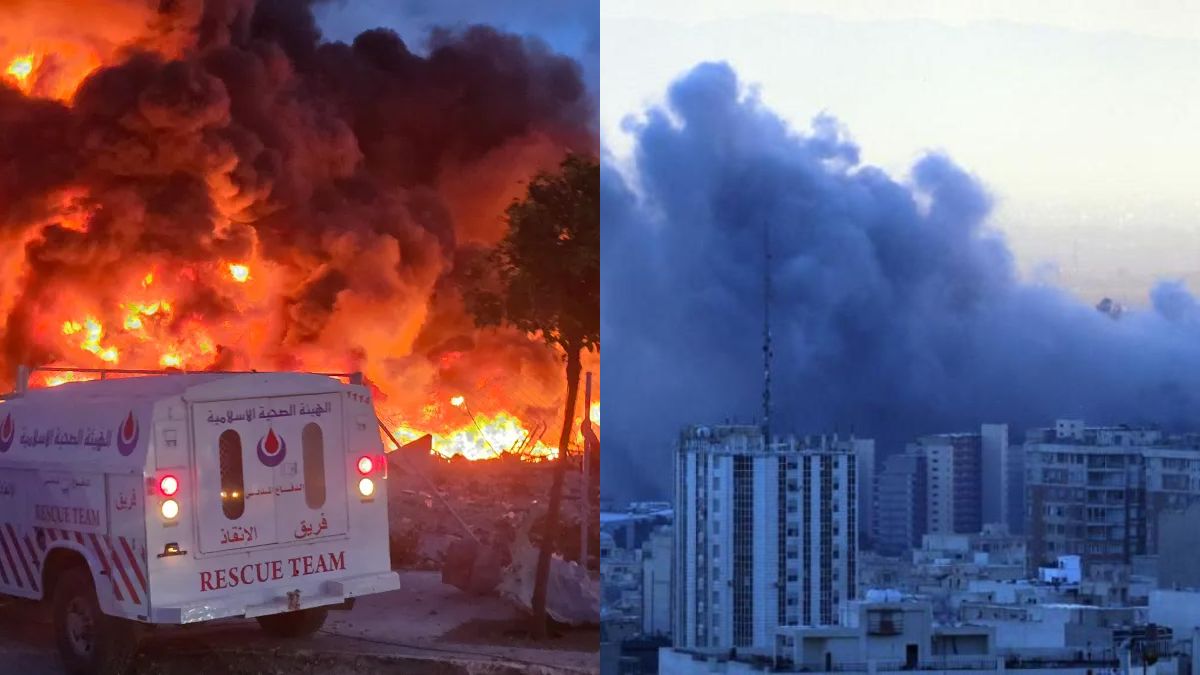
US-Israel attack on Iran Highlights: Iran War Top Developments on March 5
- Senate Republicans stopped a measure that would have limited President Trump’s ability to continue the war without Congress approving it.
- Turkey said NATO air defenses shot down an Iranian ballistic missile headed toward its airspace.
- Defense Secretary Pete Hegseth said a US submarine fired a torpedo and sank an Iranian warship. It was the first time an American submarine fired a torpedo at an enemy ship since World War II.
- An Iranian naval ship with 180 crew members sank in the Indian Ocean off Sri Lanka. Authorities fear dozens may be dead.
- Hegseth and press secy Leavitt said US and Israeli forces will soon control Iranian airspace completely and that they would be able to deliver “death and destruction all day long.”
- As the fifth day of fighting ended, Israel launched another wave of attacks on Tehran. The conflict shows no sign of slowing.
- China said it will send a special envoy to help mediate the conflict. The UK, France and Greece are deploying military assets to protect their citizens.
- Financial markets calmed after days of turmoil. But US gasoline prices have jumped 20 cents compared to last week.
- Top Iranian officials are considering Mojtaba Khamenei, son of the slain leader, as successor. Israel warned that if he follows his father’s ideology, he will be “an unequivocal target for elimination.”
- The White House said 17,500 Americans have returned home since the war began. The press secretary said the State Department had given “many signs” before the strikes.
Here are the latest updates
Iran war could last weeks: Trump
Trump said the US has “the capability to go far longer” than its previously projected time frame of four-to-five weeks, indicating that the war with Iran could drag on for longer than expected.
Explosions erupted across Tehran through the night and into the early hours of Tuesday morning, as the US and Israel continued their days-long military onslaught against Iran.
France ready to defend
French Foreign Minister Barrot said Tuesday that France was ready to defend its partners if they request help. The semi-official Cyprus News Agency (CNA) also noted that France was planning to send anti-missile and anti-drone systems to Cyrpus after a UK military base on the island was attacked by drones this week.
Americans struggle to leave the region
The US State Department is urging all Americans in the Middle East to leave immediately due to serious safety risks. This includes citizens in Bahrain, Egypt, Iran, Iraq, Israel, the West Bank and Gaza, Jordan, Kuwait, Lebanon, Oman, Qatar, Saudi Arabia, Syria, the UAE, and Yemen.
However, limited flights are making it hard to leave. More than 1,000 flights had been canceled by Tuesday morning, following thousands of cancellations on Sunday and Monday, according to FlightAware.com.
In Israel, US Ambassador Mike Huckabee said Americans have “very limited options” to leave and warned that the embassy cannot evacuate or assist citizens directly. Airspace over the UAE, Qatar, Kuwait, Israel, Bahrain, Iraq, and Jordan remains mostly closed, and flights near the conflict zone continue to be rerouted or canceled. Some flights from India to Dubai had to turn around, while a few managed to leave the UAE late Monday.
US orders departure of non-emergency staff across Middle East
The United States has ordered the mandatory departure of non-emergency government personnel and their families from Jordan, Bahrain, Iraq, Qatar, and Kuwait because of serious security concerns.
The State Department said staff in Jordan, Bahrain, Qatar, and Kuwait face ongoing threats of drone and missile attacks from Iran, along with major disruptions to commercial flights. In Jordan and Bahrain, officials also warned of possible terrorist attacks, while in Iraq the risk of violence and kidnapping is considered very high.
This is the first such order since the US and Israel launched military operations against Iran. It reflects the growing dangers to US embassies and military facilities as tensions rise and Iran retaliates.
US Embassy in Saudi Arabia shuts down after drone attack
In Riyadh, the US Embassy also canceled all consular appointments after being hit by suspected Iranian drones earlier Tuesday. The Saudi defense ministry said the attack caused minor material damage and limited fire, but there were no initial reports of injuries.
The embassy advised Americans to continue sheltering in place in Jeddah, Riyadh, and Dhahran and to avoid visiting embassy facilities until further notice. “All routine and emergency American Citizen Services appointments are canceled. Maintain a personal safety plan,” the embassy posted on X.
Saudi Arabia’s military said it intercepted and destroyed eight drones near Riyadh and the central city of Al Kharj earlier Tuesday. The statement did not mention any casualties or further damage.
US Embassy in Kuwait closes amid rising tensions
The US Embassy in Kuwait announced it will remain closed until further notice due to “ongoing regional tensions.” The embassy said all regular and emergency consular appointments are canceled and promised to provide updates when operations resume.
The closure follows the first US service members killed in the conflict between the United States and Iran. They died after a direct Iranian strike hit a makeshift operations center at a civilian port in Kuwait on Sunday morning. US Central Command confirmed on Monday that six service members have now lost their lives.
Americans in Israel face limited ext options
Americans in Israel now face very limited options to leave the country, according to US Ambassador Mike Huckabee. The embassy cannot evacuate citizens directly, and those trying to depart are advised to take a shuttle operated by the Israeli Ministry of Tourism to Taba, Egypt, and then catch flights from there or Cairo. Leaving via Jordan is not recommended because flights are inconsistent, and even when Tel Aviv’s main airport reopens, only very limited flights will be available, prioritizing passengers already ticketed with El Al. Airspace restrictions over much of the Middle East continue to make travel challenging.
Pentagon had warned about strain on weapons and troops
Before the US launched military action, officials including Chairman of the Joint Chiefs, Gen. Dan Caine, warned that a large operation in Iran could put pressure on service members and US assets in the region. Sources told CNN that a long military campaign could also strain US weapons stockpiles, especially those used to support Israel and Ukraine.
Trump says US ‘highest end’ munitions stockpiles not where he wants
President Donald Trump on Monday spoke about the US munitions stockpiles, saying that while overall supplies are strong, the highest-grade weapons are “not where we want to be.”
Trump posted on Truth Social, “The United States Munitions Stockpiles have, at the medium and upper medium grade, never been higher or better. At the highest end, we have a good supply, but are not where we want to be. Much additional high grade weaponry is stored for us in outlying countries.”
Deadly protests erupt over Khamenei reports
The protests began after reports that Iran’s Supreme Leader, Ayatollah Ali Khamenei, had been killed in joint US-Israel strikes. Demonstrators gathered outside the US Consulate General in Karachi.
According to officials, the protests turned violent. At least 10 people were reported killed on Sunday after security forces opened fire when protesters breached the consulate’s outer wall.
Sukhdev Assardas Hemnani, a provincial government spokesperson, said that “security” personnel fired at the crowd but did not clarify which agency was involved.
Reuters reported that US Marines were involved in firing at the protesters. This is the first confirmation that American troops directly engaged during the unrest.
It is still unclear whether the Marines’ shots hit or killed anyone. Officials also said it was unknown if others, such as private security contractors or local police, fired during the clash to protect the consulate.
US war with Iran splits Iranian-American community
The recent US and Israeli military strikes on Iran are stirring strong reactions across the Iranian-American community. Some are supportive of the attacks, seeing them as necessary, while others fear the consequences and are deeply concerned about safety and rising tensions.
Asian stocks hit as oil surges amid Iran conflict
Asian markets faced pressure on Tuesday as the Iran war pushed oil prices higher, raising inflation fears. This weighed on bonds, while US stocks remained mostly unchanged. Investors sought safe havens, sending the dollar and gold higher.
Equity futures for Japan and Australia fell, while Hong Kong’s climbed. The S&P 500 ended flat Monday, and the Nasdaq rose slightly. Energy and defense stocks gained, tech shares with strong balance sheets held up, and airlines dropped. Gold crossed $5,300 per ounce.
The conflict disrupted the Strait of Hormuz and a major Saudi refinery. West Texas Intermediate crude jumped over 6%, while European natural gas surged after Qatar shut its LNG export plant. Rising energy costs raised worries about inflation and the Federal Reserve’s easing plans, pushing the 10-year U.S. Treasury yield to 4.03%. The dollar rose 0.7%.
US cancels visa appointments in Pakistan after deadly Karachi protests
The United States has cancelled all visa appointments in Pakistan until March 6 because of the dangerous situation following violent protests outside its consulate in Karachi. The move shows how tense things have become around US missions in the region.
The US Embassy in Islamabad said the suspension applies not just to Karachi, but also to the embassy in the capital and the consulate in Lahore. The embassy called the decision necessary due to the “current security situation.”
Netanyahu defends US‑Israeli strikes on Iran
Israeli Prime Minister Benjamin Netanyahu has spoken out about the ongoing military strikes by the United States and Israel against Iran. In his remarks, he made it clear why he believes the actions were necessary, calling them a way to protect the world from harm.
Netanyahu said it is “not a terrible thing to protect the world from theological thuggery.”
He argued that the recent strikes were not about expanding a long war, but about stopping a threat before it could grow worse. According to Netanyahu, the goal of the military campaign is to make the region safer, not to cause endless destruction.
Netanyahu’s comments came amid rising tensions in the Middle East after coordinated strikes by US and Israeli forces hit targets inside Iran. In response, Iran fired back with missiles and drones at American and allied bases across the Gulf.
Smoke rises over Beirut suburbs amid explosions
Plumes of smoke were seen rising and explosions heard in the southern suburbs of Beirut on Tuesday morning, according to Reuters video footage.
The Israeli military issued evacuation orders for dozens of villages and settlements in Lebanon and said it had started attacking Hezbollah targets in Beirut.
Hezbollah said in a statement on Tuesday that it had launched drones into Israeli territory in response to the Israeli bombings in Lebanese towns.
Earlier on Tuesday, the Israeli Air Force reported intercepting two drones that crossed into Israeli territory from the direction of Lebanon.
Helping Indians return home safely
In this critical time, EaseMyTrip is operating special charter flights today from Fujairah to Delhi and Mumbai.
🇮🇳 Helping Indians Return Home Safely
— EaseMyTrip.com (@EaseMyTrip) March 3, 2026
In this critical time, EaseMyTrip is operating special charter flights today from Fujairah to Delhi and Mumbai.
✈️ Fujairah → Delhi & Mumbai
🗓 Departure: 3rd March 2026
⏰ Between 7:00 PM – 9:00 PM
Seats are limited and confirmations…
US Envoy: Iran deal impossible Before Strikes
US special envoy Steve Witkoff described the final attempts to reach a nuclear deal with Iran, which collapsed just before the US launched major operations.
“President Trump sent me and Jared [Kushner] to really determine on his behalf whether they were serious about doing a deal that addressed his objectives,” Witkoff said, describing meetings in Geneva aimed at curbing Tehran’s nuclear program.
The US delegation had proposed a decadelong halt to uranium enrichment, offering to pay for the fuel. “They rejected that, which told us at that very moment that they had no notion of doing anything other than retaining enrichment to the purpose of weaponizing,” Witkoff said.
Witkoff said they knew by the second meeting that an agreement was unlikely but returned for a third meeting as a final attempt. “It was very clear it was going to be impossible, probably by the end of the second meeting, but then we went back to the third meeting just to give it the last college try,” he added.
The talks’ collapse led to Trump announcing joint US-Israeli strikes on Iran. Around the same time, Trump urged Tehran to make concessions, saying, “They should make a deal, but they don’t want to quite go far enough. They don’t want to say the key words: ‘We’re not going to have a nuclear weapon.’”
Gulf nations intercept hundreds of missiles and drones
The joint US-Israel strikes on Iran over the weekend have triggered retaliatory attacks across the Middle East. Countries hosting US military bases have faced missile and drone strikes targeting urban centers, airports, hotels, and energy infrastructure, causing unrest in cities long used to relative security.
Here’s a look at what the Gulf nations have intercepted so far
Key Updates: US-Iran conflict and Gulf crisis
Peaceful protests across US against military action in Iran
Across the United States, thousands of people took to the streets on Monday to protest the US-Israeli military operation in Iran. Demonstrators gathered peacefully to voice their opposition to the war.
In Boston, protesters braved low temperatures to march through the city. One participant told the crowd he opposed “these endless, stupid, immoral, dangerous wars,” according to CNN affiliate WCVB.
In New York City, demonstrators held a short rally in Manhattan before peacefully marching through the streets. They chanted “hands off Iran now” and carried banners and posters expressing their message against the conflict.
Similar protests were held in Chicago, Portland, Oregon, and Madison, Wisconsin, as people across the country voiced their opposition.
India makes special arrangements for stranded passengers
IndiGo has announced 10 special relief flights from Jeddah to India on March 3, 2026, to help passengers stranded due to the conflict in the Middle East. These flights will operate depending on necessary approvals and current airspace conditions.
IndiGo has already received clearance for four flights scheduled for today. These flights will fly from Jeddah to Mumbai, Hyderabad, and Ahmedabad. They are specifically arranged for passengers who had booked IndiGo tickets earlier but could not travel because of the rising tensions and disruptions caused by the war.
The Indian airline is working closely with the Consulate General of India in Jeddah to ensure smooth movement of passengers back to India.
Limited evacuation flights begin in UAE
Stranded travelers have started leaving the UAE on a few evacuation flights from Dubai and Abu Dhabi. Most commercial air traffic in the Middle East remains suspended. The US State Department has urged citizens in 13 countries, including the UAE, Jordan, Saudi Arabia, Egypt, Lebanon, and Oman, to “depart now via commercial means due to serious safety risks.”
Iran drone hits Dubai building housing US troops
Iran’s Press TV reported a Shahed-136 drone struck a building in Dubai housing American military personnel, causing “significant impact.”
Iran FM says Rubio admitted ‘No Iranian Threat’
Seyed Abbas Araghchi, Iran’s foreign minister, said US Secretary of State Marco Rubio acknowledged there was no real threat from Iran.
“Mr. Rubio admitted what we all knew: US has entered a war of choice on behalf of Israel. Shedding of both American and Iranian blood is thus on Israel Firsters. American people deserve better and should take back their country,” he posted on X.
Vance: US strikes aim to change Iran’s mindset
Vice President JD Vance said President Donald Trump ordered military strikes on Iran to force a fundamental shift in the Iranian regime’s “mindset,” not to start a long-term war.
In an interview with Fox News on Monday, Vance explained that Trump believed the only way to make sure Iran never gets a nuclear weapon was to act decisively. “He wanted to make sure that Iran could never have a nuclear weapon and that would require fundamentally a change in mindset from the Iranian regime,” Vance said.
He added that Trump saw the Iranian regime as weakened but determined to reach the brink of nuclear capability. “He decided to take action because he felt that was necessary in order to protect the nation’s security,” Vance said.
Vance also reassured Americans worried about another long military conflict in the Middle East. “There’s just no way that Donald Trump is going to allow this country to get into a multi-year conflict with no clear end in sight and no clear objective,” he said.
The vice president emphasized that the administration wants to avoid the mistakes of past wars in Iraq and Afghanistan. “We’re not going to get into the problems we had with Iraq and Afghanistan,” he said.
Sirens in Bahrain: Authorities urge residents to take shelter
A warning siren was sounded across Bahrain early Tuesday, the Interior Ministry said.
“The siren has been sounded. Citizens and residents are urged to remain calm and head to the nearest safe place,” the ministry wrote on X.
US Central Command said that U.S. forces are hitting Iran with precision and force. “As the Secretary of War stated this morning, US forces are hitting Iran surgically, overwhelmingly, and unapologetically. Operation Epic Fury is laser-focused on destroying Iranian offensive missiles,” the command said.
The statement highlights that the current military operations are carefully targeted, aiming specifically at Iran’s missile capabilities while continuing the wider campaign under Operation Epic Fury.
As the Secretary of War stated this morning, U.S. forces are hitting Iran surgically, overwhelmingly, and unapologetically. Operation Epic Fury is laser-focused on destroying Iranian offensive missiles. pic.twitter.com/0mwRSOPwUb
— U.S. Central Command (@CENTCOM) March 3, 2026
Israel says Palestinian Islamic Jihad commander killed in Beirut
The Israel Defense Forces (IDF) said it has killed Abu Hamza Rami, a commander of Palestinian Islamic Jihad, in Beirut, Lebanon.
In a statement, the IDF said, “Abu Hamza Rami carried out hundreds of terrorist attacks against IDF troops and Israeli civilians, including recruiting and training terrorists and procuring weapons. During Operation Northern Arrows, he managed the movement of PIJ’s terrorists along the Syria-Lebanon border and their activities against IDF troops in southern Lebanon. His elimination has significantly degraded PIJ’s ability to carry out terrorist operations against Israel.”
World’s key oil route slows to a crawl
Oil and gas prices did jump. But the increase has been much smaller than what people remember from past crises.
Brent crude — the global oil benchmark — has climbed to its highest level since June. That sounds dramatic, but compared with earlier energy shocks, the rise has been limited.
European natural gas prices have surged 39%. Even that sharp jump, however, looks modest when placed next to the huge swings seen during the 2021-22 energy crisis, when prices soared to extreme levels and stayed there for months.
In short, the market is tense. Supply routes are under pressure. Major energy facilities have shut down. But so far, prices have not spiraled the way they once did.
Fear in energy markets
For the past three days, oil and gas traders have been watching what many had always feared — a worst-case situation playing out in front of them.
The Strait of Hormuz, one of the most important shipping routes in the world, has almost come to a standstill. This narrow stretch of water carries about one-fifth of the world’s oil supply. When tankers stop moving there, the whole energy market feels it.
The Strait of Hormuz is a key route for global energy. Every day, massive oil tankers pass through it, carrying crude to countries across Asia, Europe and beyond.
Now, tanker traffic through the strait has nearly stopped.
Iranian missile and drone attacks have added to the chaos. The strikes forced the closure of the world’s biggest liquefied natural gas facility. They also led to the shutdown of Saudi Arabia’s largest oil refinery.
With such major sites out of action and ships unable to move freely, many in the market expected prices to explode.


