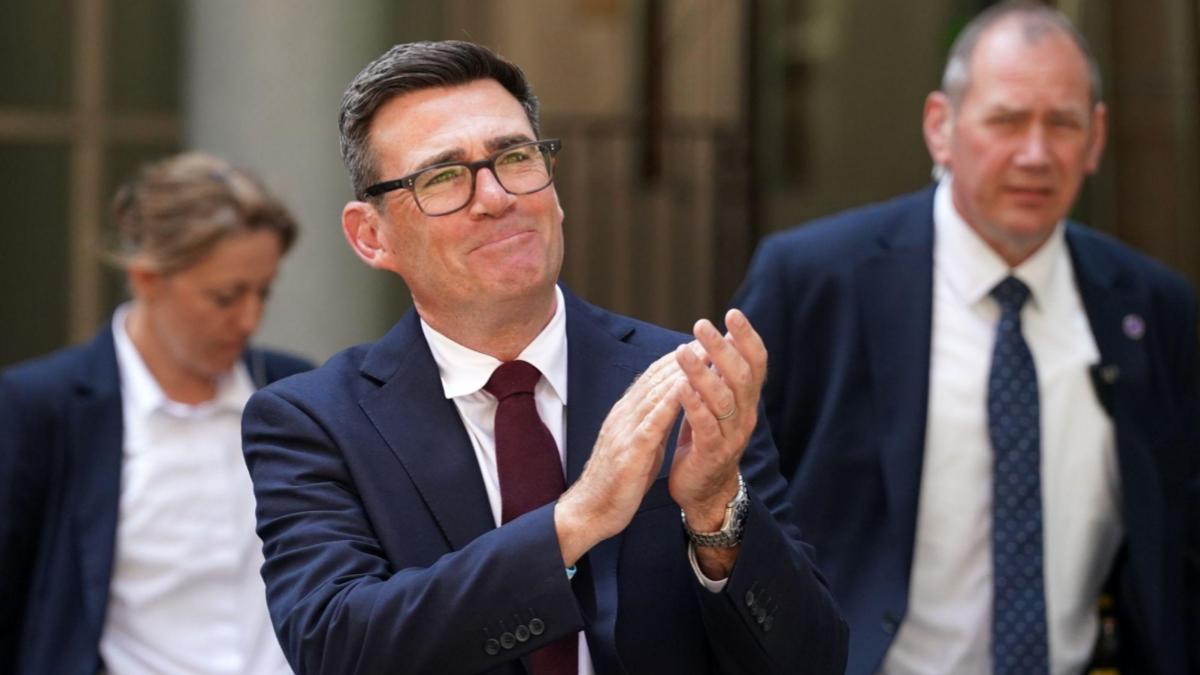
Andy Burnham was confirmed Friday as the newly elected leader of Britain’s governing Labour Party, putting him on course to become prime minister-designate and take charge at 10 Downing Street next week. Burnham will be invited by King Charles III to form a new government on Monday, after outgoing Prime Minister Keir Starmer formally submits his resignation to the monarch.
The announcement came from chair of Labour’s National Executive Committee (NEC) Shabana Mahmood at a special party conference in London. With only one MP nominated for the role, the contest was a formality. “There was only one nominated MP… hardly a nail biter,” Mahmood told the conference.
Message of continuity and change
In his first speech as Labour leader, Burnham said he was “ready to lead the party and to build on the foundations laid by Keir Starmer”, according to the BBC. He credited Starmer with taking Labour from its worst-ever defeat to its best-ever victory, putting the party in a position to change people’s lives.
Burnham pointed to falling NHS waiting times and the rebuilding of Britain’s reputation on the world stage as among his predecessor’s key achievements.
But he also struck a note of transformation, promising “a new politics based on unity and hope” and “an economy that works for everybody”, regardless of where they live.
From Manchester to No. 10
Burnham’s rise has been anything but conventional. A decade ago, he walked away from a 20-year climb up the Labour ladder in London to run for mayor of Greater Manchester. A month ago, he returned to Parliament by winning a high-risk special election. And on Monday, he will become Britain’s 59th prime minister.
The sudden downfall of Starmer after just two years in office has swept the 56-year-old Burnham into power. He arrives at No. 10 carrying the weight of expectation and unanswered questions about how he will handle it, according to the Associated Press.
Burnham made his political name in Manchester but he was born in Liverpool. His father worked as a British Telecom engineer and his mother as a receptionist; he grew up in a close-knit Catholic family, the AP reported.
He and his brothers were the first generation of their family to attend university and Burnham didn’t just attend any university. He studied at Cambridge, one of Britain’s oldest and most prestigious institutions.
After graduating, Burnham worked as a journalist at trade magazines before moving into politics as a researcher and adviser to Labour figures.
Britain’s parliamentary democracy allows the ruling party to replace its leader and therefore the prime minister, without calling a general election. With Labour retaining its majority, Andy Burnham can take over immediately, while the next nationwide election is not due until 2029. Leadership changes have become increasingly common in British politics, with Burnham set to become the UK’s seventh prime minister since 2016.