




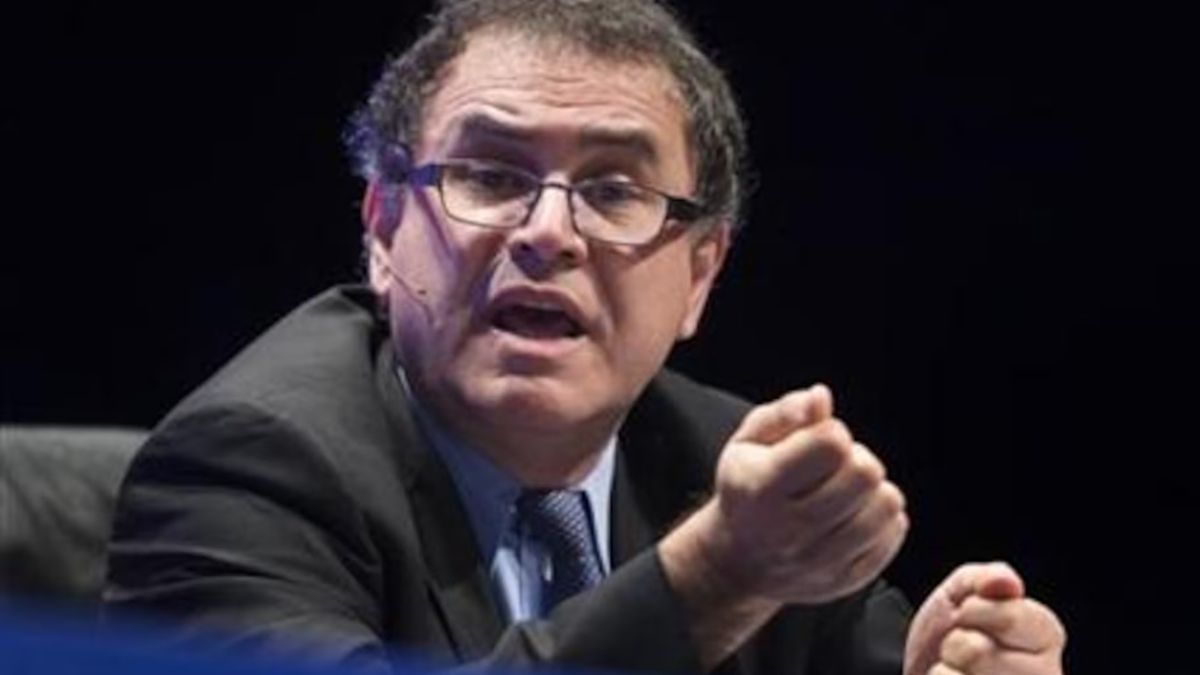
Turkish-American top economist Nouriel Roubini believes artificial intelligence will transform the global economy so deeply that governments will eventually have little choice but to provide a universal basic income to citizens.
Speaking in an interview with Bloomberg TV, Roubini said raising the retirement age will not solve future economic challenges because AI and robots will replace a large share of workers over the next two decades. Instead, he said that governments will have to create new systems that support people both during their working years and after retirement.
“A large chunk of the population is going to be replaced by AI and robots in the next 20 to 25 years,” Roubini told Bloomberg TV. “Eventually, we need some form of universal basic income for everybody while they work and once they retire. We’re already on the way,” he added.
Roubini made the remarks while discussing the future of Social Security in the United States. The trust fund that helps pay retirement benefits is expected to run short of money by 2032, raising concerns over how future retirees will receive benefits.
The economist, widely known as “Dr. Doom” after correctly warning about the 2008 global financial crisis, said the answer does not lie in asking people to work for more years. He believes technology will reshape the labour market much faster than policymakers expect.
Why does Roubini think universal basic income is unavoidable?
According to Roubini, artificial intelligence will become the biggest technological revolution in human history. He expects AI to evolve into artificial general intelligence (AGI), where machines match or even exceed human thinking and problem-solving abilities, reported Bloomberg TV.
He believes this technological leap will sharply increase productivity and economic growth. Roubini predicted global GDP growth could rise from around 2% to 4% by the end of this decade to about 6% by 2040 and even reach 10% by 2050, reported Bloomberg TV.
That rapid expansion, he said, would create enormous wealth. Governments could then collect more taxes from companies and individuals who benefit the most from AI and redistribute that money to the rest of society. “We’ll either have an ex-post distribution, that is universal basic income, or we’ll have it ex-ante,” Roubini told Bloomberg TV. “Ex-ante means some form of socialism,” he added.
He added that governments may eventually take ownership stakes in major technology companies as another way to share the financial gains created by AI.
Roubini referred to Financial Times report that OpenAI has discussed the idea of giving the public a stake in the company so that ordinary people can benefit from the success of artificial intelligence. He suggested such ideas show that policymakers and technology companies have already started thinking about new economic models.
He believes some form of wealth redistribution has become difficult to avoid. “We’re already going in that direction, effectively,” he told Bloomberg TV.
Is Roubini worried about AI replacing human jobs?
Although many people view AI-driven job losses as a major threat, Roubini rejected the idea that his forecast is pessimistic. Instead, he described it as an optimistic vision of the future. He argued that if machines perform most work while economies grow much faster than today, governments will have enough resources to support people financially.
“It’s actually an optimistic scenario,” he said, pointing to an economy with “10% growth” and “machines doing all the work.”
OpenAI CEO Sam Altman has previously suggested that governments may eventually provide a guaranteed income if AI replaces large numbers of jobs, although he has since softened that position. Earlier this year, the United Kingdom’s investment minister also said the government was considering universal basic income as one possible response to AI-related job disruption.
Tesla and SpaceX CEO Elon Musk has also predicted that advances in AI and robotics could make work optional within the next two decades, allowing people to choose whether they want to work instead of depending on employment for income, reported Fortune.
Roubini believes this transformation will not happen overnight, but he sees it as the likely direction of the global economy. In his view, artificial intelligence will create enormous wealth while forcing governments to rethink how income and opportunity are shared across society.


