




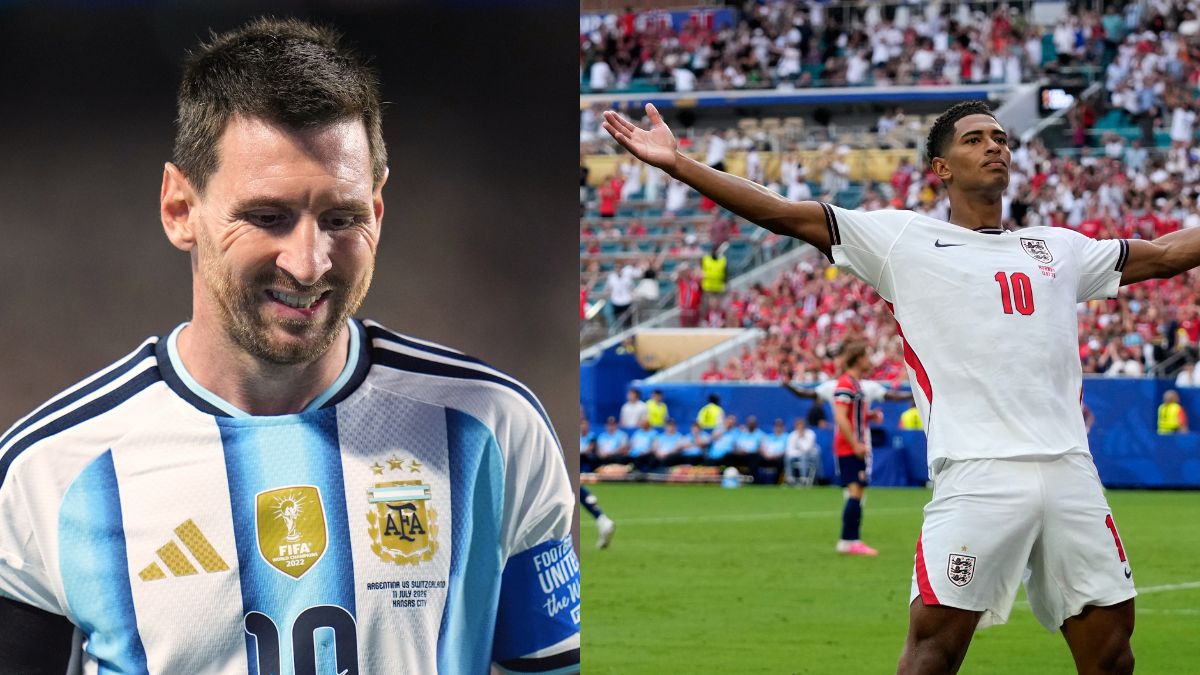
The 2026 FIFA World Cup has been narrowed down to four teams, with the tournament now entering the semi-final stage. France take on Spain in the first last-four clash on Wednesday (12:30 am IST), followed by England’s blockbuster meeting with Argentina on Thursday (12:30 am IST).
While FIFA is celebrated as the time when every nation unites in a spirit of sport and unity, a sense of the inseparability of geopolitics from football is also associated with it. The most fascinating example of this is the ‘Falkland rule’.
The FIFA Referees Committee follows this guideline when appointing match officials to ensure absolute neutrality on the pitch.
Under this policy, English referees are strictly prohibited from officiating matches involving Argentina, and likewise Argentine referees are barred from England’s fixtures.
The Falkland Islands dispute behind FIFA’s policy
The geopolitical backstory begins back in 1982, the ‘Falkland War’, a brief but sad war between the United Kingdom and Argentina over the sovereignty of the Falkland Islands.
The Argentines called it ‘Guerra de las Malvinas’. The tension swiftly turned into a major football rivalry as four years later the two competed aginst each other in the 1986 FIFA World Cup quarter-finals.
The match featured Diego Maradona’s infamous “Hand of God” goal and his stunning “Goal of the Century.” Ever since, the face-off between these teams has become a heated rivalry.
Why FIFA does not appoint English referees for Argentina matches
FIFA wants to keep things fair, as an English referee might cause controversy, and any decision against Argentina might instantly shift away from a simple human error to allegations of political bias.
A clear example of this protocol occurred during the Qatar FIFA World Cup when English referee Michael Oliver was heavily considered the best for officiating the World Cup final.
But because Argentina advanced to the final, Oliver and his crew were taken out of refereeing the official match.
Argentina vs England: Head-to-head record in World Cups and overall
Wednesday’s face-off will be the sixth meeting between the two teams. Earlier, they played five official matches, where England stood higher with three wins and Argentina with one, plus a draw.
The very first match was played during the 1962 group stage at Rancagua, Chile, and was won by England with a score of 3-1.
England took over the match with an early penalty scored by Ron Flowers and the second one scored moments before half-time. Later, Jimmy Greaves scored the third goal, while José Sanfilippo netted Argentina’s only goal of the match.
England defeated Argentina 1-0 in another FIFA World Cup match at Wembley Stadium in 1966. An important incident occurred during this second face-off when Antonio Rattin, the captain of Argentina, was sent off in the 35th minute for refusing to leave the field.
The game saw only a lone goal in the 77th minute by Geoff Hurst, giving England another win against their inextricably linked rival.
Argentina’s 2-1 victory over England in the 1986 FIFA World Cup quarter-finals is regarded as one of the tournament’s most memorable matches.
It was played on June 22 at Mexico City’s Estadio Azteca and featured Diego Maradona’s controversial ‘Hand of God’ goal as well as his extraordinary solo strike, often considered the ‘Goal of the Century’.
Argentina overcame England in a penalty shootout following a thrilling 2-2 draw in the Round of 16 of the 1998 FIFA World Cup.
On June 30, the game was played at the Stade Geoffroy-Guichard in Saint-Étienne, France, and Argentina won 4-3 from the penalty spot.
England edge Argentina through Beckham’s winning penalty in 2002
Just before half-time, Michael Owen was pulled down inside the penalty area by Mauricio Pochettino. David Beckham stepped up and drove his spot-kick low and hard down the middle to seal a gutsy 1-0 victory for England.
Why the policy still matters today
As England and Argentina prepare to meet once again on the World Cup stage, FIFA’s long-standing policy remains in place to ensure the spotlight stays on the football rather than the officials. By avoiding referee appointments that could raise questions over impartiality, the governing body aims to minimise controversy in one of international football’s most historic rivalries.


