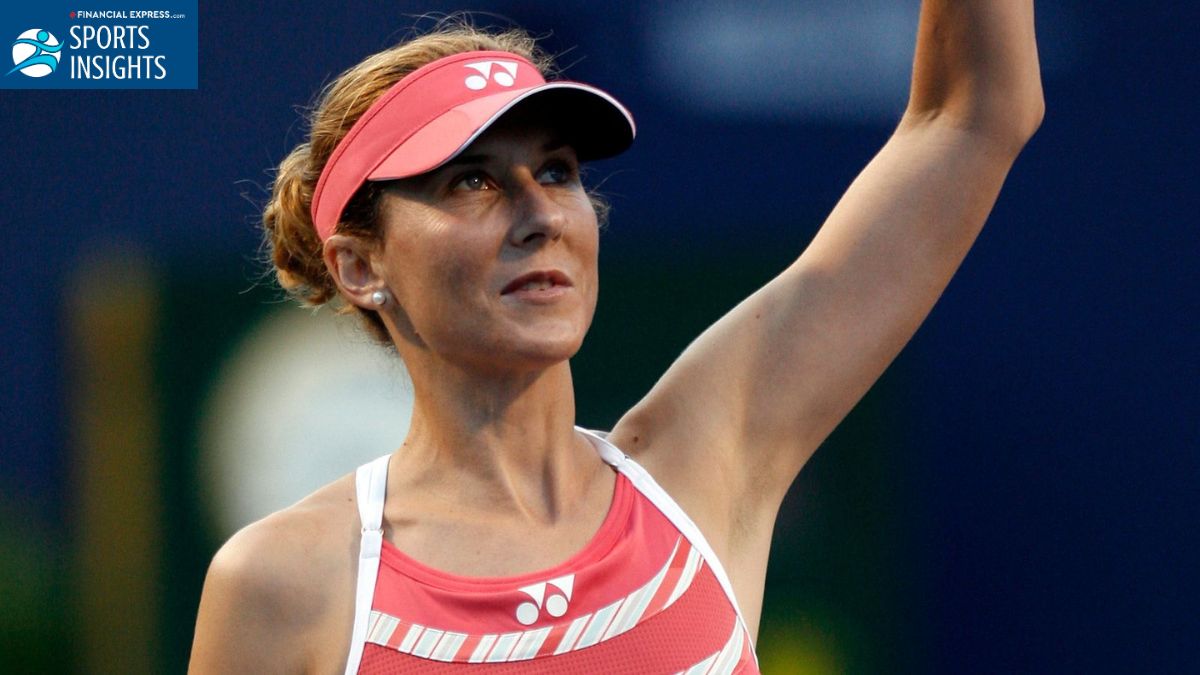
In April 1993, Monica Seles was the best tennis player alive, 19 years old, and about to lose everything except her money sense.
Six weeks after a stranger stabbed her on a changeover bench in Hamburg, the players she had beaten for two straight years voted to take away the one thing the sport still owed her: her ranking. That vote, more than the knife, is the real beginning of this story.
The wound nobody saw
On April 30, 1993, during a changeover in a quarterfinal match at the Citizen Cup in Hamburg, a 38-year-old unemployed German lathe operator named Gunter Parche walked onto the court with a five-inch boning knife and plunged it into Seles’s back, directly between her left shoulder blade and her spine.
The physical injury healed inside two weeks.
What could not be closed was the discovery that came after.
Parche did not deny what he had done. He told police he only wanted to hurt her badly enough that she could not play tennis for a long time. His idol was Steffi Graf. Seles was standing in the way. The German courts effectively agreed with his logic.
He spent under six months in detention and received two years of probation, the judges reasoning that he posed no danger to society as long as Seles was not playing tennis. Seles never set foot on a German court again.
That was the state’s failure. The tour’s failure came next, and it hurt more.
Rome, and a room full of rivals
While Seles lay in seclusion battling depression, post-traumatic stress and a binge eating disorder she told almost no one about, the WTA gathered its top players in Rome to decide something simple on paper and brutal in practice: should her No. 1 ranking be frozen while she recovered?
Her rivals said no.
Steffi Graf and Arantxa Sánchez Vicario both raised doubts about restoring Seles’s ranking automatically. Only Gabriela Sabatini voted to protect it. Seles remembered exactly who stood where.
“Gaby thought about a human being before thinking about a dollar amount or ranking points that a lot of players wanted at that point,” Seles said. “So that speaks to the tremendous character of Gaby.”
Read that quote again and notice what it is really saying. It is not praise for one friend. It is a verdict on everyone else in that room. The tour Seles had given her childhood to had looked at an empty No. 1 seat and voted, quietly, to let the market decide who filled it.
A cartoonist’s daughter
To understand how far that vote had strayed from where Seles began, go back to Novi Sad, in what was then Yugoslavia, where her father Karolj Seles, a cartoonist by profession, was trying to get a bored nine-year-old interested in tennis.
She had wanted to be an ice skater. The snow-clad mountains around Novi Sad made that dream feel natural. But her father, Karolj, was a professional cartoonist and television producer. He understood storytelling. He understood engagement. He took a tennis ball and drew Tom and Jerry on it. “You’re the cat,” he told her. “That’s the mouse. Go get it.”
That playful deception produced a player of terrifying intensity. By eleven, she had won the Junior Orange Bowl in Miami. Nick Bollettieri, the legendary coach who ran an academy in Florida, spotted something in her that he did not see in the wealthy American kids who paid full tuition.
He sponsored her move. She trained for free. By fifteen, she was a professional. By fifteen years and nine months, she was in the world top 10. By sixteen years and six months, she had beaten Steffi Graf in the final of the French Open, becoming the youngest Grand Slam champion in history.
Between January 1991 and February 1993, Seles entered 34 tournaments and reached the final in 33 of them. Her match record was 159 wins and 12 losses. In Grand Slams, it was 55 wins and one solitary defeat. She won eight of the last eleven Grand Slam events she entered.
She was nineteen years old and already the most commercially valuable female athlete on the planet, pulling in $7 million in endorsements in 1992 alone, a figure that dwarfed her record-breaking $2.6 million in prize money. Nike wanted her. Fila had already signed her to a $4 million apparel deal. Yonex had locked her into an $18 million racket contract.
This was the player the tour declined to protect.
From flat fees to ownership
Before Hamburg, Seles’s commercial life ran on the standard model of the time: flat-fee endorsement contracts, $4 million with Fila, $18 million with Yonex, both carrying reduction clauses that let the brand cut payments if she missed tournaments or slipped in ranking.
It is a sensible structure for a sponsor. It is a dangerous one for the athlete, because it puts the entire financial risk on a body that can be injured in a single afternoon.
When Seles returned to the tour in August 1995 after a two and a half year absence, she came back with her brother Zoltan and IMG’s Stephanie Tolleson working a different playbook entirely. Instead of chasing bigger fees, she started asking for ownership. Stock. Co-branded product lines. Rights that did not evaporate the moment she stopped winning matches.
Nike gave her a five-year deal worth fifteen to $25 million dollars and even built her a signature shoe, the Purple Haze. But Nike’s contracts, like most of that era, forbade athletes from selling advertising space on their own sleeves.
That single restriction, small on paper, had become intolerable to a woman who had learned exactly what it felt like to have her career controlled by someone else’s committee. In 2000, she left for Yonex.
The new deal was almost a rebuttal to the old one. Seles kept the right to sell sleeve advertising herself. Her bonuses leaned heavily toward winning rather than merely competing. Yonex built an entire product line carrying her name, making her a partner in its growth rather than a face on its packaging.
Even Nike’s own global director of tennis marketing, Chris Vermeeren, admitted defeat plainly: “Monica has been great for the company, but we couldn’t come up with the same agreement.”
Sit with that sentence for a moment. A global sportswear giant could not structure a contract to hold onto a player who, three years earlier, had been recovering in seclusion from a stabbing and an eating disorder.
The market’s read on Monica Seles had changed completely. She was no longer a cost to be managed. She was a partner other companies now had to compete for.
A portfolio built like a bunker
Her personal money habits followed the same instinct. Growing up under real economic strain in Yugoslavia had taught Seles’s parents a defensive kind of discipline, and she carried it with her for life.
Rather than live the way sports stars of her stature usually did, she and Zoltan built a conservative, highly liquid portfolio, roughly seventy percent in tax-free municipal bonds, the rest in blue-chip names like Coca-Cola, General Electric and Home Depot. The rule was almost monastic: spend only the interest, around $450,000 a year, and never touch the principal.
She drove a Toyota Land Cruiser she had won as a prize in Japan. Her Sarasota estate, 5,871 square feet behind double security gates, was described by real estate agents as strikingly clutter free, the home of someone who trusted very little and controlled what she could.
Turning the wound into work
Even her private suffering eventually became a business relationship, and it is worth naming that plainly. In 2009, Seles published a memoir about her binge eating disorder, then became a paid spokesperson for Shire Pharmaceuticals’ medication for the condition, the first such drug to win FDA approval.
In 2022, she was diagnosed with myasthenia gravis, a rare, incurable neuromuscular autoimmune disease that causes severe muscle weakness, fatigue, and double vision. True to the blueprint she had established during her binge eating disorder campaign, Seles did not retreat into isolation.
In August 2025, she stepped forward as the face of argenx’s “Go for Greater” patient support initiative, synchronizing the launch with the 2025 US Open, the very tournament she had conquered in 1991 and 1992.
Argenx, a global immunology developer, sells the intravenous infusion Vyvgart and its subcutaneous counterpart Vyvgart Hytrulo. By securing argenx as a premier global sponsor of the US Open, Seles merged clinical biotech marketing with her personal narrative of triumph over physical limitation.
The man who stayed
There is one relationship in this story that never had a contract clause. Seles’s father Karolj, the cartoonist who once drew Tom and Jerry on a tennis ball to make a nine-year-old fall in love with the game, was diagnosed with cancer not long before Hamburg.
He fought it through the stabbing, through her disappearance from the tour, through her slow and painful return. He died in 1998, five years after his daughter was attacked, having spent his last years watching her rebuild a career and a self out of wreckage he could do nothing to fix from a hospital bed.
Seles has said little publicly about what those years cost her privately. She did not need to. Every clause she later fought for in a Yonex contract, every bond she refused to touch, every dollar she kept out of reach of another Rome-style vote, carries the same signature.
It is the discipline of someone who watched the people meant to protect her fail twice, once in a stadium and once in a conference room, and decided that the only guarantee left was the one she wrote herself.
Karolj Seles never saw the fortune, the fame beyond tennis, or the life Monica would eventually build. But he saw the one thing that mattered most. He saw his daughter return to the court when the world had already written her off. He saw her refuse to stay broken. And before he was gone, he saw the mouse catch the cat.