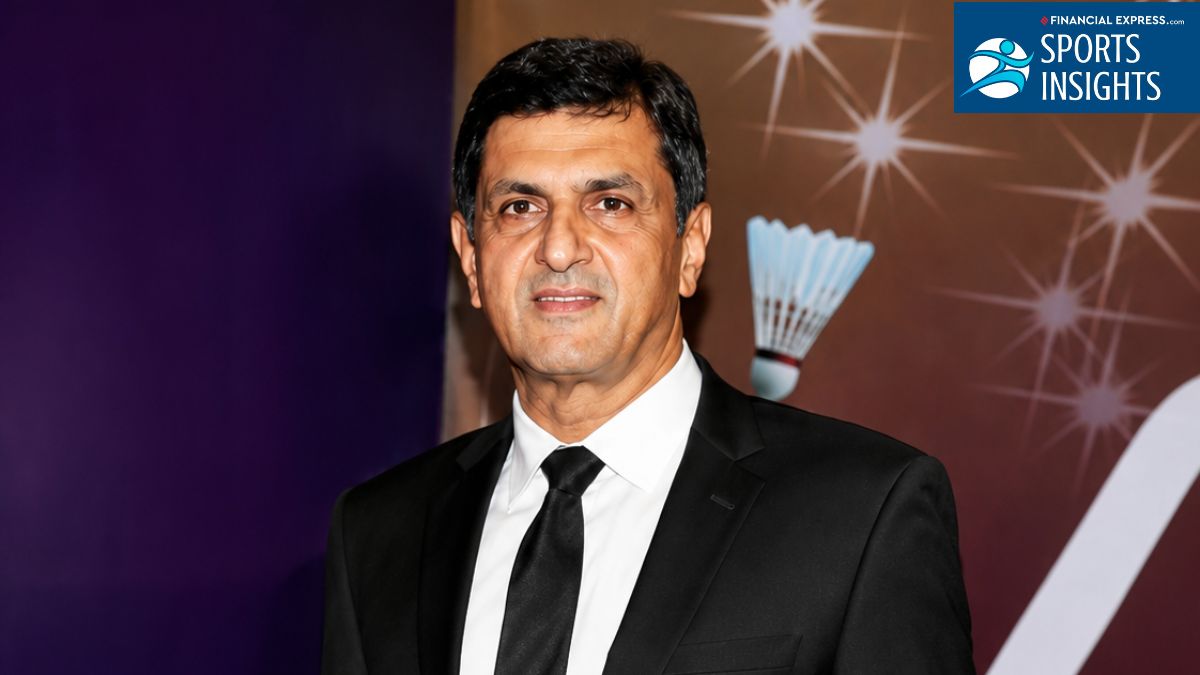
March 23, 1980. Wembley Arena. Cold.
Not Bangalore cold. London cold. The sort that makes a shuttlecock fly like it is angry. Prakash Padukone, 24 years old, clerk at Union Bank of India, walked onto the court to face Liem Swie King. The Indonesian had given away 46 points in four rounds. Third straight All England title on the line. The bookies laughed at the Indian. Back home, Bangalore was asleep.
Padukone beat him 15–3, 15–10. Did not drop a game all tournament. Last point: net-cord drop. Then a kill. Arena went quiet. Applause. Handshake.
Here is what nobody saw coming. This was not just a badminton match. It was a business model. For years Indian sport had been run like a government department. Athletes were civil servants with rackets.
Padukone just proved you could become world number one without a ministry file, without a state camp, without waiting for some bureaucrat to approve your foreign trip. Private money. A corporate sponsor willing to gamble. And the discipline to train like a professional, not a clerk.
Five days later Bangalore gave him a reception the newspapers compared to Wimbledon. Crowds. Speeches. Flowers. But underneath all that noise, an idea was forming. If one bank clerk could do this, what could a proper academy do?
Took 14 years for the answer to arrive.
The Coin Flip
To understand why Padukone mattered, go back 33 years. 1947. Another Indian in another All England final. Prakash Nath. Born in Lahore in 1920. Father Alok Nath was a hockey player. Family estate had its own badminton court.
Nath was so flexible his racket brushed his heel on overhead shots. Won the 1946 National Championship by beating his childhood friend Devinder Mohan. Both picked for London.
Chief referee Herbert Scheele put them in the same quarter. Only one could advance. So they flipped a 50-pence coin. Nath won. Mohan walked over. British press called it a scandal. The two friends called it common sense. Save energy. Give India a shot.
Nath beat local favourite Radford to reach the final. Morning of the final, he opened The Times. “Lahore in Flames.” His neighbourhood — Abbott Road, Nesbit Road, Gawal Mandi — was burning. Did not know if his family was alive. Played Denmark’s Conny Jepsen in a daze. Lost 15–7, 15–11.
Came back to a partitioned India. Family safe. Home and business gone. Survived Partition riots, retired at 27, moved to Bombay, built an electronic machine tools business, never played again.
Nath had everything. Talent. Private court. Wealth. What he did not have was a system. No federation to protect him. No sponsor to catch him when he fell. Padukone spent his whole life making sure no Indian athlete would repeat that story.
Cement and Girders
Padukone was born in Bangalore in 1955. Father Ramesh Padukone ran the Mysore Badminton Association. No indoor facilities. So at age seven in 1962, Padukone started training at the Canara Union in Malleswaram.
It was a wedding hall. Cement floor. No shock absorption. Low metal girders hung from the ceiling. Hit a high clear and the shuttle struck the bars. So Padukone learned to keep the shuttle low. Flat clears. Wrist drops. Not because a coach taught him. Because the architecture forced him.
Wedding season locked the players out for six months. They tracked marriage schedules and rushed back the moment the bookings ended. Padukone lost in the first round of his first tournament, the Karnataka State Junior Championship, in 1962. By 1970 he was National Junior Champion.
That same year he saw Rudy Hartono play an exhibition in Jabalpur. Power. Aggression. Relentless. Padukone changed his style overnight. In 1971, at 16, he became the youngest National Senior champion. Nine straight titles followed. 1971 to 1979.
But national titles do not win you Olympics. Before turning 18 he played the Thomas Cup and saw how East Asian teams trained. Year-round. Scientific. Then Union Bank, his employer, partly funded a six-week camp in Indonesia.
He watched their national team do strength conditioning in structured camps. Came back. Added weights. Result: gold at the 1978 Commonwealth Games. Then Wembley.
After 1980 he moved to Denmark. Played for Hvidovre Club in the Danish League. Trained with Morten Frost. One of the first Asians to base himself in Europe.
The message was clear. Government camps before big tournaments were not enough. You needed continuous professional training. Since the government was not building it, someone else had to.
The Academy
Padukone retired in 1989. Chaired the Badminton Association of India. Coached the national team from 1993 to 1996. Found the state system slow. Bureaucratic. Indifferent to athletes trying to compete with China and Korea.
On October 1, 1994, he co-founded the Prakash Padukone Badminton Academy in Bengaluru with U. Vimal Kumar and industrialist Vivek Kumar. India’s first private, corporate-sponsored coaching model.
They made one crucial decision. Full scholarships. Pure merit. Housing, equipment, travel, training — all covered by corporate partners. No kid turned away because their parents could not afford a racket.
First partner: BPL Ltd. Consumer electronics giant. Rajiv Chandrashekar and Ajit Nambiar backed it for 10 years. Then Tata Group came in for 12 years through the Tata Padukone Training Centers.
On September 5, 2019, Infosys Foundation signed a five-year, ₹16-crore MoU. ₹3 crore in year one. ₹3.25 crore after that. Sudha Murty ran it. Focus was Tier-2 and Tier-3 cities. Elite group grew from 45 to 65 players across Under-13 to Under-19.
This was not charity. It was investment. And it was working.
Vivek Kumar’s Bet
The academy needed space. Vivek Kumar, former Karnataka state champion, sold his company Trident Powercraft and poured over ₹50 crore of his own money into a 15-acre complex near Bengaluru airport. The Padukone-Dravid Centre for Sports Excellence.
Advisory board: Padukone and Rahul Dravid as co-chairs. Viren Rasquinha. Nandan Kamath. The centre housed Dolphin Aquatics, cricket under K. Jeshwant, football, tennis, squash. Ran on rent and profit-sharing with academies on campus.
And here is the clever part. The centre gave the Sports Authority of India a ten-year rent-free deal for the Abhinav Bindra Targeting Performance centre. Advanced sports science. Rehabilitation. Hydrotherapy.
Elite Indian athletes got top-tier care free of charge. The government did not build it. A private entrepreneur did. The government got access. The athletes got treatment. The centre got sustainability.
“The Only Way Back Is to Return on Court and Play”
The best proof of the model was Aparna Popat. She joined in 1994. Sixteen years old. Moved from Mumbai to Bengaluru to train under Padukone, Vimal Kumar, and physical trainer V.R. Beedu.
She never waited for perfect conditions. She made the most of what she had, trained harder than everyone else, and turned every setback into motivation. The result? 9 consecutive National Women’s Singles titles from 1997 to 2006, matching Prakash Padukone’s remarkable record.
Then February 2000. Drug test. Phenylpropanolamine. Active ingredient in a common cold medicine. She had written it on her declaration form. They banned her for a year anyway. Ranking crashed from 23 to nearly 80.
She told Padukone she was done. Could not face it. Wanted to retire. He told her: “The only way back is to return on court and play.” Brought her back to the academy. Shielded her from the press. Focused her on strokes, footwork, strength.
When the ban ended she rebuilt to 23 and qualified for the 2004 Athens Olympics. India’s only women’s singles representative.
Her last stand came at the 2006 National Championships in Bangalore. Beat 15-year-old Saina Nehwal in the final for her ninth consecutive title. A wrist injury ended her career soon after. But the point was made. The state banned her. The private sector saved her.
From One Academy to 400 Athletes
By the late 1990s Padukone knew one sport in one city was too small. India needed a multi-sport machine. The idea came from Geet Sethi. English billiards champion. MBA from B.K. School of Business Management in Ahmedabad. Ran a travel agency called Raag Travels.
At the 1998 Bangkok Asian Games and the 2000 Sydney Olympics, Sethi watched Indian athletes struggle. No preparation. No medical care. No mental conditioning.
On a flight from Sydney to Mumbai he sketched a plan on a napkin and showed it to Padukone. In 2001 they co-founded Olympic Gold Quest (OGQ). Section 8 non-profit. Foundation for Promotion of Sports and Games.
OGQ operated outside government. Approved funding in 48 hours. Equipment. Medical care. International camps. No committees. No ministry sign-offs.
Funding came from CSR, private equity, donations. Tax deduction under Section 80G. Recognised as 501(c)(3) in the US. In FY ending March 31, 2025, the foundation generated ₹94.8 crore in annual revenue.
Viren Rasquinha, former hockey captain, runs it as MD and CEO. OGQ supports around 400 athletes across 10 Olympic and 8 Paralympic sports. 150 junior scholars. 101 para-athletes. Spends ₹15 lakh to ₹60 lakh per senior athlete annually. Training. Coaching. Sports science.
The numbers are unbelievable. 13 out of 21 Indian Olympic medallists from London 2012 through Paris 2024 were OGQ athletes. At the Tokyo and Paris Paralympics, OGQ-supported athletes won 35 out of 48 Indian medals. This is not sponsorship. This is a medal factory.
The Fight
None of this came easy. By 1997 Padukone was at war with the Badminton Association of India (BAI). He called it arbitrary, unconstitutional, and non-professional. President Fazil Ahmed ran it like a fiefdom. Padukone led a rebellion, becoming the face of the breakaway Indian Badminton Confederation (IBC). Players and state units followed him.
BPL Ltd publicly backed Padukone. Said they would fund his academy no matter what the BAI thought. The BAI, led by Executive President V.K. Varma, threatened to ban any player who joined the IBC from representing India. Warned Air India and Indian Railways employees that their jobs were at risk.
Pullela Gopichand and Aparna Popat had their European Circuit entries withheld. The International Badminton Federation stepped in. Directed the BAI to submit the entries. Called for a settlement.
Fazil Ahmed resigned. V.K. Varma became president. Padukone accepted Executive President role until June 2000. The precedent was set. National federations could no longer ignore private academies and corporate sponsors. The private sector had proven it could produce champions. The state had to share the stage.
What Comes Next
On October 1, 2025, Padukone stepped down at 70. The PPBA became the Centre for Badminton Excellence. Vimal Kumar and Vivek Kumar took charge. Lakshya Sen and P.V. Sindhu train there.
In June 2025, Padukone and his daughter Deepika launched the Padukone School of Badminton. Funded by Deepika’s Ka Enterprises. Managed by Aditya Prakash. Nine states. Over 200 students. A grassroots pipeline, not a residency model.
Padukone also invested in Machaxi, a Bengaluru sports-tech startup from 2022. Through Ka Enterprises and Zerodha’s Rainmatter. AI-backed performance tracking. Junior players analyse their own data.
In Hyderabad, Pullela Gopichand’s academy — founded 2004 on five acres of state land, funded by Nimmagadda Prasad and a personal home mortgage — follows the blueprint Padukone drew. Saina Nehwal, P.V. Sindhu, Kidambi Srikanth came from there. Gopichand himself came from Padukone’s academy.
Two academies. One lineage. And one man who proved the government does not need to own Indian sport for Indian sport to win.
The Last Shuttle
That March evening in 1980, after Padukone had beaten Liem Swie King and shaken hands with officials he barely knew, he walked back to the players’ area. The arena was emptying. The lights were still bright.
He sat on a bench and looked at his racket. Same racket he had used at the Canara Union in Malleswaram, where the floor was cement and the ceiling had girders and the weddings locked him out for half the year. Same racket he carried to Denmark, Sweden, Indonesia, every cold court where nobody expected an Indian bank clerk to win.
He did not give a victory speech. He packed his bag, walked into the London evening, and caught a flight home. Five days later Bangalore gave him a reception fit for Wimbledon. But the real victory was quieter. It was the idea that settled into everyone who watched him: Indian sport could be built by Indians, funded by Indians, and run by Indians — without waiting for a government file to move.
45 years later, that idea is an industry. The ecosystem Padukone built now spans a ₹94.8-crore annual non-profit in Olympic Gold Quest, a ₹50-crore multi-sport complex on the outskirts of Bengaluru, and corporate partnerships running into tens of crores more. Four hundred athletes. Thirteen Olympic medallists. Thirty-five Paralympic medals.
And one man, now 70, who still remembers what it felt like to train on a wedding hall floor, waiting for the marriages to end so he could play.