




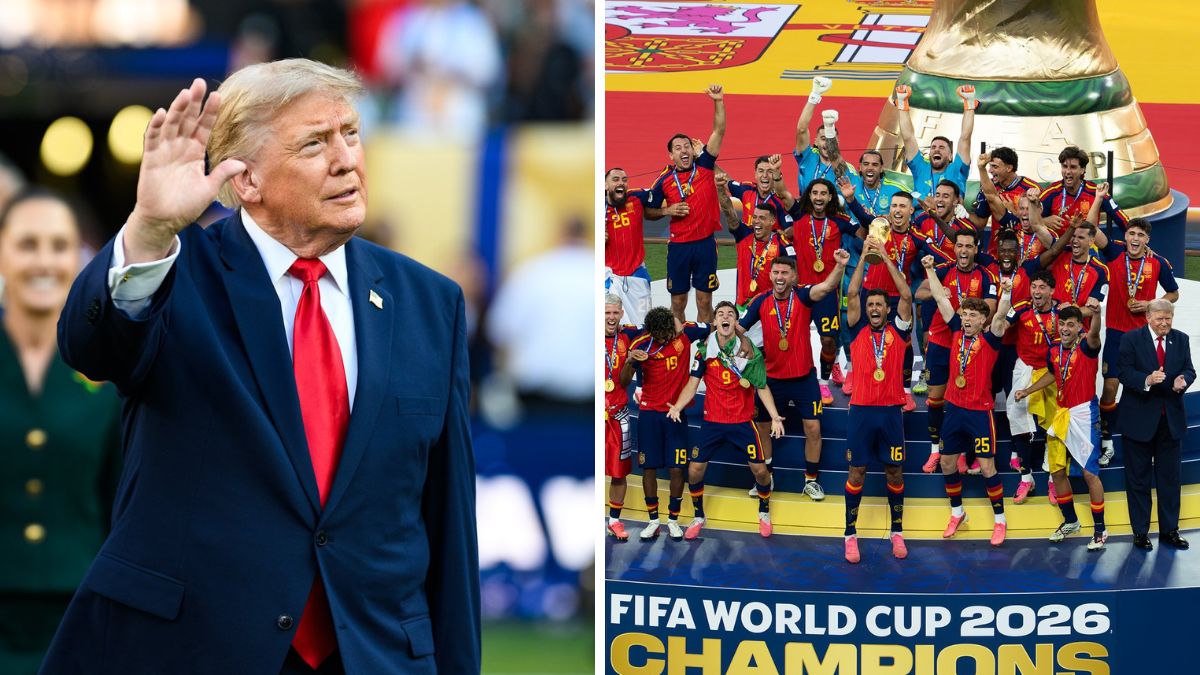
Spain defeated Argentina 1-0 after extra time at New York New Jersey Stadium on Sunday, with Ferran Torres breaking the deadlock in the 106th minute to deliver La Roja their second FIFA World Cup title. “It was a goal scored by 47 million people,” Torres said afterwards, referring to Spain’s population.
But while Spain celebrated with the trophy and Argentina reflected on a dramatic final featuring Emiliano Martínez’s world-record 12 saves and Enzo Fernández’s red card, the tournament produced another winner whose triumph may become evident only with the passage of time.
The United States did not lift a trophy. In fact, Mauricio Pochettino’s side bowed out in the Round of 16. Yet by the time the curtain fell on the first 48-team FIFA World Cup, America had arguably achieved something even more significant—cementing its status as the commercial capital of global sport.
How did the United States emerge as one of the biggest winners of FIFA World Cup 2026? The answer lies in the unprecedented scale of the tournament, the commercial success it generated and the economic opportunities it created.
The Biggest World Cup Ever
The 2026 World Cup expanded from 32 to 48 teams and from 64 to 104 matches, with the United States hosting 78 of those matches across 11 stadiums—roughly three-quarters of the entire tournament.
That scale translated directly into record commercial returns.
On the eve of the final, FIFA President Gianni Infantino told member associations in Manhattan that FIFA’s revenue for the 2023-26 commercial cycle would exceed $15 billion (around ₹1.42 lakh crore), comfortably surpassing the original $11 billion budget and almost doubling the $7.57 billion (around ₹71,915 crore) generated during the previous four-year cycle built around Qatar 2022.
The World Cup itself accounted for approximseo tately $11 billion (around ₹1.04 lakh crore) in revenue, according to FIFA, revised upward from an earlier estimate of $9 billion (around ₹85,500 crore) as ticket sales, hospitality demand and commercial revenues exceeded expectations.
That works out to an average of nearly $106 million (around ₹1,007 crore) in revenue generated per match.
The Economic Dividend Is Still Being Measured
The tournament concluded only on Sunday, meaning its full economic impact will take months to assess.
Before the World Cup began, a FIFA-commissioned study by the World Trade Organization and Oxford Economics projected that the tournament would generate $30.5 billion (around ₹2.90 lakh crore) in economic output, contribute $17.2 billion (around ₹1.63 lakh crore) to U.S. GDP and support around 185,000 jobs.
Those figures remain projections rather than audited outcomes, and many of the jobs were expected to be temporary.
Some early indicators have already prompted caution. U.S. tourism data for June—the tournament’s opening month—showed international visitor numbers broadly flat year-on-year, suggesting the final economic impact may differ from pre-tournament forecasts.
Alex Lasry, Chief Executive Officer of the FIFA World Cup 2026 New York New Jersey Host Committee, said after the final that the tournament’s economic impact had “exceeded expectations”, although the committee has yet to release an audited post-event economic assessment.
More Than Football
The United States also became the stage for several FIFA firsts.
The governing body staged its inaugural World Cup final halftime show, curated by Chris Martin of Coldplay and featuring Madonna, Shakira, Justin Bieber and BTS in support of the FIFA Global Citizen Education Fund.
Separately, around 50,000 fans gathered at Central Park’s Great Lawn for what organisers described as the largest official World Cup final public watch party anywhere in the world.
Together, they reflected something larger than football: America’s ability to transform a sporting event into a global entertainment spectacle.
How Did the United States Eventually Win?
Spain left New Jersey as world champions.
FIFA departed with the richest tournament and the most lucrative commercial cycle in its history.
The United States, meanwhile, strengthened its position as the world’s preferred destination for mega sporting events.
The projected $30.5 billion (around ₹2.90 lakh crore) economic impact will continue to be debated, and economists will spend months assessing how much of it ultimately materialised. But some outcomes are already beyond dispute.
America successfully staged 78 matches, welcomed millions of spectators, generated record ticketing and hospitality revenues, and provided the infrastructure and commercial ecosystem that enabled FIFA to transform the first 48-team World Cup into the most valuable tournament in football history.
Spain won the trophy.
Beyond the pitch, the United States may have secured the more enduring victory.
America’s Infrastructure Became FIFA’s Biggest Asset
Much of that commercial success rested on American infrastructure.
The United States offered world-class stadiums, premium hospitality suites, sophisticated ticketing systems and one of the world’s strongest corporate sponsorship markets—advantages few countries can replicate at such scale.
Matchday and hospitality revenue reached a record $3 billion (around ₹28,500 crore), more than tripling the $950 million (around ₹9,025 crore) generated during Qatar 2022. Broadcasting rights remained FIFA’s single largest income stream, contributing $4.2 billion (around ₹39,900 crore), or roughly 39 per cent of the governing body’s commercial cycle revenue.
The tournament also distributed a record $1 billion (around ₹9,500 crore) in prize money, compared with $440 million (around ₹4,180 crore) in Qatar four years ago. Even so, prize money represented less than one-tenth of the tournament’s revenue, underscoring how the business of the World Cup has outgrown its sporting rewards.
| Revenue Stream | Qatar 2022 | North America 2026 |
| FIFA four-year cycle revenue | $7.57bn (₹71,915 crore) | $15bn (₹1.42 lakh crore) |
| World Cup revenue | — | ~$11bn (₹1.04 lakh crore) |
| Matchday & hospitality | $950m (₹9,025 crore) | $3bn (₹28,500 crore) |
| Broadcasting rights | — | $4.2bn (₹39,900 crore) |
| Prize money | $440m (₹4,180 crore) | $1bn (₹9,500 crore) |


