‘The world’s mine oyster.’
This phrase was reportedly first used by William Shakespeare in his play The Merry Wives of Windsor. It means having absolute freedom and limitless opportunities to do whatever one wants and achieve what one desires.
US President Donald Trump can be accused of many ills, but humility isn’t one of them. Hence, the line is apt for describing what he thinks of himself and his place in the scheme of things in the world.
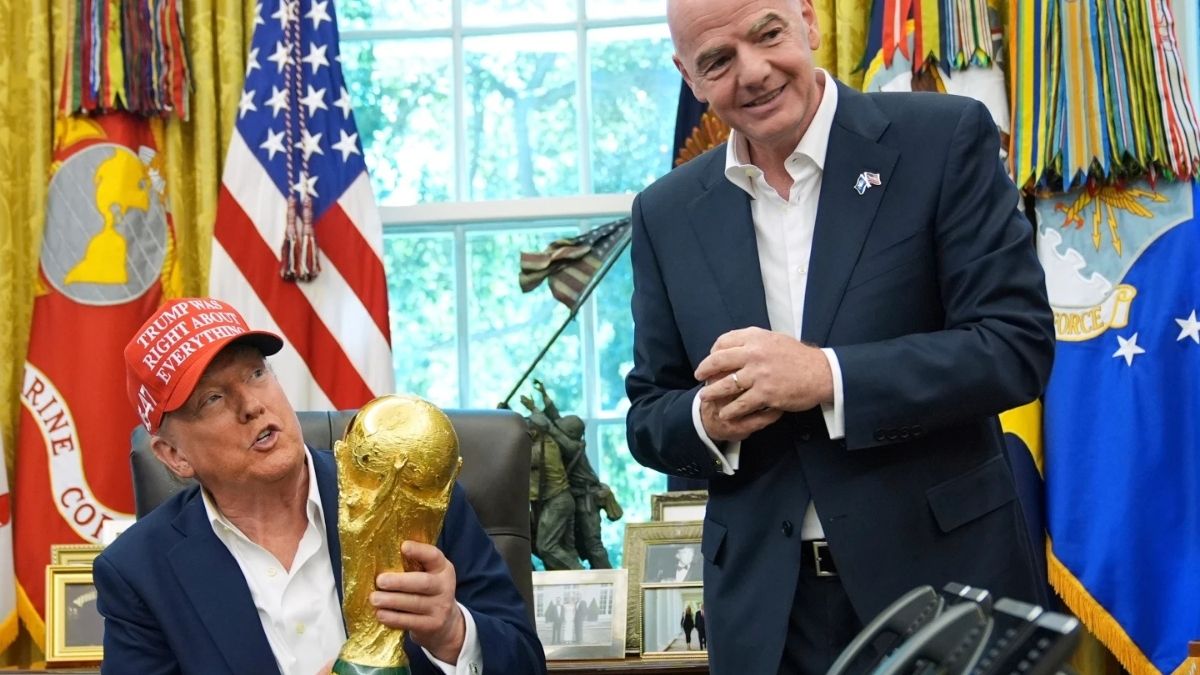
How else can one explain his reported backing for FIFA president Gianni Infantino as the next United Nations secretary-general? The tenure of incumbent Antonio Guterres ends in December, and his successor has to be elected by then.
The UN secretary-general can be called the most high-profile diplomat in the world, and the role requires a great deal of knowledge, experience and expertise about a large number of issues. Guterres served as the Prime Minister of Portugal from 1995 to 2002, and according to various polls, has been considered among the best. He was also the UN High Commissioner of Refugees before becoming secretary-general in 2016. In contrast, before taking over as FIFA president, Infantino was head of the European football confederation UEFA.
Apart from the professional eligibility for the post, there is the small matter of being elected, even if one has the backing of arguably the most powerful man in the world. Six candidates have already thrown their hats in the ring for the top job at the UN, and all of them have been either presidents, vice-presidents or foreign ministers of their respective countries, or heads of other UN agencies.
But Trump is unlikely to be swayed by such small print. He believes Infantino to be widely respected and capable of bringing people together, based on what he has done over the past few months. It’s well known that the two have worked together in the lead-up and during the 2026 FIFA World Cup, which the United States co-hosted with Mexico and Canada. Conferring the first-ever FIFA Peace Prize on the US President wouldn’t have hurt their relations either.
Having his way
The just-concluded World Cup, the first to feature 48 teams, was touted as a big success, but it was not without controversy on and off the field. Trump and his administration could do as they pleased, whether it was not allowing a Somali referee to set foot on American soil or getting a red card on a US player set aside before a knockout game. The astronomical prices of tickets also burnt a hole in many fans’ pockets, and kept the tournament beyond the means of many of them.
This is apart from all the in-match controversies and the VAR (Video Assistant Referee) talking points and charges of favouritism against one particular team. Also, the introduction of hydration breaks, bringing football closer to American sports with their four quarters, as well as the half-time in the final stretching to nearly half an hour instead of the usual 15 minutes.
Hardly any edition of the FIFA World Cup can indeed be called totally free from controversy, but staging of a tournament – successful or otherwise – can’t become the basis for giving the chief executive a much larger diplomatic post, that would be responsible for maintaining peace and order throughout the world.
But according to the US President, Trump is right about everything. If Infantino can stage the biggest FIFA World Cup in history – even though the administrative side was totally controlled by the Trump administration – he is worthy of any major assignment.
Legendary Liverpool manager Bill Shankly once said: “Some people believe football is a matter of life and death. I am very disappointed with that attitude. I can assure you it is much, much more important than that.”
Trump wants to give a whole new spin to this idea. If Infantino can conduct a football tournament, he can bring peace in the Middle East, end the Russia-Ukraine conflict, solve the US-Iran impasse and make the world a better pl
Salvation on the field
It’s a mercy that the action on the field did the heavy lifting. The 2026 World Cup will be known for some unforgettable quality on the field. The best ‘team’ won, even though its brightest young star Lamine Yamal was nowhere close to his best and was often peripheral to proceedings.
Spain had so many match-winners in their ranks, some of them even coming off the bench, that the spotlight was never monopolised by one player. It’s a reflection of the La Roja side that triumphed in 2010, but even there, Xavi Hernandez and Andres Iniesta were more celebrated than Rodri now. That team was never dependent on its forwards for goals, even though they had pedigreed strikers like David Villa and Fernando Torres. Mikel Oyarzabal was their highest goal scorer in the 2026 tournament with five, but the Real Sociedad forward is still not a household name. Their next biggest contributor was Mikel Merino, who came off the bench to salvage the situation against Portugal and Belgium.
Their success was built around a watertight defence that was breached just once in eight matches. If the back door remains permanently shut, it gives the attackers all the confidence they need to keep the opposition under sustained pressure.
In terms of the team being the star, the side that comes closest would be the victorious West German side coached by Franz Beckenbauer and led by Lothar Matthaus in 1990. Ironically, Argentina were the opponents in that final as well and tried to break the rhythm of the superior team with overly defensive and physical play, hoping that their talisman (Diego Maradona then, Lionel Messi now) could provide one moment of inspiration that would make the difference.
A record that could stay intact for a long time is Kylian Mbappe’s tally of 22 goals, amassed in just three editions. Messi, whose record the Frenchman broke in the 10-goal third-place playoff, needed six tournaments.
In fact, Mbappe was widely tipped to lead Les Bleus to their third crown before their juggernaut was brought to a halt by the eventual champions in the semifinals.
All this shows that however the administrators and politicians try to push their vested agendas on sport, the action on the field, more often than not, has the final say.