




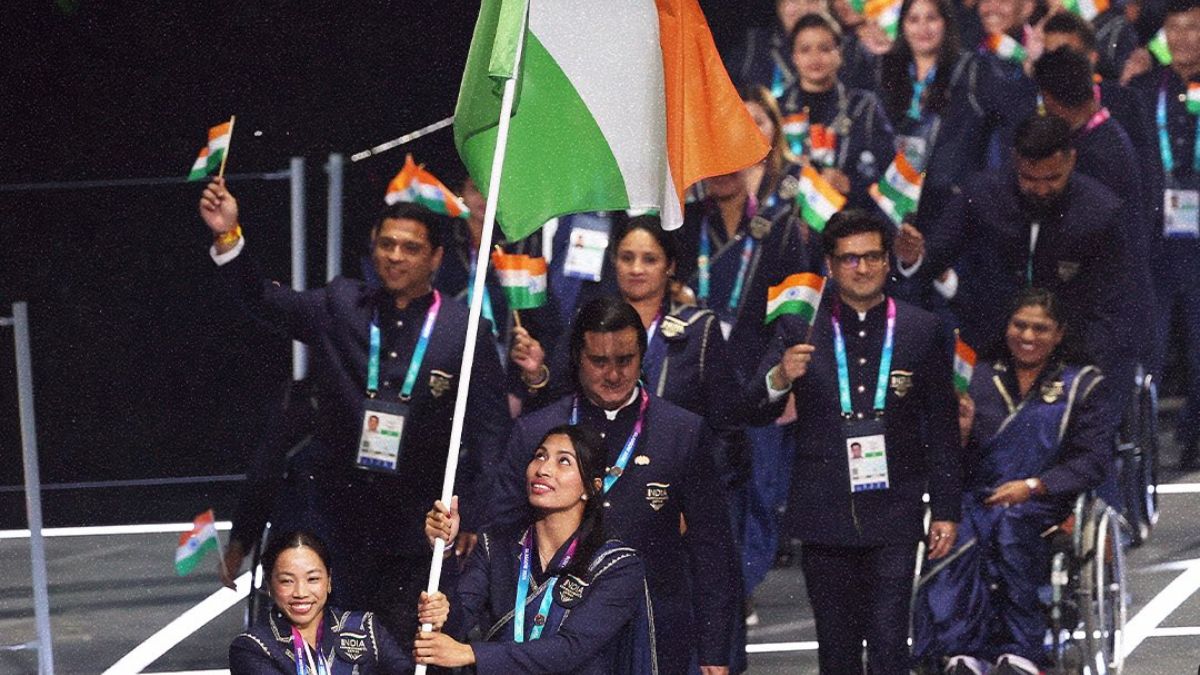
As the Glasgow 2026 Commonwealth Games run through 23 July to 2 August, a reduced 191-member Indian contingent, spearheaded by Neeraj Chopra, Mirabai Chanu and Lovlina Borgohain, is chasing medals in a Games stripped down to just 10 sports, nine fewer than at Birmingham 2022.
It is a fitting moment to look back at India at the Commonwealth Games across 92 years, a journey that has turned a nation content with a single wrestler on a distant podium into a top-four force capable of chasing a hundred medals on home soil. The story is not one of steady, linear growth but of long droughts punctuated by sudden leaps, each tied to a shift in which sport India chose to back.
The lone pioneers
India’s Commonwealth Games journey began at the 1934 British Empire Games in London, where a six-member contingent, competing only in athletics and wrestling, had no institutional machinery behind it. Welterweight wrestler Rashid Anwar delivered the solitary result that mattered: a bronze in the 74kg freestyle category, beating Wales’ Leonard Morgan before finishing behind two other finalists.
It remains, to this day, the medal every retrospective on India at the Commonwealth Games returns to as the starting point.
Independence did not immediately translate into podiums. It took until Cardiff 1958, 24 years after Anwar’s bronze, for India to add a gold to its Commonwealth Games account. Milkha Singh won the 440 yards on the track, while heavyweight wrestler Lila Ram claimed gold in the same edition. Wrestling remained the spine of India’s effort through the following two decades, with Kingston 1966 and Edinburgh 1970 pushing the tally into double figures for the first time. Edmonton 1978 marked a different kind of milestone: badminton pair Ami Ghia and Kanwal Singh Thakur Singh became the first Indian women to win a Commonwealth Games medal, with a bronze in doubles.
The precision revolution
The 1990s changed the arithmetic of India at the Commonwealth Games. Targeted investment in shooting and weightlifting, sports where India could compete on more equal terms than in track and field, began paying off. Auckland 1990 saw India jump to fifth overall with 32 medals, 13 of them gold, driven by weightlifters such as Raghavan Chandrasekaran and an emerging shooting programme.
Manchester 2002 confirmed that shift was permanent. Pistol shooter Jaspal Rana anchored a dominant shooting effort, and the Indian women’s hockey team added a historic gold, as India finished fourth overall with 69 medals – 30 of them gold, at the time its best Commonwealth Games showing.
Delhi 2010: the high-water mark
Hosting the Commonwealth Games for the first time gave India its greatest campaign yet. New Delhi 2010 produced 101 medals, 38 gold, 27 silver and 36 bronze, enough for second place overall behind Australia and the only time India has crossed the hundred-medal mark at the Commonwealth Games. Shooting alone delivered 30 medals, 14 of them gold, led by Gagan Narang and Abhinav Bindra.
Wrestlers took 19 medals from 21 competitors, and Krishna Poonia’s discus gold ended a 52-year wait for an Indian athletics gold at the Games. Geeta Phogat also became the first Indian woman wrestler to win Commonwealth Games gold, and gymnast Ashish Kumar delivered India’s first medals in that discipline.
The Games came at a heavy cost, with preparation spending reported above $11.5 billion (roughly ₹95,450 crore at contemporary exchange rates) and lasting controversy over graft and delays, but on the field of play it remains the benchmark by which every later Indian Commonwealth Games campaign is measured.
Holding the line after Delhi
Since 2010, India at the Commonwealth Games has settled into a pattern of consistency rather than escalation, helped along by the removal of sports such as archery and Greco-Roman wrestling from several host programmes, disciplines that alone had accounted for 19 of Delhi’s medals.
Glasgow 2014 brought 64 medals and fifth place. Gold Coast 2018 improved that to 66 medals, 26 of them gold, and third place overall. Birmingham 2022 yielded 61 medals and fourth place, with the wrestling contingent producing a clean sweep of 12 medals from 12 weight categories entered.
India at the Commonwealth Games: 92-Year Historical Summary (1934–2026)
| Edition | Host City | Gold | Silver | Bronze | Total | Overall Rank | Key Milestones & Defining Highlights |
| 1934 | London, England 🇬🇧 | 0 | 0 | 1 | 1 | 12th | CWG Debut: Rashid Anwar wins India’s 1st CWG medal (Bronze in 74kg Freestyle Wrestling). |
| 1958 | Cardiff, Wales 🏴 | 2 | 1 | 0 | 3 | 8th | 1st Gold Medals: Milkha Singh (440 yards track) & Lila Ram (Heavyweight Wrestling) win Gold. |
| 1966 | Kingston, Jamaica 🇯🇲 | 3 | 2 | 2 | 7 | 6th | Wrestling dominates with 3 Golds (Bishan Singh, Mukhtiar Singh, Bhim Singh). |
| 1970 | Edinburgh, Scotland 🏴 | 5 | 3 | 4 | 12 | 6th | First double-digit medal tally; Wrestling delivers 5 Gold medals. |
| 1978 | Edmonton, Canada 🇨🇦 | 5 | 4 | 6 | 15 | 6th | Ami Ghia & Kanwal Singh Thakur Singh win India’s 1st female CWG medal (Badminton Bronze). |
| 1990 | Auckland, New Zealand 🇳🇿 | 13 | 8 | 11 | 32 | 5th | Precision Era Begins: Weightlifting wins 24 total medals (12 Gold); Shooting debuts on podium. |
| 1994 | Victoria, Canada 🇨🇦 | 6 | 11 | 3 | 20 | 4th | Compact 10-sport format; Jaspal Rana’s breakthrough in Shooting alongside Weightlifting core. |
| 2002 | Manchester, England 🇬🇧 | 30 | 22 | 17 | 69 | 4th | Major Leap: Indian Women’s Hockey team wins iconic Gold; Shooting delivers 30 medals (14 Gold). |
| 2006 | Melbourne, Australia 🇦🇺 | 22 | 17 | 11 | 50 | 4th | Shooting dominates with 27 medals (16 Gold), led by Samresh Jung (5 Golds, Best Athlete). |
| 2010 | New Delhi, India 🇮🇳 | 38 | 27 | 36 | 101 | 2nd | All-Time Peak: India crosses 100 medals on home soil; Krishna Poonia & Geeta Phogat win historic Golds. |
| 2014 | Glasgow, Scotland 🏴 | 15 | 30 | 19 | 64 | 5th | Vikas Gowda (Discus Gold) & Parupalli Kashyap (Badminton Gold) anchor post-Delhi performance. |
| 2018 | Gold Coast, Australia 🇦🇺 | 26 | 20 | 20 | 66 | 3rd | Neeraj Chopra wins Javelin Gold; Table Tennis team sweeps 8 medals led by Manika Batra. |
| 2022 | Birmingham, England 🇬🇧 | 22 | 16 | 23 | 61 | 4th | Wrestling delivers a 12-for-12 medal sweep; Women’s Lawn Bowls Fours wins historic Gold. |
| 2026 | Glasgow, Scotland 🏴 | TBD | TBD | TBD | TBD | TBD | Trimmed 10-Sport Format: Roster excludes Shooting, Wrestling, Badminton, Hockey, TT, and Cricket. |
A leaner test in Glasgow
Across all editions since 1934, India’s Commonwealth Games medal count now stands well past 500, built overwhelmingly on wrestling, shooting and weightlifting, with badminton, table tennis and hockey adding depth in more recent decades. Glasgow 2026 tests that legacy under unfamiliar conditions: wrestling, badminton, table tennis, hockey, cricket and squash, sports that have carried India’s medal tallies for decades, are absent from the programme altogether, leaving athletics, boxing, weightlifting, judo, swimming, cycling and gymnastics to carry the load.
What began with one wrestler alone on a London podium in 1934 has become a sporting infrastructure now facing its leanest Commonwealth Games menu in years, a real test of whether India’s Commonwealth Games story can still find new peaks when its most reliable sports are taken off the table.


