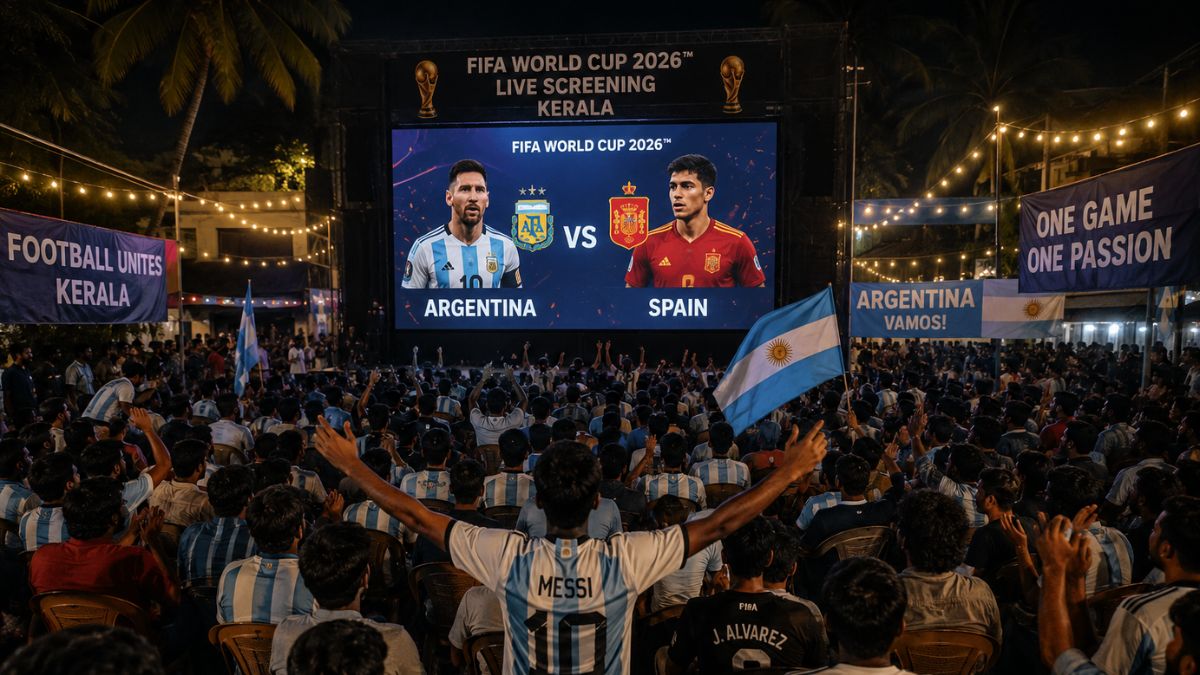
In a small town in Malappuram district, Sharafu Maravattam has spent the days before Sunday’s FIFA World Cup final doing what he has done every four years since Brazil 2014: arranging projector rentals, finding someone to pay the electricity bill and hoping the monsoon doesn’t wash away another temporary shed.
“In my radius of 10 kilometres, there may be more than 10 screenings,” Maravattam, a football enthusiast and former president of Manjapada, the official supporters’ brigade of Kerala Blasters FC told Financialexpress.com. “Ninety-nine per cent are not associated with Eagles FC or anyone.”
Why did he name Eagles FC one may wonder. The distinction, necessary always, has become sharper this year. For the first time, Kerala is hosting an organised, commercial public-viewing operation alongside the hundreds of neighbourhood screenings that have long defined the state’s World Cup culture.
Eagles FC Kerala, in partnership with Zee’s Unite8 Sports, is operating official fan parks in Kochi, Kozhikode and Thiruvananthapuram for the tournament’s closing weekend. The flagship venue at Kochi’s Rajiv Gandhi Indoor Stadium features a 10-foot replica of the FIFA World Cup trophy and what organisers describe as India’s largest indoor LED screen. \
The Kozhikode venue is being promoted as the largest in the Malabar region, while the Thiruvananthapuram fan park is billed as the biggest in the Travancore region. Those claims have not been independently verified.
The official rollout arrives as Argentina prepare to face Spain at MetLife Stadium in New Jersey. India, meanwhile, remains absent from football’s biggest stage. The men’s national team has never played a FIFA World Cup match, having come closest in 1950 before withdrawing after qualifying by walkover.
Yet Kerala has never needed India to qualify in order to embrace the tournament.
The economics of a koottam
Where Eagles FC’s fan parks rely on sponsorships, branding and large-scale infrastructure, Kerala’s traditional World Cup screenings run on something far simpler. Known locally as koottam, a gathering, they are organised by neighbourhood youth clubs, residents’ associations and groups of friends.
“Most of the people are daily workers or daily labourers,” Maravattam said. “They are setting up the facility by bearing their own money. They are not looking for funds.”

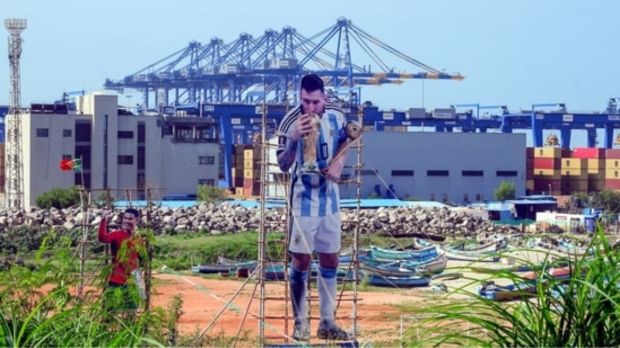
The model is almost entirely community-driven. A projector is rented. One resident pays the electricity bill. Another arranges seating. A local businessman may sponsor refreshments or contribute towards equipment. Because this year’s World Cup falls during Kerala’s monsoon, many neighbourhoods have also spent their own money erecting temporary sheds to protect spectators from the rain.
For Maravattam, the motive has never been commercial. “People aren’t looking to make money,” he said. “They just want everyone in the community to experience the World Cup together.”
From plastic chairs to professional fan parks
The official fan parks are not replacing Kerala’s football culture. They are formalising it. According to an Eagles FC Kerala representative, previous World Cups were almost entirely driven by local communities.
“Until the last edition of the World Cup, there was no standardised or professional screening. Local communities, school unions and housing societies would simply come together, put up a projector and show the match.”
The representative said Kerala’s football culture made the expansion possible. “People in Kerala follow football naturally. The football culture here is on another level compared to other parts of India. Football is as popular as, or even more popular than, cricket in the state.”
All three official fan parks have been designed as indoor venues because of the state’s unpredictable monsoon. Open-air screening was ruled out early, the representative said: “If it rains, it will be a problem for fans. That’s why everything is indoors.”
More community than commerce
For Faheem Barami, a Kozhikode-based journalist who has closely followed Kerala’s football culture, the official fan parks represent an addition rather than a replacement.
“North Kerala has always loved football, especially during the World Cup. People gather to celebrate, make noise and enjoy the atmosphere together. That’s what these screenings are really about.”
Barami believes the commercial aspect is often overstated. “I don’t think this is mainly about investment. Most venues have free entry. Sponsors get visibility because large crowds turn up, but the bigger objective is bringing people together.”
He also pointed to changing audience patterns. “Every World Cup, the crowds become bigger. This time I’ve noticed more women attending than before, and people are travelling from other districts to watch the matches.”
Together, the official fan parks and the informal neighbourhood screenings form two parallel World Cup ecosystems: one organised, branded and sponsor-backed, the other volunteer-driven, community-funded and largely invisible in financial terms.
Why Kerala never runs out of football fans
Barami says the state’s football loyalties have been inherited across generations. Brazil first captured Kerala through Ronaldo, Ronaldinho and Kaká. Argentina followed through with Diego Maradona before Lionel Messi inspired another generation. Cristiano Ronaldo then helped Portugal become the state’s third major football tribe.
“Parents who supported Brazil or Argentina passed those loyalties to their children. Messi has created an enormous Argentina following, while Ronaldo has done the same for Portugal,” he said.
Those loyalties explain why Sunday’s final is expected to draw enormous crowds despite India having no stake in it.
Two economies, one final
For Maravattam, however, the draw has never been the teams alone. Screens at home cannot replicate what the koottam offers, he said: “Most people already have televisions or mobile phones. They can watch the match from home. But they come to the public screenings because the atmosphere is almost like a stadium. Fans of every team gather together and experience the match as a community.”
By kickoff on Sunday, money will have flowed across Kerala through two very different systems. One comes from sponsors, partnerships and organised fan parks. The other comes from neighbourhoods pooling cash, renting projectors and building temporary shelters with their own hands.
Neither depends on India being at the World Cup. Together, they explain why, even without a single appearance on football’s biggest stage, Kerala continues to celebrate the FIFA World Cup like a place that has always belonged there.