





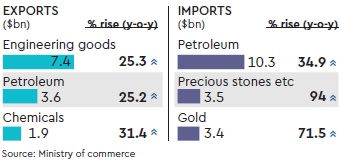
Merchandise export growth slowed sequentially to 12.4% in December, while imports jumped 21.1% during the month, aided by a spike in crude oil prices and a favourable base, showed the official data released on Monday. Imports, in absolute terms, touched a three-year high of $41.9 billion in December, while exports touched $27 billion, driving up trade deficit to $14.9 billion, again a three-year peak. However, excluding the almost 35% rise in oil purchases from overseas (thanks to a 19% increase in crude prices from a year earlier), overall imports rose 17.2% in December. Barring oil, a 71.5% jump in imports of gold and 94% surge in those of pearls, precious and semi-precious stones and a 19% rise in electronic items pushed up overall imports. Analysts said imports of gold, and pearls, precious and semi-precious stones jumped considerably in December, contrary to expectations, suggesting a restocking exercise after the festive season. In a comfort for policy-makers, even non-petroleum and non-bullion exports in December rose a decent 12.1%. Interestingly, exports of meat, poultry and dairy products grew an impressive 80.6% to $505.6 million, despite a crackdown on illegal abattoirs in Uttar Pradesh, which accounts for a bulk of the country’s buffalow meat exports, earlier last year. The engineering goods segment continued its good performance and recorded a 25.3% expansion in exports in December to $7.36 billion.

Also, services exports during November rose 8.8% to $15.39 billion, improving from a 3.1% rise in the previous month. Services imports in November rose at a faster pace of 10.9% to $9.64 billion. In October, services imports had grown 3%. But analysts say the key to any improvement in export competitiveness will be how much the currencies of its peers move against the dollar when the rupee is mostly appreciating. Aditi Nayar, principal economist at Icra, said with the trade deficit averaging $14.2 billion per month in the just-concluded quarter, Icra expects the current account deficit to record a considerable y-o-y deterioration to $16-18 billion in Q3 FY18 from $8 billion in Q3FY17, and $7 billion in Q2FY18. “Despite elevated commodity prices, an unfavourable base effect is likely to weigh upon the pace of growth of exports and imports in Q4 FY18. Overall, the CAD is likely to widen nearly three-fold to $42-44 billion in FY18 from $15 billion in FY17,” she said. Higher imports augur well for export prospects as well, as the share of import-intensive export sectors in overall exports rose from 35% in 2000 to around 45% in 2015.


