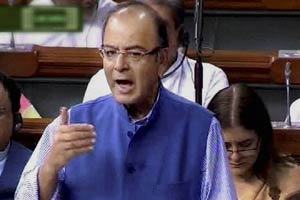
Finance minister Arun Jaitley on Thursday reduced the damage potential of a recent redefinition of corporate residency for tax purpose in India and gave minimum alternate tax (MAT) exemption for the income foreign companies earn in India by way of of capital gains, interest, royalty and fee for technical services.
Replying to the debate on the Finance Bill, 2015, in the Lok Sabha, which later passed it by a voice vote, he also extended MAT relief to real estate investment trusts (REITs) to make this investment vehicle, yet to gain traction due to lack of conducive tax regime, more attractive.
Even as the minister stopped short of rescinding the MAT notices slapped on foreign portfolio investors (FPIs) for their past capital gains, he broadened the prospective waiver by extending the same to all “foreign companies” in cases where the relevant tax rates fall below the MAT rate of 18.5%.

In a significant move, he relaxed the new OECD-compliant definition of residency proposed in February by stating that residency would be attributed only if a firm’s place of effective management (POEM) is in India.
As per the earlier proposal, a company would have been deemed resident in India if its POEM “at any time of the year” in the previous year was in India. The government has now deleted the phrase “at any time of the year” in what would allay the fear that a single board meeting in India could practically get a firm residency tag and consequent tax liability in India.
Foreign companies as well Indian ones with many overseas arms have said that the POEM rule as proposed in February could have adverse consequences for them, despite the double taxation avoidance agreements coming to their help in many cases. The residency redefinition is aimed at dissuading the creation of shell companies outside the country by companies that are controlled from India to avoid paying tax here.
The minister obliged investors keen to set up REITS by allowing MAT exemption at the time of exchanging the shares of the special purpose vehicle with the units of the business trust set up as part of organising this business. As per the existing rules, only tax neutrality is allowed at the time of the unit swap. “I propose MAT exemption from the gain or losses arising from the exchange of shares with the business trusts. MAT will be applicable only on actual transfer of such units,” Jaitley said.
He announced some indirect tax changes for the benefit of exporters of low-grade iron ore, rubber growers and silk producers and promised release of an “extremely simplified” income-tax return form soon.
Faced with stiff resistance from the Reserve Bank of India (RBI), he decided not to strip the central bank of the power to regulate government securities at least for the time being and deferred the setting up of an independent Public Debt Management Agency (PDMA). He, however, reiterated that public debt management would have to be carved out of the RBI.
He also provided a level playing field for private sector defence manufacturers by withdrawing excise duty exemption to state-owned defence companies and ordinance manufacturers. Also, additional duty of customs, countervailing duty and special additional duty on imports have been withdrawn.
On the PDMA plan, the minister said: “Since the RBI has been handling public debt management, the government in consultation with the RBI will prepare a detailed road map separating the debt management function and the market infrastructure from the RBI and having a unified financial market.”
The move to take away regulation of G-Secs from the RBI and give it to the market regulator Sebi was with the objective of bringing all financial products under the proposed unified financial sector super regulator, as recommended by the Financial Sector Legislative Reforms Commission. RBI governor Raghuram Rajan is believed to have disagreed with the move, saying lack of authority with the RBI to regulate government bonds would constrain monetary policy transmission. “This government is committed to unifying the financial market both by making the government securities part of this market as well as creating a proper bond currency derivative market,” Jaitley added.
The creation of PDMA, it is reckoned, would enable the RBI to focus on its core function of monetary policy (flexible inflation-targeting) and regulating banks. Such an agency is also expected to lower the government’s borrowing costs eventually and foster a liquid and efficient G-Sec market. The idea is also to resolve the conflict of interests involved in the RBI simultaneously targeting inflation and funding the government.
In what could give tax relief to cooperative sugar mills in Maharashtra, their taxable income will be computed after allowing deduction for their extra payment (over and above the fair and remunerative price fixed by the Centre) to the farmers. While the entire cane price payment in states like Uttar Pradesh was calculated as a mill’s expenditure by the income tax authorities, in the case of Maharashtra only the first instalment of payment to farmers was recognised as expenditure by the I-T department. This had resulted in higher income tax burden for Maharashtra cooperatives, who had to challenge such a discrimination in courts. Export duty on iron ore fines (with 58% iron content) has been reduced to 10% from 30%, a move welcomed by miners from Goa.
Jaitley also proposed changes to the special tax regime for broad-based fund managers such as sovereign wealth funds that he proposed in Finance Bill, 2015. The Bill had proposed certain conditions regarding the minimum number of investors, and the threshold of participation interest of a single member of the group or connected persons. Jaitley said these conditions are being dropped as sovereign wealth funds and pension funds regulated under the laws of their countries would not be able to fulfil them.
For Updates Check Economy News; follow us on Facebook and Twitter