




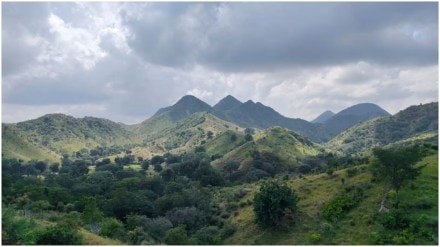
The central government’s assurance that it will not relax mining rules for the Aravallis offers little comfort to those alarmed by a newly adopted definition of this fragile ecological lifeline of north-west India. In November, the Supreme Court accepted recommendations of an environment ministry panel—ostensibly aimed at curbing mining—that defined Aravalli hills as landforms rising 100 metres or more above local relief.
The problem is that, according to an internal assessment by the Forest Survey of India (FSI), barely 8.7% of the range meets this threshold. The apex court had sought a uniform definition of the Aravallis last year to address regulatory ambiguity. Until now, the FSI has followed a slope-based criterion—any landform with a gradient of three degrees or more—since 2010.
A technical committee constituted last year proposed a more nuanced benchmark: a minimum slope of 4.57 degrees and a height of at least 30 metres. That definition would have protected nearly 40% of the hills. By contrast, the newly accepted cut-off has triggered legitimate fears that over 90% of the Aravallis could be left vulnerable.
What did environment minister say?
Environment Minister Bhupender Yadav has said that only about 2% of the 1.47 lakh sq km Aravalli range can be mined—and that too subject to studies. He has also assured that no mining permissions will be granted in Delhi, and that more than 20 reserve forests and protected areas in the Aravallis will remain safeguarded. The government has further clarified that two or more hills of 100-metre height located within 500 metres of each other—and the land between them—will be treated as part of the range. These assurances must not remain rhetorical.
Geographic significance of the Aravallis
Any dilution or interpretative leeway could worsen the ecological distress of a region already battling water scarcity and air pollution. The Aravallis stretch across Gujarat, Rajasthan—which accounts for nearly two-thirds of the range—Haryana, and Delhi, and perform irreplaceable ecological functions.
They recharge groundwater, stabilise soil, support wildlife corridors, moderate climate in semi-arid conditions, and act as a bulwark against desertification. In the context of toxic air pollution in the National Capital Region, their role becomes even more critical: the upper reaches trap finer pollutants, while the lower hills block heavier sand particles.
The government should dispel all ambiguity by clearly mapping the Aravallis—a step the court itself has ordered. With tools such as Geographic Information Systems readily available, authorities should prepare granular, publicly accessible maps down to the taluka level. The fate of the Aravallis can’t be left to the pressures of urbanisation and mining, both of which have long undermined the range. A 2023 study found that nearly 8% of the Aravalli hills disappeared between 1975 and 2019. It warned that if current trends continue, losses could rise to 22% by 2059, potentially allowing the Thar Desert to creep closer to Delhi.
The revised yardsticks are meant to curb illegal mining. But from an ecological standpoint, no blanket concession—even one limited to 1-2%—is necessarily benign. Mining viability depends on mineral deposits, but mining permissions should be guided primarily by environmental consequences, not just elevation. Urbanisation has unquestionably harmed the Aravallis—not because cities must inevitably destroy nature, but because of a deeply flawed planning model that prioritises land use over natural systems. For now, policy must err firmly on the side of conservation. The Aravallis are too critical to be reduced to a technical definition.


