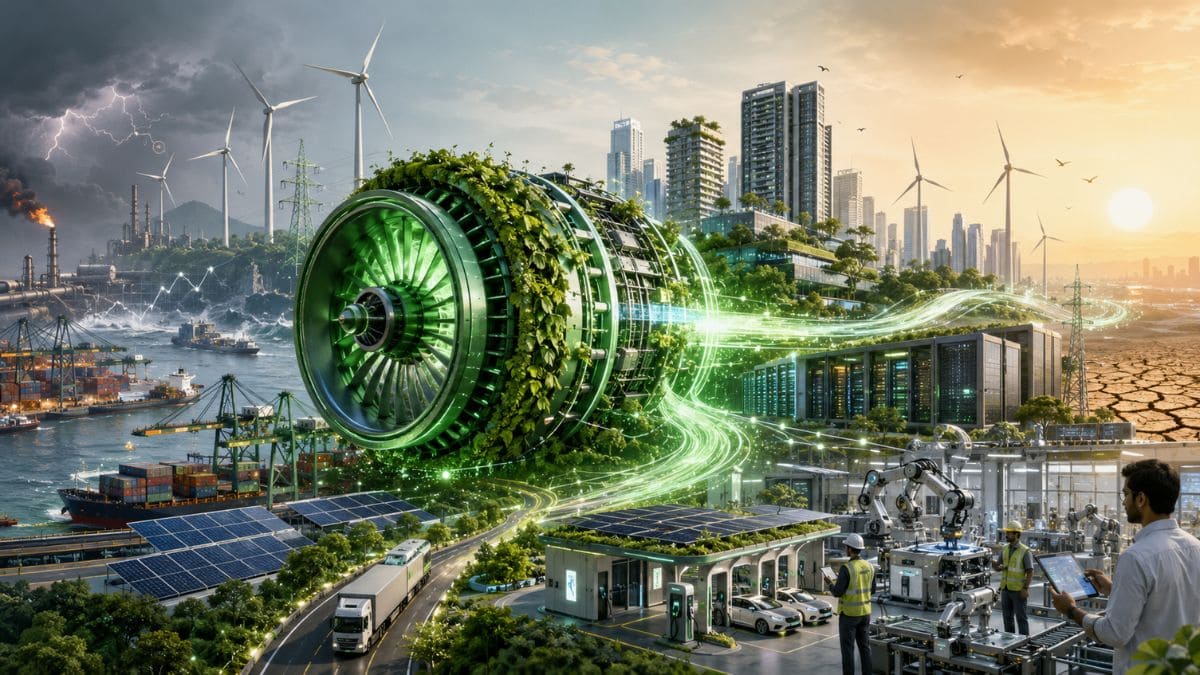
Three disruptions are reshaping the world in which Indian businesses are operating. None of them are temporary.
The first is geopolitical and geoeconomic. Military and trade conflicts are reshaping business as usual — whether it is the tariff wars of 2025 or the current West Asia crisis causing worldwide energy shocks. The bulk of these disruptions trace back to one root cause: fossil fuel dependence.
Fertilisers, food, cooking fuel, metal production, petrochemicals, shipping, aviation are all critically linked to oil and natural gas. This year alone, industrial hubs in India like the ceramics and steel sectors have faced shutdowns amid the energy crisis. Every business dependent on long global supply chains is exposed. What used to be a once-in-a-decade shock are hitting us several times a year now.
The second is technological. AI is rewriting cost curves and compressing decision cycles, making business models based on slow logistics or labour arbitrage obsolete. Crucially, it accelerates the green transition across multiple sectors — from energy-saving grid optimisation to rapid material research for efficient solar cells.
Yet, we must acknowledge the paradox: AI’s infrastructure is immensely resource-intensive, with data centres requiring vast amounts of energy and water for cooling. The Council on Energy, Environment and Water’s analysis shows that more than half of India’s data centres are already exposed to temperatures above 35°C for over 90 days annually; and due to climate change, nearly 90% could face similar heat exposure by 2040.
The strategic challenge for Indian leaders is to harness AI’s efficiency without allowing its footprint to undermine broader sustainability goals.
The third is planetary. India lost 247 billion labour hours to heat in 2024 alone — nearly $194 billion in potential income losses. The heat is felt most in agriculture and construction. But rising climate risks will reach other sectors too. Over 10,000 MSMEs lost more than `1,700 crore when Chennai flooded in 2015.
The response to all three disruptions converges in the same place: going green. Reducing fossil fuel dependency directly cuts geopolitical exposure. Building resource efficiency and supply chain resilience cuts climate vulnerability. And technology makes it cheaper and faster to get there than ever before.
Here is the frame Indian business leaders, boardrooms, and CEOs need to internalise. Pursuing green — cleaner energy, circular supply chains, resource efficiency, bio-based products — is competitive resilience and revenue growth.
Green builds resilience. Ørsted, a Danish energy company, had 85% of its portfolio in fossil fuels in 2006. It chose to flip that ratio in 2008 as a long-term strategy to remove its dependence on fossil fuel. Today, it has achieved a 98% reduction in emissions from its baseline and is the world’s largest offshore wind developer.
This means it is no longer exposed to fuel price volatility when conflict erupts in a faraway region. Hindustan Zinc, operating in water-stressed Udaipur, invested in water recycling and digital water management. It has recycled 71 billion litres of treated sewage water and cut freshwater usage by 28%.
Mars Inc launched a climate-smart rice initiative across four countries because 9-12% of its product portfolio depends on rice. It is investing in supply chain resilience before the crisis arrives, not after.
Green also drives growth. Godrej & Boyce’s Good & Green lines now represent over a third of revenues, targeting 50% by 2032 — driven by energy-efficient appliances, sustainable construction materials, and alternative refrigerants.
Infosys scaled its built environment by 1.7 times while increasing energy consumption by only 20% across 30 million sq ft of green-certified buildings. Companies like Heidelberg Materials are raising capital more cheaply than competitors, while demand for their low-carbon products outstrips supply.
So what should Indian business leaders do?
Map your exposure. How much of your input costs and supply chains are tethered to fossil fuels or long, fragile global networks? That is your starting point. The cost of inaction shows up as operational downtime, reputational damage, regulatory penalties, and a rising cost of capital as financiers price in these risks. Carbon taxes are already a reality in many markets Indian exporters serve.
Identify your green growth pathways. Four levers exist: new green product lines; resource efficiency and circular supply chains; green bonds and sustainability-linked finance; and talent. Demand for green skills is growing at nearly twice the pace of supply, according to LinkedIn’s 2025 Green Skills Report.
A recent study by CEEW suggests the green economy could attract over $4 trillion in investments and create 48 million full time equivalent jobs by 2047. Not every lever applies equally to every business. But at least one does.
Pursue green through innovation. Young Indian companies — Sea6 Energy in seaweed-based biofuels, Accacia.ai in carbon tracking for buildings — are creating new product and service categories.
Large businesses can accelerate this by funding innovators, building in-house R&D, or deepening industry-academia collaboration. For instance, IIT Bombay and JSW Steel are already doing this in sustainable steel.
Shift the internal frame. Stop asking “what is the cost of going green?” Start asking “what is the cost of not going green?” The answer, increasingly, is loss of revenue, rising costs, stranded assets, and an inability to attract the next generation of talent and capital.
The three disruptions are becoming structural transformations. For those willing to act, they are the greatest growth opportunity of our times. Green is not the responsible thing to do. It is the smart thing to do in a hotter world.
Disclaimer: The views expressed are the author’s own and do not reflect the official policy or position of Financial Express.