




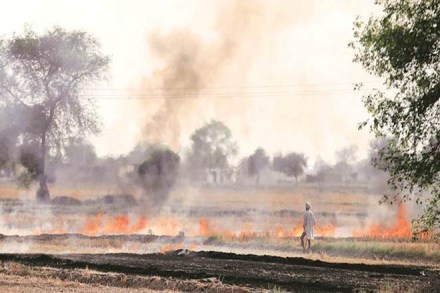
Part of Delhi’s winter asphyxia can be attributed to crop residue burning in Punjab and Haryana, various studies have shown. A new study by researchers from the University of Washington, the Oklahoma State University and the International Food Policy Research Institute (IFPRI) pegs the cost of crop residue burning at $30 billion annually, by raising the risk of suffering acute respiratory illnesses (ARI) for those who suffer exposure in greater doses vis-a-vis those who are exposed to other sources of outdoor pollution but a much smaller degree of crop residue burning. The study found that the frequency of reported ARI in Haryana was strongly correlated with the number of daily fires (mostly from crop burning) recorded for an area by satellite imagery. Compared to this, southern states, where both crop residue burning and cracker burning record a much lower frequency and intensity, showed much lower vulnerability to ARI. What is worse, outdoor pollution, from crop residue burning, vehicular pollution, crackers, etc, is negating the gains made in reducing indoor pollution. No wonder, the study estimates, a complete abatement of fire-cracker and crop residue burning could stem the loss of 4.2 million and 14.9 million years in terms of disability-adjusted life years, valued at 1.7% of India’s GDP over five years.
Read | Billionaire Baba: Patanjali’s Acharya Balkrishna among Forbes’ billionaire list
Studies also show that it is linked to irreversible impairment of pulmonary function among children aged 10-13 years. Apart from this, the practice has a deleterious impact on soil quality and alters soil microflora with serious implications for agriculture in the long-run. While the states have taken steps to discourage farmers—through heavy fines—the practice continues, likely meaning that farmers find paying the fines more economical than undertaking more environmental-friendly methods of getting rid of the crop stubble, like using happy-seeder machines. The NITI Aayog had suggested anaerobic burning of the waste in a closed brick-and-clay structure to produce a carbon-rich residue called bio-char that can be used as a soil nutrient. But, even this has proved difficult to implement, given the costs, and the government’s (states and the Centre) inability to defray it to an extent where the farmer doesn’t feel the pinch. The solution perhaps lies in weaning Punjab and Haryana away from paddy. Paddy cultivation in these regions, in fact, exacts a large environmental toll. Scaling down public procurement of paddy at MSP drastically in these states apart from getting rid of subsidised power and water are, thus, imperative.
Also read | Modi wave in action as most feel corruption is down, cost of living has fallen
India’s burden from non-communicable diseases (NCD), including respiratory illnesses, is increasing. Given the country was the first to set a target of reducing NCD-deaths by 2025, it needs to urgently act on curbing crop burning. The right strategy to do this will need to balance the needs of those whose exposure to pollution from crop stubble burning is high with the needs of the farmers. And, that would be quite the tightrope to walk.


