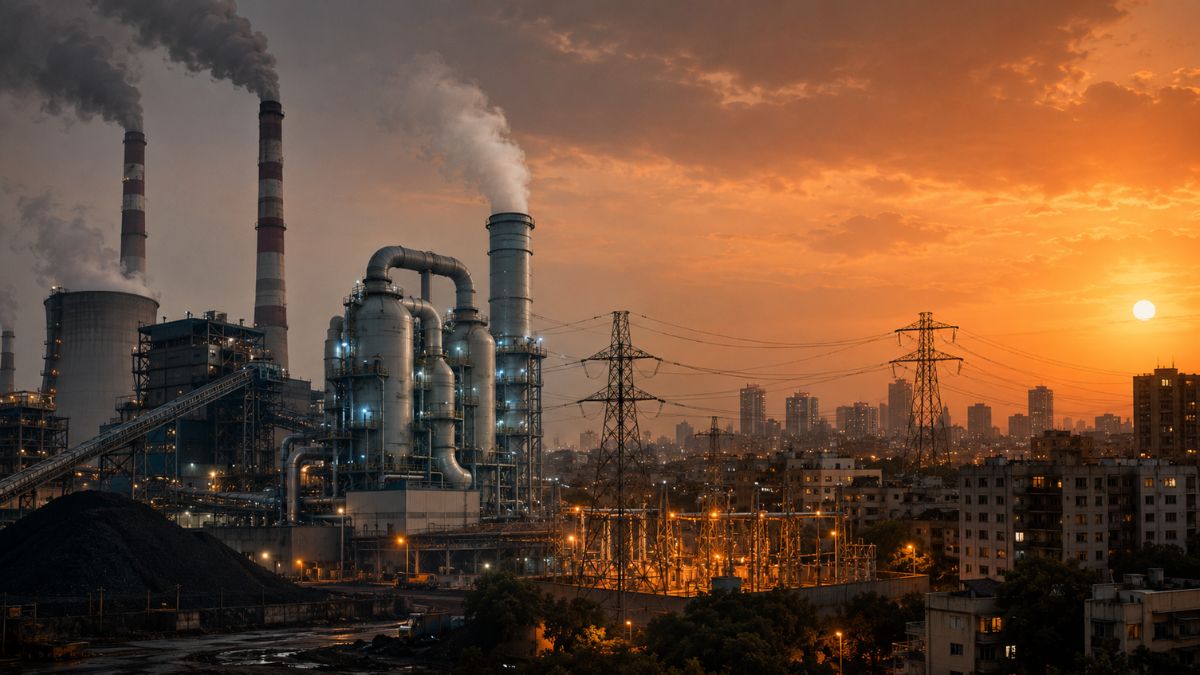
This piece is concerned with two unrelated issues linked to the power sector. First, a recent study conducted by two premium engineering institutes in India has concluded that the country should install flue gas desulphurisers (FGDs) in all its coal-based power plants. FGDs are meant to suck out sulphur from the flue gases emitted from power stations.
The sulphur in the flue gases adds to particulate matter in the atmosphere and therefore is detrimental to human health. Installation of FGDs has been prescribed even though sulphur content in Indian coal is relatively low.
Ironically, in a different study (2022) conducted by one of the two institutes concerned, it was mentioned that because the sulphur content in Indian coal is low, it makes little sense to install FGDs.
In fact, it went a step further. It revealed that in the process of removing sulphur from the flue gases, FGDs are releasing more carbon in the atmosphere, and thus installation would result in an increase in carbon footprint.
There is no denying that research is an evolving process where a subsequent study may come to a conclusion that is diametrically opposite to a previous one. However, when that happens, it confuses the policymakers regarding the next course of action.
The earlier study of 2022 was music to policymakers’ ears because India was not making any progress on the installation of FGDs. There were repeated dilutions to the environmental norms and in the final analysis, the government devised some norms and opined that only about 11% of the power stations need to install FGDs.
Though the revised environmental norms were first introduced in 2015, till as late as 2025, only a handful of power stations had installed FGDs. While the actual installation was zero for the state generators, only about 5% of the power stations in the central sector installed FGDs.
The private sector performance was a little better at 13%. There are several reasons for this poor performance. First, when the revised norms were issued in 2015, there was practically no domestic manufacturer of FGDs. Soon, there was a scramble to manufacture these, but the issue of cost and its effect on retail price of electricity came up.
The fixed cost would go up by about 70 paise per unit and there would also be an enhancement of variable cost to the extent of about 4 paise. Additionally, it was a nightmare for regulators since they did not know about the legitimate costs which should be allowed to the developer. Finally, there was also the question of space as many of the older plants did not have space to install FGDs.
While there is apparently no rethinking about installation of FGDs, the current talk is about the galloping demand for power and how to meet it. A new demand high of about 270 gigawatt (Gw) was met recently, but this does not mean that there are no power cuts.
The way shortages are estimated is complex, and outages due to dilapidated infrastructure are not taken into account. Several parts of the country are facing outages which can stretch for a few hours and affluent areas like Gurugram are no exception.
This is partly on account of dilapidated distribution infrastructure which can’t take the load. Not all discoms in the country have been able to upgrade their infrastructure (like Delhi, financed through retail tariffs). So ultimately, all the brouhaha about meeting a new demand high has to be taken with a pinch of salt and it is no reflection of consumer welfare.
Having said that, it may be added that it is not only a question of dilapidated infrastructure. There is a drastic fall in generation once the sun goes down, meaning our conventional supply sources — like coal, gas, nuclear — are struggling to meet the night load.
Uttar Pradesh has complained that power is not available in the exchange either. One is thankful that the peak demand has shifted to solar hours (3.30 pm) against the evening hours (7 pm) as it used to be earlier. The ageing coal-based fleet seems to be the culprit, as there are several outages due to enhanced power demand. Demand has surged due to excessive heatwave conditions necessitating prolonged use of air-conditioners.
This is a matter of concern as we have always boasted that we have more than ample capacity of coal-based generation. There have been statements from the government in the past that no fresh coal-based power stations would be set up.
There has, of course, been a volte-face and the latest position is that ~70-80 Gw of fresh capacity will be created by 2035. The actual realisation, incidentally, is only about 25 Gw in the last five years. If measured against the government’s own cumulative targets from 2021-22 to 2025-26, only 44% has been achieved pan-India, and if we measure only the central sector, it is even less at 42%.
To sum up, we seem to be heading for a crisis. Government directives to keep all coal and gas plants running has not been good enough. Our addition to renewable capacity, though substantial, is not enough to replace coal. Our battery back-up is almost negligible, so we can’t use solar power during non-solar hours.
Our growth in nuclear capacity is almost meagre and as for hydro, it is almost non-existent. There is no availability of gas in any case, and generation from gas stations is abysmally low. So, for the immediate future, only the weather gods can come to our rescue.
The author is Visiting Professor, ICRIER
Disclaimer: The views expressed are the author’s own and do not reflect the official policy or position of Financial Express.