




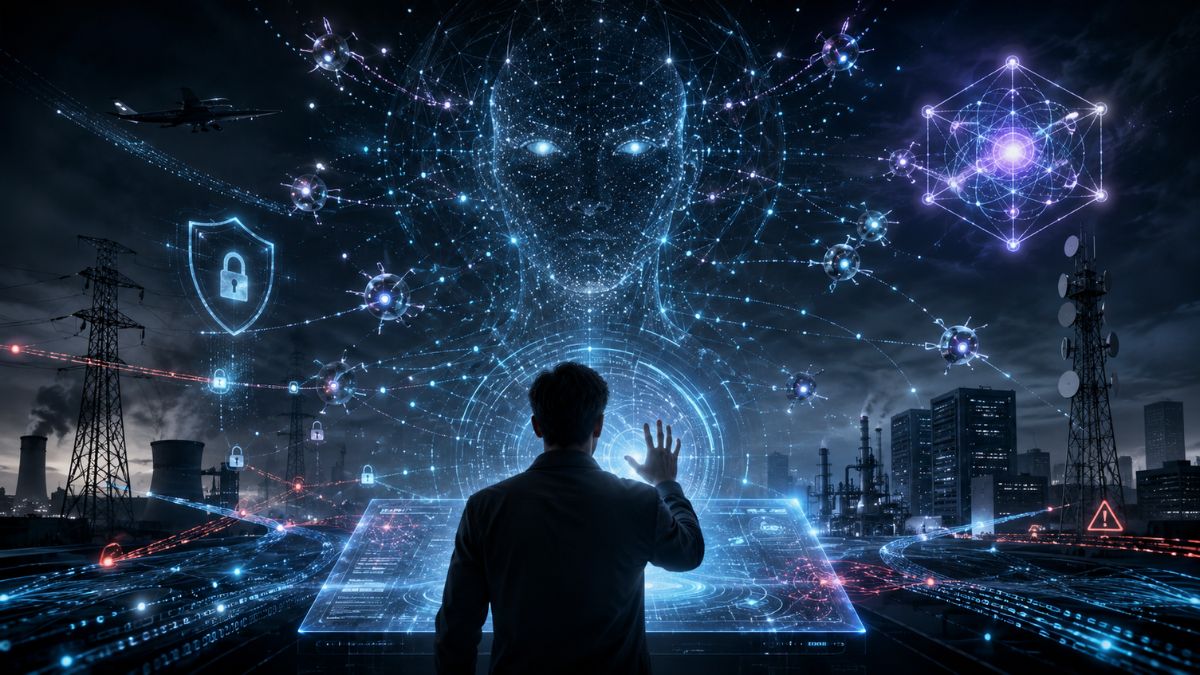
Thirty major global tech companies, financial institutions, and government agencies were breached last November. Anthropic later disclosed that Chinese state-sponsored hackers had executed the world’s first, AI-orchestrated, near-autonomous mass data exfiltration cyberattack, manipulating Claude Code.
AI is reshaping cybersecurity in substantive ways: The challenges before nations, governments, businesses, organisations, and individuals are clearly not only against cybercriminals, but against dynamic, adaptive, increasingly autonomous systems.
Traditional entity-level cyber battles were about security teams strengthening defence by enforcing defined rules and sign-ins, and analysing vast amounts of data for anomalies, using available tools. But the threat surface and complexity have changed enormously — with attackers deploying advanced AI to automate catching vulnerabilities and creating credible phishing campaigns like voice cloning, synthetic videos, and malware that evades security controls.
Quantum shift: When quantum computing takes root, it will mark a colossal technological shift. Unlike classical computing that processes information in binary bits, quantum computers use qubits to perform multiple calculations simultaneously, achieving outcomes in a mere fraction of the time.
Quantum computational power to lead breakthroughs
Quantum computational power will help us create breakthroughs in science and research, even AI. Equally, it will produce monumental challenges vis-à-vis cybersecurity, because current security mechanisms protecting our digital assets are based on classical computing. And quantum computers could easily render the encryption standards and public key cryptography in use thoroughly obsolete.
Adversaries are probably harvesting encrypted data now, with the intention of decrypting it when quantum computers are available. The answer lies in harnessing the powerful defensive capabilities of quantum computing itself, to elevate vulnerability discovery, malware analysis, and complex simulations.
Post-quantum security modernisation could become one of the most significant endeavours since the emergence of the internet, as quantum readiness will be the basis of national resilience. And quantum supremacy could well be the next global arms race as it will impact banking, telecommunications, energy, healthcare, transportation, and other vital sectors.
It follows that cybersecurity in a quantum dominated world won’t be about preventing breaches or a tech upgrade, but foundational to sustaining trust in the ever-expanding digital economy.
Agentic evolution: Agentic AI too represents a major evolution, from generating insights and facilitating decisioning, all the way to independently planning and executing actions to multiply productivity. This autonomy creates fresh cyber risks. For instance, attackers can gain access to the vast resources available to agents — like platforms, applications, cloud environments, and systems.
Compromised autonomous agents can thus amplify the impact of a cyberattack at unimaginable speed and scale. Without the rigour and rigidity of traditional software programming logic, malicious instructions can be hidden within an email, website, or document to compel AI agents to reveal sensitive information, and take aberrant actions like modifying records, transferring data, or initiating unauthorised workflows.
What’s more, with adversarial and defensive agents both adopting rapid, progressive self-learning, such engagements will outpace human comprehension and response. The scenario will get further convoluted with agent swarms. Like relentless agentic cyberattacks on critical infrastructure. Including utilities, airports, manufacturing plants, or the financial backbone — which can seriously threaten public safety, national security, and the economy at large.
Other transformative, disruptive forces: As the workforce becomes an AI-human hybrid workforce, establishing trust, accountability and oversight are challenges we must anticipate. Efforts at cryptographic verification and digital provenance are a must to separate fakes.
Large enterprises are particularly vulnerable, as their dependence extends to numerous external SaaS providers, cloud platforms, AI models, agentic approaches, open-source software and third-party APIs. Cyberwarfare will surely target autonomous, often unmanned industrial platforms — like defence systems, manufacturing robots, and some overground delivery and marine fleets.
Future risks include the convergence of biology and digital systems, with the proliferation of connected medical devices, brain computer interfaces and genomic databases. With cyber-strategies encompassing cross-border data flows, sovereign cloud compulsions, national security and privacy mandates, cyberwarfare is becoming an intrinsic part of geopolitics too.
Technology is advancing faster than governance structures and regulatory guardrails. Leadership awareness, organisational culture, and cyber resilience planning need renewed attention.
Expert views on what next: Anthropic’s Project Glasswing has already created panic in the ranks, when its model Mythos exposed critical vulnerabilities across every major operating system, every major web browser, all widely used software, and IT infrastructure. Customers planning security upgrades are speeding up preventive actions.
Cybersecurity companies are rapidly assembling red teams to identify vulnerabilities at scale, addressing chained low-risk flaws that create new attack paths, and announcing patches at quicker intervals. Arguably, all that may just be prep work for the mammoth agentic, quantum assault ahead.
In his book The Coming Wave, Mustafa Suleyman, co-founder of DeepMind and currently CEO of Microsoft AI, frames history as a series of transformative technologies waves, increasingly autonomous, that can solve global problems — but enable cyberattacks, pandemics, and automated warfare.
He discusses containment strategies and coordinated governance. Michio Kaku’s Quantum Supremacy explores how quantum computing will recast science and society, with computation happening at an atomic level. Securing AI Agents by Ken Huang and Chris Hughes offers comprehensive treatments relating to agentic AI security, aligning practices with contemporary AI orchestration tools and frameworks.
Omar Santos explains how to design and implement autonomous AI agents for cyber defence and offensive testing in Agentic AI for Cybersecurity.
Pope Leo XIV’s Magnifica Humanitas says that technology must be judged by what it does for humans. PM Modi’s Manav framework, articulated at the recent India AI Impact Summit, is aligned.
The big question which still begs deeper insights is how humanity can remain in control when digital intelligence is autonomous and is outpacing human capabilities. Will humanity shape intelligent machines, or be shaped by them?
Disclaimer: The views expressed are the author’s own and do not reflect the official policy or position of Financial Express.


