
India’s IT industry remains one of the country’s largest export-driven sectors, generating export revenue of US$ 224.4 billion (bn) in FY25.
Exports accounted for nearly 79% of the industry’s total revenue, according to NASSCOM. Exports are expected to touch US$ 246 bn in FY26.
This implies that Indian IT companies continue to derive a significant share of their revenue from international markets, particularly North America and Europe.
As enterprises across these regions accelerate investments in artificial intelligence (AI), cloud computing, cybersecurity, and data center infrastructure, demand for digital transformation services is expected to remain strong.
This creates a favourable environment for Indian IT companies with a diversified global client base and high export exposure. However, it also makes their earnings sensitive to overseas economic conditions and currency movements.
Here are 5 Indian IT stocks with strong export exposure and diversified global client bases.
#1 LTM Limited
First on the list is LTM Limited.
LTM, part of the Larsen & Toubro Group, is a global technology services and consulting company.
The company has recently rebranded itself as a ‘Business Creativity Partner.’ This new identity states that competitive advantage goes to those who can combine intelligent systems with deep industry expertise and human insight to achieve measurable business outcomes.
To execute its AI-centric vision, LTM has divided its business model into 3 integrated Lines of Business, all powered by its proprietary AI ecosystem, BlueVerse.
A key pillar of LTM’s service delivery is ‘Domain × Technology Convergence.’ Through this, its engineers tailor outcome-driven solutions across verticals like Banking & Financial Services, Healthcare, Energy, Retail, and Manufacturing.
LTM operates is 42 countries across 5 continents and 118 offices. Export contribute more than 94% of revenue, with North America contributing 73.4% and Europe 14.9%.


Source: LTM Investor Presentation
To accelerate its growth and expand its footprint, LTM recently announced the proposed acquisition of Randstad’s European and Australian IT services business for an enterprise value of €160 million (m).
This business brings in over US$ 500 m in annual revenues. This acquisition significantly expands LTM’s presence in the core European and Australian markets, giving it access to marquee accounts.
LTM will also gain domain expertise in regulated and high-growth sectors such as aerospace & defense, automotive, and utilities. Further, it will enhance LTM’s local talent pool and sovereign capabilities necessary to build secure regional AI and cybersecurity solutions.
LTI Mindtree Share Price – 1 Year

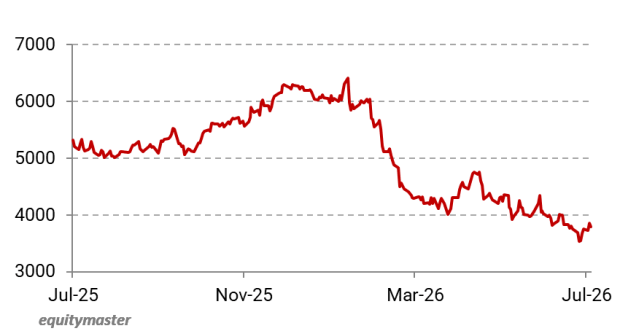
Source: Equitymaster
Management expects demand to be driven by outcomes, with clients prioritizing efficiency-enhancing changes and investments in AI.
As a company, LTM’s priorities are focused on sustaining profitable growth while maintaining operational discipline. The management has identified several areas for future growth.
The first is demand for sovereign cloud, AI infrastructure modernization, and stronger cybersecurity. It plans to provide industry-specific agentic AI solutions for highly regulated, asset-heavy industries.
Alongside this, the company is expanding its presence across Europe, the Middle East, ANZ, and the GCC.
Looking ahead to the next five years, LTM is guided by its strategic ‘Lakshya FY31′ plan. By then, LTM aims to double its revenue and achieve 200 bps improvement in its EBIT margin.
From a financial perspective, FY26 revenue grew 11.3% YoY to Rs 423.1 bn. EBITDA grew 16.3% to around Rs 75.6 bn with margins at 17.9%. Net profit surged 8.3% to Rs 49.8 bn.
#2 Persistent Systems
Second on the list is Persistent Systems.
Persistent operates as an AI-led, platform-driven digital engineering and enterprise modernisation firm. The company is expanding its scale and capabilities, targeting an annualized revenue run rate of around US$ 2 bn by Q4 FY27.
In FY26, it reported revenue growth of 23.5% to Rs 147.5 bn. This marked 24 consecutive quarters of revenue growth. Exports accounted for 91.2% of the revenue mix in FY26.
The company’s performance across its three core verticals during FY26 was well balanced, with banking leading growth. The Total Contract Value (TCV) was US$ 2.4 bn for FY26 and an Annual Contract Value (ACV) was US$ 1.8 bn.
The BFSI sector grew by 28.4%, accounting for a 34.6% share of revenue. This was followed by Software, High-Tech, and Emerging Industries (+13.8%), which contributed 39.8%. Healthcare and Life Sciences grew by 10.1%, contributing 25.6% to revenue.

Source: Equitymaster
The revenue mix remained moderately diversified, with the top 5 clients contributing 32.2%, the top 10 contributing 41.6%, and the top 20 contributing 52.9% to the FY26 revenue.
Looking ahead, the acquisition of Nagarro at an enterprise value of €1.27 bn is a major expansion. It creates a US$ 2.9 bn revenue firm and serves as a strong driver of geographical and vertical growth.
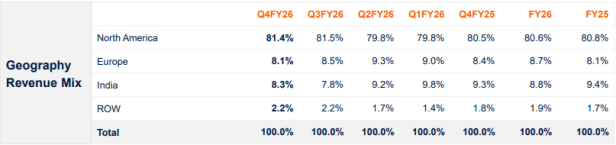
It would shift Persistent’s revenue reliance away from North America (reducing from over 81% to 62%). At the same time, the European footprint will increase to 22% and the Rest of the World (Middle East, Japan, Australia) to 16%.
Persistent Systems Share Price – 1 Year

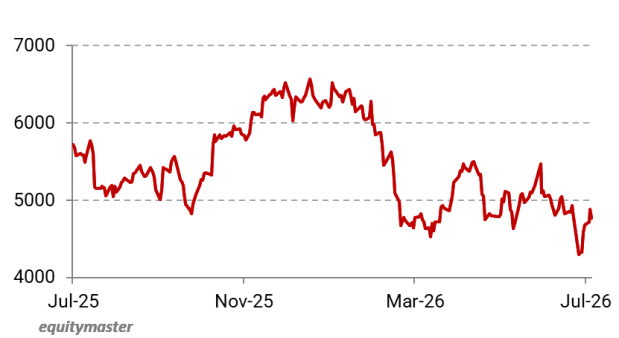
Source: Equitymaster
The deal introduces new scaled verticals, including industrial, consumer, and public sector domains.
It also brings critical capabilities in ERP/SAP implementations and status as an accredited OpenAI reseller, complementing Persistent’s CX and digital engineering strengths.
Management expects the Nagarro acquisition to be cash and reported-EPS-accretive in the first year, excluding one-time transaction costs.
The combined entity will start with a leverage ratio (Net Debt over combined EBITDA) between 1.9 and 2.5. The company plans to bring it down to 1 by FY30.
#3 Coforge
Third on the list is Coforge.
Coforge is a global AI-native engineering services leader. It focuses on designing, building, and delivering intelligent solutions to engineer autonomous enterprises for its clients.
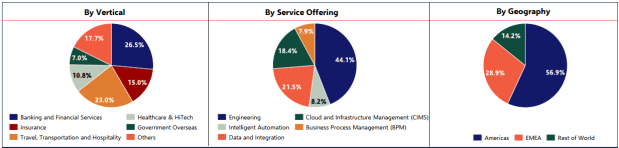
The company’s FY26 revenue grew 35.9% to Rs 164.2 bn. BFS contributed the largest share at 26.5%. Travel, Transportation, and Hospitality contributed 23% of revenue, growing 60-62%. Insurance accounted for 15% of revenue. Healthcare and HiTech contributed 10.8% of revenue, up 78-98% YoY.
The executable order book stood at US$ 1.7 bn, up 16.4% YoY.

Source: Coforge Investor Presentation
The Americas represent the largest market (56.9%), followed by EMEA (28.9%) and the Rest of the World (14.2%). Collectively, exports accounted for over 85.8% of FY26 revenue.
Coforge has positioned itself to capitalise on the estimated US$ 750-800 bn enterprise AI market through its assets, platforms, and strategic acquisitions. The firm has invested over US$ 5.5 m in AI learning and training its workforce.
It’s using hybrid human-agent delivery pods called ‘ModSquads.’ These squads combine AI agents with domain experts to deliver projects 40-50% faster. It also shifts clients from hourly billing to outcome-based pricing.
Coforge utilises an enterprise-grade ‘OneAI platform’ featuring over 60 domain-specific AI solutions and over 110 pre-built AI agent archetypes. This has led to 25-35% productivity uplifts in development and up to a 10x faster legacy modernisation.
Coforge also added over 7,000+ AI engineers operating within a Human+Agent delivery model.
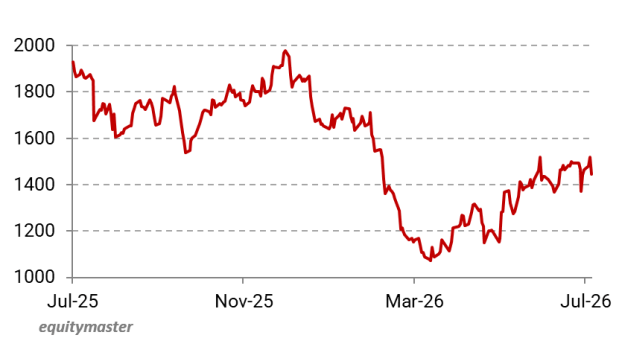
Coforge Share Price – 1 Year
Source: Equitymaster
Further, the recent acquisition of Encora could be a key growth driver.
The Encora acquisition deepens Coforge’s AI-native engineering capabilities. It brings a composable, agentic platform (AIVA) designed for AI engineering and is platform-agnostic. This platform accelerates Software Development Life Cycle delivery by 50% to 80% in specific use cases.
Furthermore, Encora brings a strong base of Fortune 500 clients. It expands Coforge’s addressable wallet by adding 45+ accounts with over US$ 10 m in annual revenue, and 40+ clients with AI engagements.
The combined entity is projected to achieve a revenue of approximately US$ 2.5 bn. It expects synergies of 20-25% within the combined business.
The company has strategically closed a US$ 20 m low-margin Indian portfolio. This is expected to increase margins. The EBITDA margin is expected to surge to 20.5-21% in FY27, up from 18.6% in FY26.
Coforge expects flat QoQ growth in Q1FY27, followed by a stronger growth from Q2.
The management has upgraded its Free Cash Flow-to-net profit conversion guidance from historical levels of 70%-80% to a sustained 100%+ starting in FY27.
#4 Infosys
Fourth in the list is Infosys.
Infosys is a globally recognized leader in AI-first business consulting and technology services. Infosys operates across 59 countries and 290 locations worldwide.
The total consolidated revenue grew 9.6% YoY to Rs 1,786.5 bn. The adjusted operating margin stood at 21.0%, and Infosys generated strong free cash flow of US$ 3.7 bn.
Financial Services and Insurance accounts for 27.9% of revenue, followed by manufacturing 16.3%, Energy, Utilities, Resources, and Services 13.3%.
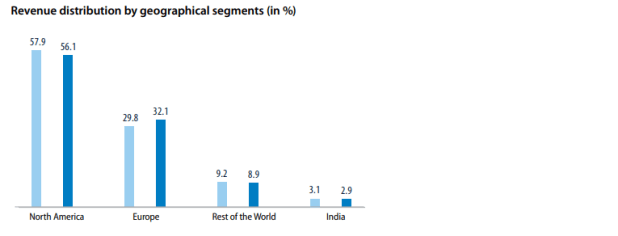
North America is the largest market, with a 56.1% revenue concentration, followed by Europe (32.1%), the Rest of the World (8.9%), and India (2.9%). Collectively, exports accounted for 97.1% of revenue.

Source: Infosys Annual Report
During FY26, Infosys secured a TCV of US$ 14.9 bn in large deals, up 24% from the prior year, with 55% of these net-new deals. The company ended the year with 1,965 active clients, with strong growth across the Financial Services, Communications, and Manufacturing verticals, particularly in Europe.
Infosys is pivoting towards becoming an AI-first enterprise to help clients navigate technology transitions.
The company is targeting a US$ 300 bn opportunity across six core pillars: AI Strategy & Engineering, Data for AI, Process AI, Agentic Legacy Modernisation, Physical AI, and AI Trust.
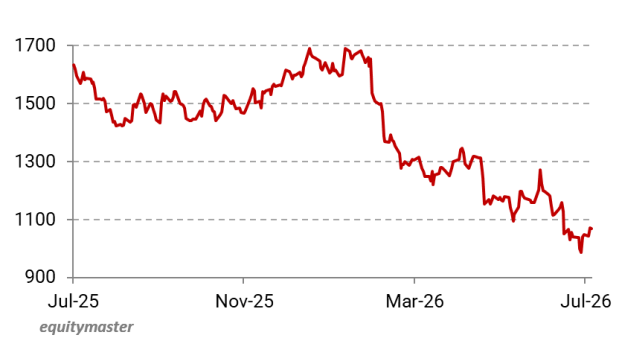
Infosys Share Price – 1 Year

Source: Equitymaster
To enable this shift, the company relies on its proprietary platform: Topaz, Cobalt, and Aster.
Infosys is collaborating with 90% of its top 200 clients on their AI journeys, with over 4,600 AI projects currently underway.
For FY27, Infosys has guided for 1.5-3.5% of revenue growth in constant currency with 20-22% margins.
#5 HCL Technologies
Last on the list is HCL Technologies.
HCL provides services around AI, digital, engineering, cloud, and software technologies.
The company reported revenue of Rs 1,301.4 bn, up 11.2% YoY, with an EBITDA margin of 17.2%. The IT and Business Services (ITBS) contributed 73.8% of revenue, followed by Engineering and R&D Services (17.0%), and HCL Software accounted for 9.5%.
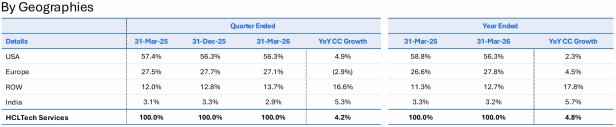
The US is the largest market, accounting for 56.3% of revenue, followed by Europe (27.8%), the ROW (12.7%), and India (3.2%). In total, exports accounted for 96.8% of revenue in FY26.

Source: HCL Investor Presentation
Despite muted discretionary spending, the company maintained strong deal momentum, with net new deal bookings (TCV) of US$ 9.3 bn in FY26, matching FY25 levels.
HCLTech organically expanded its client relationships across all segments. HCL added one new US$ 100 m+ client, eight US$ 50 m+ clients, and twenty-eight US$ 1 m+ clients in FY26. This reflects an increase in wallet share among top clients.
AI is the most critical growth driver and strategic focus for HCLTech.
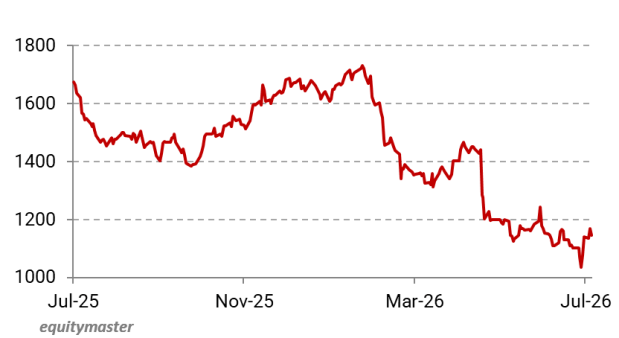
HCL Tech Share Price – 1 Year
Source: Equitymaster
The company aims to become the ‘best AI solutions company’ by leveraging its engineering pedigree.
Management categorizes the IT market into three AI-driven segments: ‘AI disrupted’ services (facing 3-5% deflation), ‘AI amplified’ services (growing at 10%+), and ‘AI native’ services (growing at 30% and expected to capture 20% of the market in 5 years).
To capitalise on this, HCL has centered its strategy around five AI pillars.
First is deploying AI across delivery and operations, using new versions of IP with a focus on agentic capabilities, expanding into new services, strengthening AI partnerships, and training AI talents.
It has expanded strategic collaborations across the tech stack, including Google (for custom AI agents using Gemini), AWS, Microsoft (agentic AI), CrowdStrike (AI security), and OpenAI (deploying specialized engineering teams for enterprise AI operating systems).
This strategic pivot is already translating into measurable outcomes. HCL’s annualised advanced AI revenue reached US$ 620 m in FY26.
The company is winning large next-generation deals, including a US$ 100 m+ AI data center program and an AI engineering contract for advanced ASIC chip development.
Conclusion
As global enterprises continue to increase investments in AI, cloud computing, cybersecurity, and data center infrastructure, Indian IT companies with international client bases are well placed to capture the next wave of technology spending.
However, not all export-oriented IT stocks offer the same growth potential.
Investors should focus on companies with consistent deal wins, expanding AI capabilities, and diversified geographic exposure. These factors are likely to play a key role in sustaining long-term earnings growth.
Furthermore, rather than relying solely on hype, investors need to carefully analyse the company’s fundamentals, including financial performance, corporate governance practices, and growth strategies.
Happy investing.
Disclaimer: This article is for information purposes only. It is not a stock recommendation and should not be treated as such. Learn more about our recommendation services here…
The website managers, its employee(s), and contributors/writers/authors of articles have or may have an outstanding buy or sell position or holding in the securities, options on securities or other related investments of issuers and/or companies discussed therein. The content of the articles and the interpretation of data are solely the personal views of the contributors/ writers/authors. Investors must make their own investment decisions based on their specific objectives, resources and only after consulting such independent advisors as may be necessary.
Every financial journey has a turning point. What’s yours?
Financial Express is launching a new series highlighting real experiences with money, investments, and the taxman. Did a sudden tax rule catch you off guard? Did a piece of financial advice change your life? Your story could provide invaluable, practical lessons for thousands of fellow taxpayers. Share your experience with us. We respect your privacy: no stories will be featured without a direct conversation and your full consent. Thank you.