




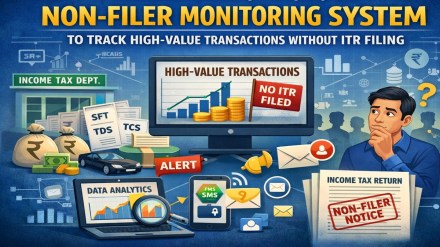
The Income Tax Department has stepped up its efforts to bring more people into the tax net by closely tracking high-value financial transactions carried out by individuals and entities who do not file income tax returns, Parliament was informed recently.
As part of this effort, the Central Board of Direct Taxes (CBDT) has rolled out a Non-Filer Monitoring System (NMS). The system uses data analytics to identify people who have undertaken large financial transactions but have not filed their income tax returns, the Finance Ministry said in a response to a query in the Rajya Sabha.
According to the Finance Ministry, the NMS brings together information received from multiple third-party sources such as banks, financial institutions, registrars and other reporting entities. This includes data from Statement of Financial Transactions (SFT), Tax Deducted at Source (TDS) and Tax Collected at Source (TCS) filings.
Once analysed, this data helps the tax department flag cases where income may have gone unreported, even though significant financial activity has taken place.
Focus on nudging taxpayers, not harassment
The government says the approach is largely non-intrusive and technology-driven. At the heart of this strategy is the CBDT’s NUDGE framework—short for Non-Intrusive Usage of Data to Guide Taxpayers.
Under this system, the department uses behavioural insights and financial data to identify gaps or mismatches in income reporting. Instead of launching immediate enforcement action, taxpayers are first encouraged to voluntarily correct errors.
This is done through SMS alerts, emails, portal-based prompts and outreach campaigns, nudging people to file belated, revised or updated returns wherever required.
Annual Information Statement plays a key role
Another important tool in this compliance drive is the Annual Information Statement (AIS). Financial information collected from third parties is shared with taxpayers through the AIS, giving them a consolidated view of their transactions during the year.
Taxpayers are encouraged to review this information, reconcile discrepancies online, provide feedback on the AIS portal, and file or revise their tax returns if needed. The government says this early-warning system helps prevent non-compliance before it escalates.
Data analytics to widen tax base
Responding to a question in the Rajya Sabha, Minister of State for Finance Pankaj Chaudhary said the Income Tax Department now relies heavily on advanced data analytics and digital platforms to widen the tax base and curb evasion.
Analytics-driven campaigns have already been carried out for issues such as foreign asset disclosures, non-genuine deductions, virtual digital asset (VDA) reporting and TDS compliance.
Scrutiny selection also automated
The government also clarified that cases selected for scrutiny are chosen through a rule-based automated system. This system analyses financial data from multiple sources to identify potential cases of tax evasion, reducing manual intervention and ensuring a risk-based approach.
No further changes in tax slabs for now
On personal income tax simplification, the government said that the new tax regime—without deductions—was recently simplified through the Finance Act, 2025, with liberal slabs and higher rebates. At present, no further changes are under consideration.
What this means for taxpayers
For taxpayers, the message is clear: large financial transactions without filing income tax returns are increasingly difficult to hide. With systems like NMS and AIS in place, the tax department now has a clearer view of financial activity—and is using it to push voluntary compliance rather than surprise action.
As digital oversight tightens, experts say reviewing AIS data regularly and filing accurate returns on time has become more important than ever.


