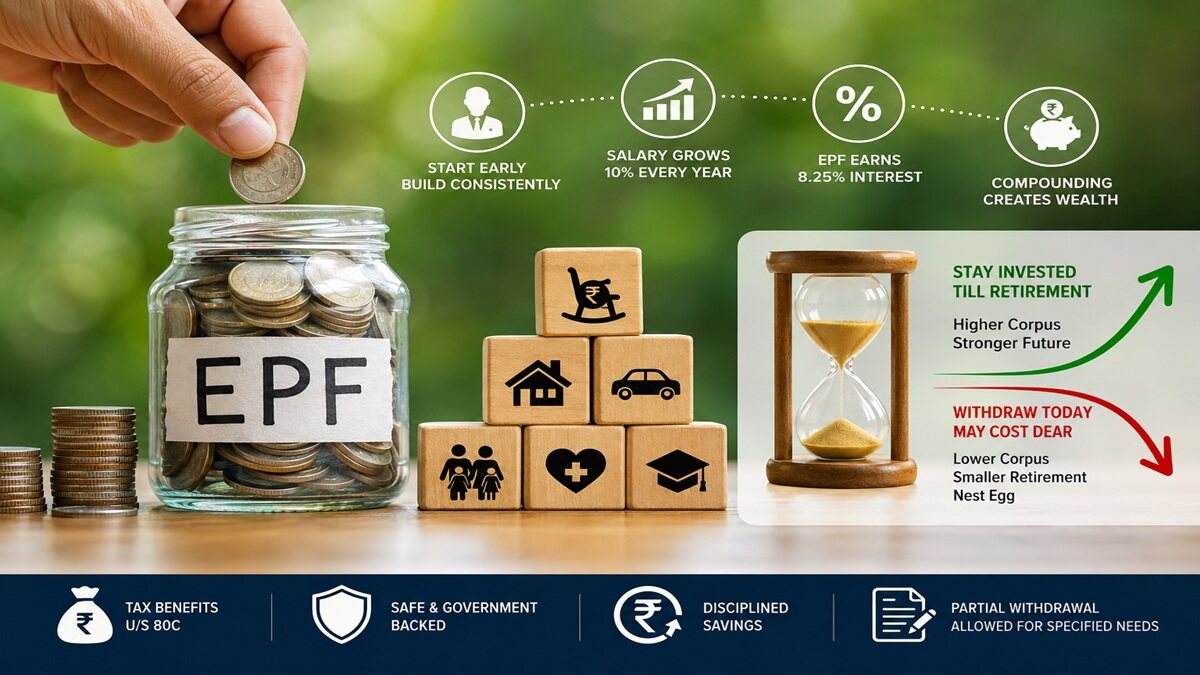
Most salaried employees view the Employees’ Provident Fund (EPF) as a retirement safety net. Yet, many also tap into it during their working years — for buying a house, funding children’s education, medical emergencies or other pressing financial needs.
While EPF withdrawals are permitted under certain conditions, the decision carries a hidden cost that is rarely visible at the time. The money withdrawn today not only reduces the current balance, it permanently loses decades of potential compounding.
In the illustration below, every Rs 1 withdrawn at age 35 reduces retirement wealth by nearly Rs 9. A single mid-career withdrawal of Rs 7.25 lakh translates into a Rs 64 lakh shortfall at retirement.
To understand the long-term impact, consider a simple illustration of a salaried employee who starts working at 25 and contributes to EPF until retirement at 58.
Understanding EPF contributions:
Under EPFO rules, both employee and employer contribute a total of 12% of basic salary and dearness allowance each. However, the employer’s contribution is split between two schemes:
Employee contribution: 12% goes entirely to EPF.
Employer contribution: 8.33% goes towards the Employees’ Pension Scheme (EPS), subject to prescribed wage ceilings; the remaining 3.67% goes into EPF.
This means the total monthly deposit into the EPF account — from both employee and employer — is 15.67% of basic pay (12% + 3.67%), while the EPS portion of 8.33% accumulates separately and does not earn the annual EPF interest rate.
Employees often focus only on the EPF balance visible in their passbook and overlook the EPS component, which is meant to support pension benefits after retirement.
The assumptions:
For this illustration, we assume: Starting monthly salary: Rs 50,000
Basic salary: 50% of gross (Rs 25,000)
Annual salary increment: 10%
EPF interest rate: 8.25% per annum (the rate declared by EPFO for FY2023-24)
Employee contribution: 12% of basic pay
Employer EPF contribution: 3.67% of basic pay (EPS portion excluded from corpus)
Total monthly EPF contribution used for corpus: 15.67% of basic pay
Retirement age: 58 years
In the first year, the employee contributes Rs 3,000 per month (12% of Rs 25,000) while the employer’s EPF share adds Rs 917.50 (3.67%). The total monthly EPF deposit is Rs 3,917.50, or roughly Rs 47,010 annually. As salary rises 10% every year, EPF contributions rise proportionately.
How much corpus is accumulated by age 35?
After ten years of continuous service — with annual salary hikes and EPF interest at 8.25% — the employee builds a meaningful corpus.
EPF corpus growth during the first 10 years
| Year | Basic Salary (Monthly) | Annual Contribution | Corpus at Year-End |
| 1 | Rs 25,000 | Rs 60,990 | Rs 66,022 |
| 2 | Rs 27,500 | Rs 67,089 | Rs 1.41 lakh |
| 3 | Rs 30,250 | Rs 73,798 | Rs 2.36 lakh |
| 5 | Rs 36,603 | Rs 89,295 | Rs 4.68 lakh |
| 10 | Rs 58,949 | Rs 1.44 lakh | Rs 14.50 lakh |
Note: The estimates in the table below are derived using a PF calculator and assume uninterrupted EPF contributions, a 10% annual increase in salary and an annual EPF interest rate of 8.25%.
At age 35, the EPF corpus reaches approximately Rs 14.5 lakh. At this stage, two possible paths emerge.
Scenario 1: No withdrawal
The employee leaves the entire corpus untouched and continues contributing to EPF until retirement. The Rs 14.5 lakh corpus compounds alongside fresh, rising contributions every year.
By age 58, the final corpus grows to approximately Rs 3.79 crore.
Scenario 2: 50% withdrawal at age 35
The employee withdraws 50% of the accumulated corpus at age 35:
Corpus at age 35: Rs 14.5 lakh
Withdrawal amount: Rs 7.25 lakh
Balance remaining in EPF: Rs 7.25 lakh
The employee continues working, receives annual increments, and keeps contributing to EPF until retirement. However, the withdrawn Rs 7.25 lakh no longer participates in compounding.
By age 58, the retirement corpus reaches approximately Rs 3.15 crore — a gap of Rs 64 lakh compared to Scenario 1.
The retirement impact
Retirement corpus comparison
| Particulars | No Withdrawal | 50% Withdrawal |
| Corpus at age 35 | Rs 14.5 lakh | Rs 14.5 lakh |
| Withdrawal | Nil | Rs 7.25 lakh |
| Corpus at age 58 | Rs 3.79 crore | Rs 3.15 crore |
| Retirement wealth lost | — | Rs 64 lakh |
Note: The estimates in the table below are derived using a PF calculator and assume uninterrupted EPF contributions, a 10% annual increase in salary and an annual EPF interest rate of 8.25%.
The employee withdrew only Rs 7.25 lakh at age 35. Yet the reduction in retirement wealth amounts to nearly Rs 64 lakh by the time retirement arrives — because that money had 23 more years to compound at 8.25%.
Put differently: every Rs 1 withdrawn at age 35 potentially costs Rs 9 in retirement wealth.
Why the impact is so large
The answer lies in compounding. EPF may not generate headlines like equities or mutual funds, but it remains one of the most powerful long-term wealth creation tools available to salaried employees. When money stays invested for 20 to 30 years, interest accrues not only on contributions but on the accumulated interest of prior years.
In this case, Rs 7.25 lakh — withdrawn at the midpoint of a 33-year career — misses 23 years of compounding at 8.25%. At that rate, money roughly doubles every 8.7 years. Over 23 years, Rs 7.25 lakh would grow to approximately Rs 48–50 lakh on its own, before accounting for the loss of compounding that the remaining balance also misses out on — which together explains the Rs 64 lakh differential.
This is why financial planners consistently advise treating EPF as a retirement fund rather than a general-purpose savings account. The earlier the withdrawal, the greater the permanent loss of future compounding.
EPF interest rate
EPFO declared an interest rate of 8.25% on EPF deposits for FY2023-24 — one of the highest risk-free returns available to salaried individuals. Over the years,
EPF has retained its appeal as a retirement product because of three structural advantages:
Mandatory and disciplined savings through automatic payroll deduction.
Government-backed framework with sovereign guarantee on deposits.
Tax benefits on contributions, interest, and withdrawal (subject to prevailing rules and conditions).
Recent years have seen greater digitisation of EPFO services — easier online claim settlement, UAN-linked account management, and faster PF balance transfers when employees change jobs. These improvements have also made partial withdrawals more accessible. Experts caution that this convenience should not encourage premature dipping into retirement savings.
The bigger lesson
Many employees view EPF withdrawals as harmless because the money technically belongs to them. But the real cost is not the rupee amount withdrawn — it is the wealth that amount could have created over the next two or three decades.
In the example above, a withdrawal of Rs 7.25 lakh at age 35 appears manageable in the short term. The same decision potentially leaves the employee with nearly Rs 64 lakh less at retirement.
When it comes to retirement savings, time is often more valuable than the amount invested. Allowing EPF savings to compound uninterrupted for decades can create a retirement corpus far larger than most employees ever anticipate — and a single mid-career withdrawal can quietly take a disproportionate slice of that away.
Disclaimer: The calculations above are illustrative in nature and are based on assumed salary growth of 10% annually, EPF interest of 8.25%, retirement at age 58 and contribution assumptions specified in the example. Actual EPF accumulation may vary depending on salary structure, EPF wage ceilings, changes in interest rates, employment gaps, EPS allocation, tax rules and future regulatory changes.
Every financial journey has a turning point. What’s yours?
Financial Express is launching a new series highlighting real experiences with money, investments, and the taxman. Did a sudden tax rule catch you off guard? Did a piece of financial advice change your life? Your story could provide invaluable, practical lessons for thousands of fellow taxpayers. Share your experience with us. We respect your privacy: no stories will be featured without a direct conversation and your full consent. Thank you.